Best AEO tools with citation analytics (2026)
AEO tools compared on citation analytics: source types, page-level trends and decay, offsite mentions, social citations, citation rank and self-citation rate.
A mention tells you an AI engine said your name. A citation tells you which page it read to say it. For AEO work the second is far more useful, because a citation is something you can act on. You can improve the page that is cited, get onto the page a competitor is cited from, or find out why your own page is ignored.
Almost every AEO tool now claims "citation tracking", which usually means a list of URLs next to each answer. That list is the starting point, not the analysis. This guide compares tools on what they do with citations once they have them. Competitor details come from our directory. Promptwatch details come from its plan matrix, Academy docs and changelog.
Why a URL list is not enough
AI answers cite a lot of sources. In Promptwatch's study of ChatGPT responses between Sep 28 and Oct 4, 2026, 47.6% of responses with at least one citation cited 10 or more different domains. Brand-specific questions were much narrower: 40.7% of those answers cited five domains or fewer (unique domains per response).
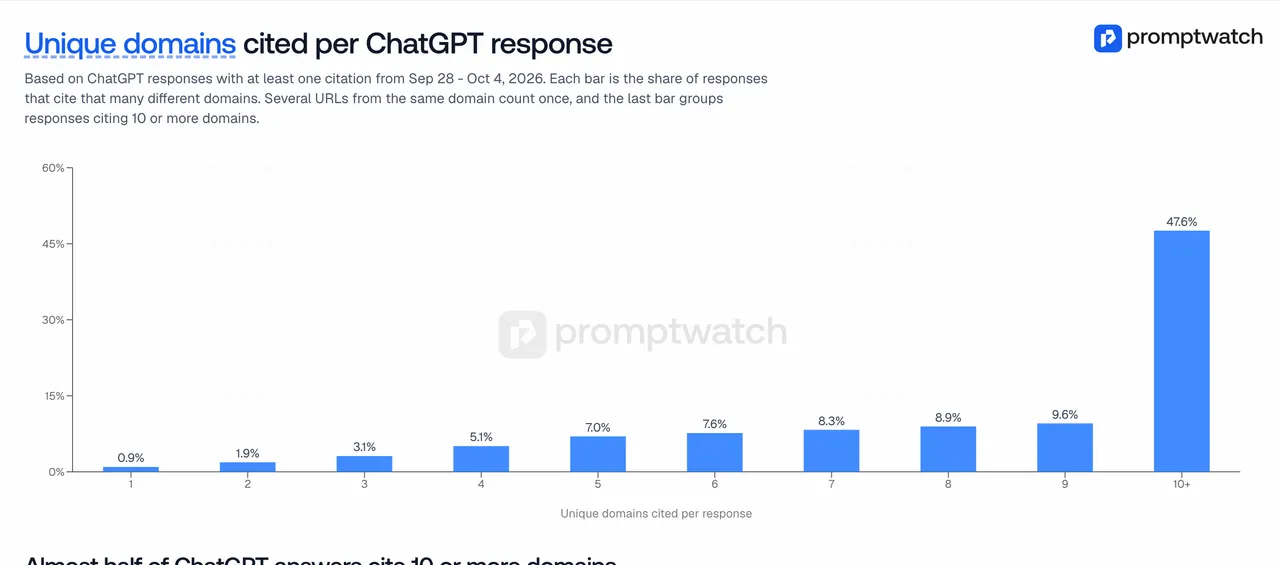 Promptwatch's "Unique domains cited per ChatGPT response" chart, from the unique domains per response report, captured November 14, 2026.
With ten or more sources in a typical category answer, you need to know which kinds of source win, which pages are rising or fading, and where you stand among them. That takes classification, history and ranking, not just a list.
What good citation analytics should answer
- Which sources does the engine use for my prompts? By page, by domain, and by type (review site, docs, listicle, forum).
- Where do I rank among them? Being the first source and being the ninth are different outcomes.
- How much of it is my own site? Versus third parties talking about you.
- Is a page gaining or losing citations over time? And how long do citations last?
- Where am I named without a link? Those pages are the cheapest outreach targets.
- What do the social platforms contribute? Reddit, YouTube, LinkedIn and Instagram are cited differently by different engines.
1. Promptwatch
Best for: teams that want every one of those six questions answered in one place, and tied to crawls and traffic.
Promptwatch splits citation analytics into three tabs. All Citations lists every cited URL with filters by monitor. URL Positions shows where each URL sits in the source list. Citation Trends, added on August 14, 2026, classifies each citation into 22 content types and 20 source types, including a Directory type for G2, Capterra and Trustpilot-style listing sites. It charts citation rate by type and domain rating over time, and gives each page a first-cited date, ramp-up days, peak rate and a decay half-life.
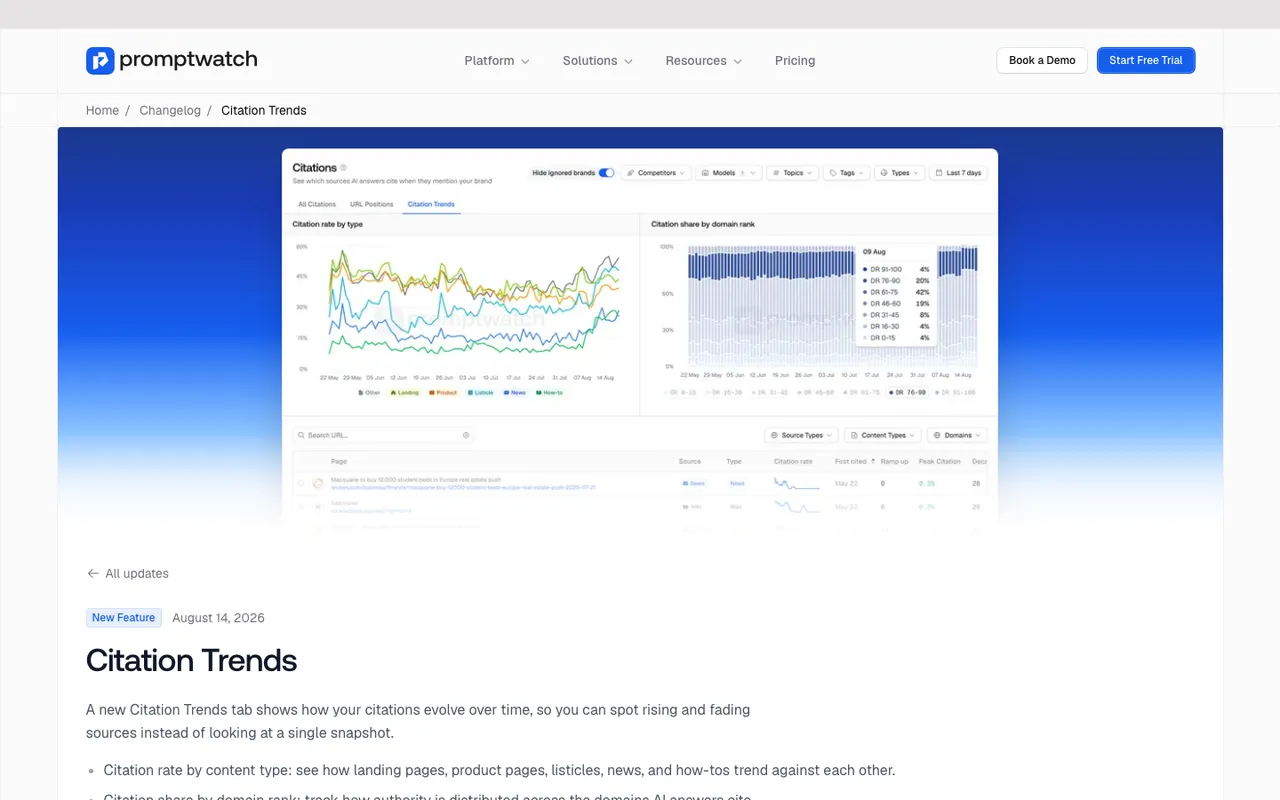 The "Citation Trends" entry in the Promptwatch changelog (August 14, 2026), captured November 14, 2026.
Two metrics answer the ranking and ownership questions. Citation rank is where your own domain lands in an answer's source list, where closer to 1 means you are a primary source. Self-citation rate is the share of citations pointing at your own domain instead of third-party pages. Promptwatch's own guidance is that mentions without self-citations usually point to a content or crawlability problem. On the Topics page, Citation Share divides your own sites' citations by all citations in that topic's answers.
Page Tracker follows specific URLs, yours or a competitor's, and shows which prompts and responses cite each one. For your own pages it adds AI crawler visits and AI click-throughs, so you can see a citation turn into a visit.
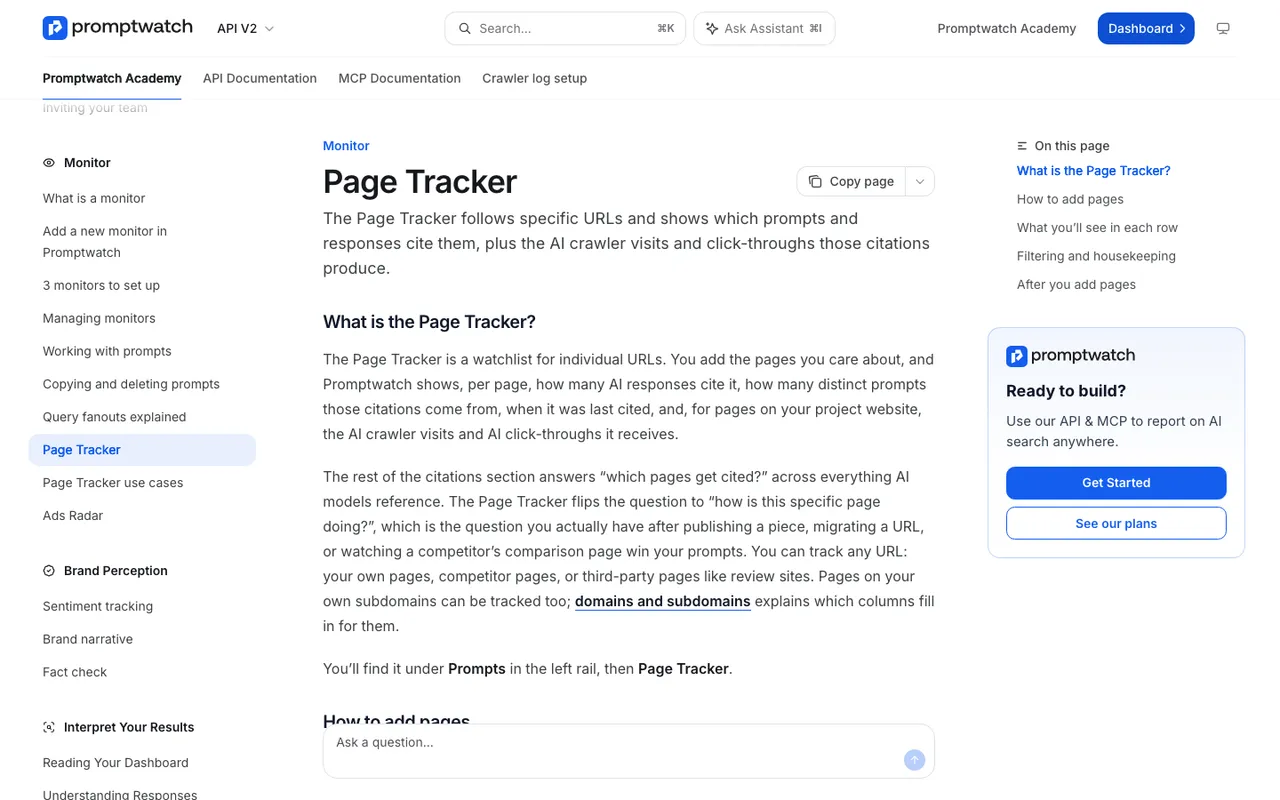 The Promptwatch Academy page "Page Tracker", captured November 14, 2026.
Beyond your site, offsite mentions find pages that name your brand without linking to you and rank them as opportunities. Separate Reddit, YouTube, LinkedIn and Instagram reports show the cited subreddits, videos, posts and accounts with their engagement, and a "My channels" filter separates your own channels. ChatGPT News and Google News citations are tracked too, and citation search highlights competitor domains. Since November 13 each project has a fixed Citations tab with cited domains, top cited URLs and cited YouTube, Reddit and LinkedIn posts, which a scheduled report can follow.
What makes this more than a report is the link to your server. Agent Analytics (from Professional) shows a crawl-to-citation path with a citation rate per page, so a page that is crawled often but rarely cited stands out as a content problem, while a page that is never crawled is an access problem. "Create content from a citation" then starts a brief from the page that beat you.
Plans: Essential is $95 a month, Professional $245 and Business $579. Promptwatch's plan matrix names no plan gate for the citation tabs, but the crawl-to-citation path needs crawler logs, which start on Professional.
2. Ahrefs Brand Radar
Best for: Ahrefs users who want citation sources at index scale.
Ahrefs Brand Radar reports YouTube and Reddit sources and AI crawler activity next to brand mentions, inside Ahrefs. Custom Prompts come with paid Ahrefs plans and the AI Visibility Index starts at $199 a month. Our entry flags a January 2026 independent test that found a large ChatGPT mention undercount, so spot check its figures.
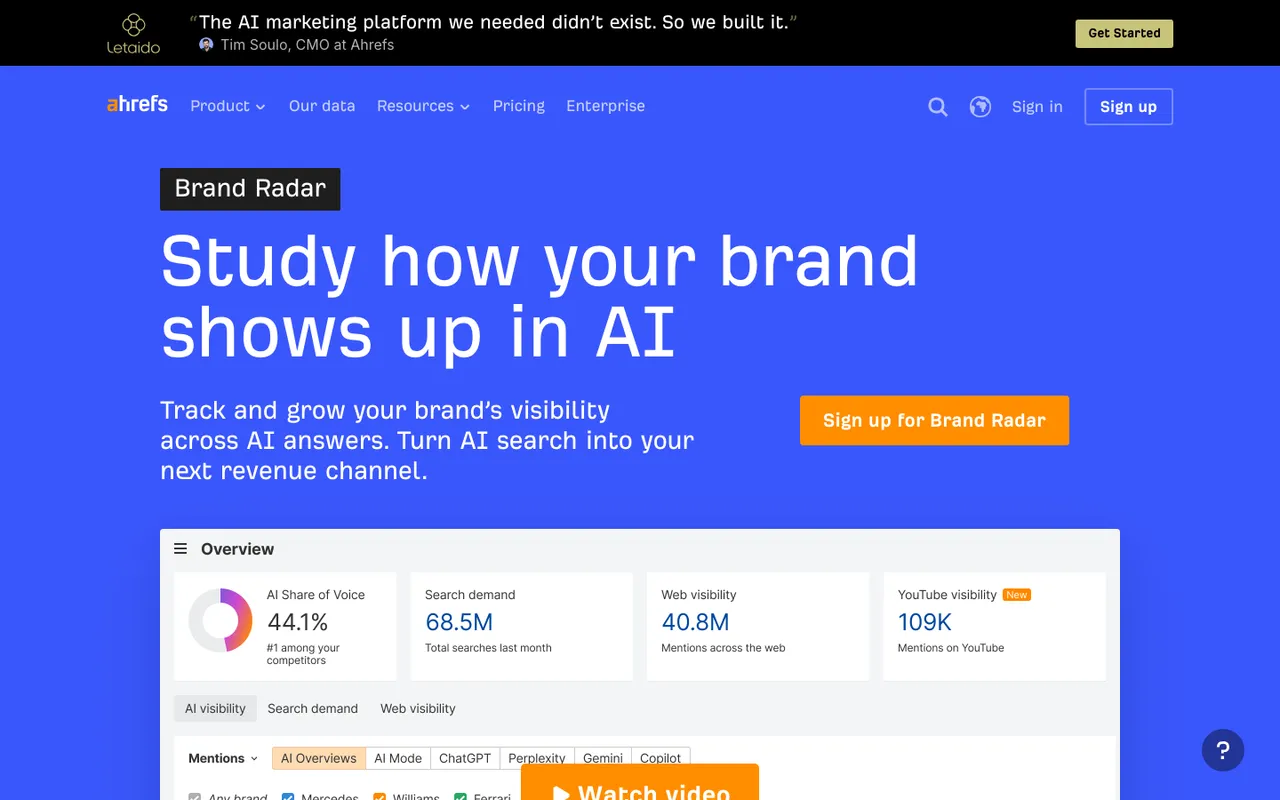 Ahrefs's Brand Radar page, captured November 6, 2026.
3. Siteimprove Advanced AEO Insights
Best for: enterprises already on Siteimprove.
Siteimprove records brand mentions and content citations separately, reports citation frequency over time, and runs its prompt set repeatedly to produce a rate. That separation is the right instinct. Pricing is not published, and its own pages list different engines.
4. Onclusive GEO Analytics
Best for: PR teams deciding where to pitch.
Onclusive GEO Analytics reports the sources AI engines cite and adds Priority Source Targets, which scores cited publications and domains by impact and effort. It sits inside a media intelligence suite. Starter is from $105 a month on an annual plan but covers ChatGPT only in one country.
5. DemandSphere
Best for: SEO teams that want citations next to SERP data.
DemandSphere includes citation analytics and Chat Rewind, which replays past AI answers. Prompts and keywords share one daily budget, and log analytics is an Enterprise add-on.
6. Profound
Best for: enterprise teams buying a broad agent platform.
Profound lists citation share and answer-level analytics. Our entry notes that some G2 reviewers reported citation counts that did not match manual ChatGPT checks. Enterprise pricing is custom.
Others with basic citation lists
HubSpot AEO includes citation analysis across ChatGPT, Perplexity and Gemini at $50 a month. LLMrefs reports cited source URLs from imported keywords at weekly cadence. Rankscale lists citation analysis on its credit plans. SE Ranking is the one to wait on: our entry says citation-level tracking is still under development.
Side by side
| Tool | Source types | Rank and self-citation | Page trends and decay | Offsite mentions | Social reports | Tied to crawls |
|---|---|---|---|---|---|---|
| Promptwatch | 22 content, 20 source types | Yes | Yes | Yes | Reddit, YouTube, LinkedIn, Instagram | Yes, from Professional |
| Ahrefs Brand Radar | Not listed | Not listed | Not listed | Not listed | YouTube, Reddit | Crawler activity listed |
| Siteimprove | Not listed | Mentions vs citations | Frequency over time | Not listed | Not listed | Not described |
| Onclusive | 11-category taxonomy | Not listed | Not listed | Not listed | Not listed | Not listed |
| DemandSphere | Not listed | Not listed | Chat Rewind | Not listed | Not listed | Enterprise add-on |
| Profound | Not listed | Citation share | Not listed | Not listed | Not listed | Check in demo |
How to use citation data in practice
A routine that turns the analytics into work:
- Pick a topic you care about and open its Citation Share. If your own sites are a small slice, find the source types that dominate.
- Sort cited pages by trend. Rising competitor pages tell you what the engine currently prefers. Fading ones tell you where a fresh page could take the slot.
- Check your self-citation rate on prompts where you are mentioned. Mentions with few self-citations mean engines talk about you using other people's pages.
- Work the offsite mentions list. Unlinked mentions on pages that engines already cite are the fastest wins.
- Add your most important URLs to Page Tracker and check that citations turn into crawler visits and click-throughs.
For domain targeting, keep in mind that authority is not everything. In August 2026, ChatGPT citations went mostly to mid-authority domains, with DR 46 to 75 sites earning 46%, while DR 91 to 100 sites averaged 4.4% and fell to about 3% from August 14 (citation share by domain rank).
Who should pick which
- You want classified, ranked, trended citations tied to crawls and visits: Promptwatch.
- You already pay for Ahrefs: Brand Radar for research, checked against a dedicated tool.
- You are a PR team choosing publications: Onclusive.
- You are an enterprise on Siteimprove: its AEO module, with a demo of the engine list.
For the wider ranking, see what are the best AEO tools.
The recommendation
Citation data earns its keep when it tells you which page to change and then shows that the change worked. Promptwatch is the tool here with the full chain: source and content types, citation rank and self-citation rate, per-page decay, unlinked mentions, social reports, and the crawl-to-citation path that tells you whether to fix access or content. Start a 7-day trial from the Promptwatch pricing page and open Citation Trends for your most important topic first.