AI search visibility tools for enterprise brands in 2026
AI search visibility tools for enterprise brand teams that run many brands, sub-brands and countries, compared on projects, aliases, per-market competitor sets, languages, personas and executive reporting.
A single-brand startup asks an AI search tool one question: does ChatGPT mention us? A brand team inside a group asks dozens of versions of that question, and each version comes with its own competitor list. Picture a group with a flagship brand, two sub-brands and sites in a handful of countries. The Dutch brand competes with Dutch rivals. The German sister brand faces a different set. Customers refer to the parent company by an abbreviation, by its pre-rebrand name, or by a product name, and AI engines do the same.
That is the job this guide ranks AI search visibility tools for enterprise on. We already publish a broad ranking of enterprise GEO platforms. This one is narrower. It asks how well each tool handles a portfolio: many brands, many markets, many languages, and a leadership team that wants one page that explains all of it.
Every competitor fact below comes from our catalog entries, most of them read from vendor pages in late October 2026. Where a vendor doesn't publish something, we say so instead of guessing.
The structure problem comes before the tool problem
A multi-brand rollout can fail at setup long before anyone opens the dashboard. Before you look at any vendor, sketch the grid you need to measure. Rows are brands and sub-brands. Columns are markets, each with a language. Every cell needs its own prompt set and its own competitor set, because "best mortgage provider" in the Netherlands and "bester Baufinanzierer" in Germany are different questions with different winners.
Then decide what a mention is. If your group has a legacy name that still appears in AI answers, does that count for the current brand? If two of your brands appear in the same answer, is that one win or two? A tool that can't encode those rules will give each regional team a different number, and the executive report will start an argument instead of ending one.
So the demo questions for a brand portfolio are specific. How do I separate brands: projects, workspaces, or tags? Can I give each market its own language and location? Can I define aliases and merge duplicate brand names? Can I keep a different competitor set per market? Can I compare personas? And what does the CMO actually receive on Monday morning?
1. Promptwatch
Promptwatch answers more of those questions in its published product than any other tool here, and it keeps going after monitoring once the grid is in place.
Structure first. Each brand plan comes with projects: one on Essential, two on Professional, five on Business, and a custom number on Enterprise. Inside a project, monitors are prompt panels that run across the models, countries and languages you choose. A monitor's language and location are fixed once it is created, which sounds like a limitation and is actually what keeps a German panel from quietly drifting into English results. Copy Prompts can create a target monitor and copy prompts into a monitor in another country if the language matches, so rolling an Austrian panel out from a German one is quick. Country-level tracking is on every paid plan. State and city tracking, plus local targeting pinned to exact coordinates, start on Business.
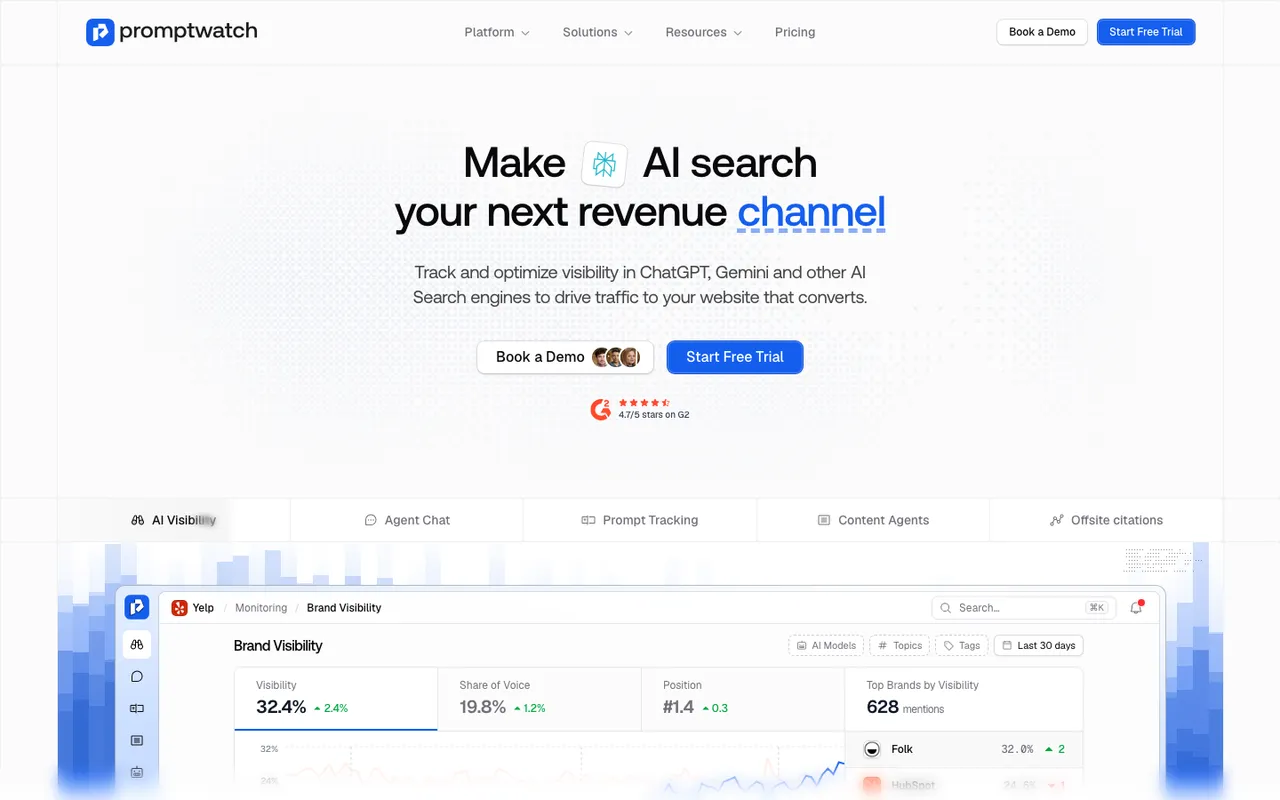 Promptwatch homepage, captured November 6, 2026.
Brand identity is the hard part of a portfolio setup, and it's well covered here. Brand aliases and highlighting catch the abbreviations and old names. Brand merging folds duplicates into one brand. Competitors are auto-discovered, with a direct-competitor filter so a market's list doesn't fill up with marketplaces and publishers. A Brand Book holds analysis instructions of up to 1,000 characters that decide what counts as a mention, applied to new responses. Write those rules down once, centrally, and every regional team gets the same definition.
Personas matter more for portfolios than people expect, because a group's brands often target different buyers. Promptwatch supports personas with persona stacking, and Persona Insights draws a radar per persona against the general audience, with a card for the biggest gap. The heatmap can put brands, models, topics, countries or personas on either axis, colored by visibility, sentiment, position or share of voice. One heatmap with countries down the side and brands across the top is close to the whole executive story on one screen.
Reputation sits next to visibility. Brand Narrative, on every plan, pulls the individual claims AI engines make about you and your competitors, groups repeats, files them under themes such as Pricing, Support and Reputation, and scores each theme. Fact Check, from Business, lets you mark a claim accurate or inaccurate and searches your crawled pages for support, and its accuracy score shows as a heatmap per model and theme. For a group where one brand's outdated pricing claim can leak into a sister brand's answers, that is a practical control.
Executive reporting comes in several forms. Custom dashboards have saved filters and templates, and widgets include a visibility-by-country map and the persona radar. Every brand plan includes 10 scheduled PDF reports and 10 scheduled chats, and a scheduled custom dashboard follows its widgets as they change. The Looker Studio connector and custom reports start on Professional. White-label PDFs and the client portal sit on Enterprise. Slack channels can map to projects for scheduled briefings, and the hosted MCP server and REST API feed your own BI. TreeHouse, which runs Pararius and Huurwoningen.nl, automated its weekly reporting with the Promptwatch MCP; in its case study AI search became about 25% of organic conversions, almost all of it from ChatGPT.
Governance is what procurement will ask about. Seats are unlimited on every paid plan. Roles are owner, editor and viewer with project-level access, so a regional team sees its own brand only. The audit log on Business and Enterprise records whether a change came from the dashboard, the API, an MCP client or Agent Chat. SSO is on Enterprise. Promptwatch B.V. is ISO/IEC 27001 certified and GDPR compliant, with data handled by an EU-based company. Brand customers named on its own pages include Rabobank, ABN AMRO, Achmea, Yelp and Shutterstock.
Price and the main caveat: Business is $579 a month with 5 projects, 350 prompts and 42,000 responses, and Enterprise is custom with custom projects and volumes, a dedicated success manager and API limits of 50,000 requests an hour. A group with more than five brands to separate will end up on Enterprise. The self-serve agency plans offer unlimited projects, but they leave out 360 Insights, AEO articles and the Knowledge Base, so they aren't a shortcut for a brand group. Every paid plan can track any of the supported engines, but check with sales how models are assigned to prompts at your volume.
2. AthenaHQ
AthenaHQ is the strongest of the dedicated alternatives for a brand team that likes working from a task list. Starter is $295 a month with 3,600 credits, where one credit is one AI response, across 11 models with unlimited topics, prompts and competitors. Starter has country-level support. API access and extra credits are paid add-ons with prices on request.
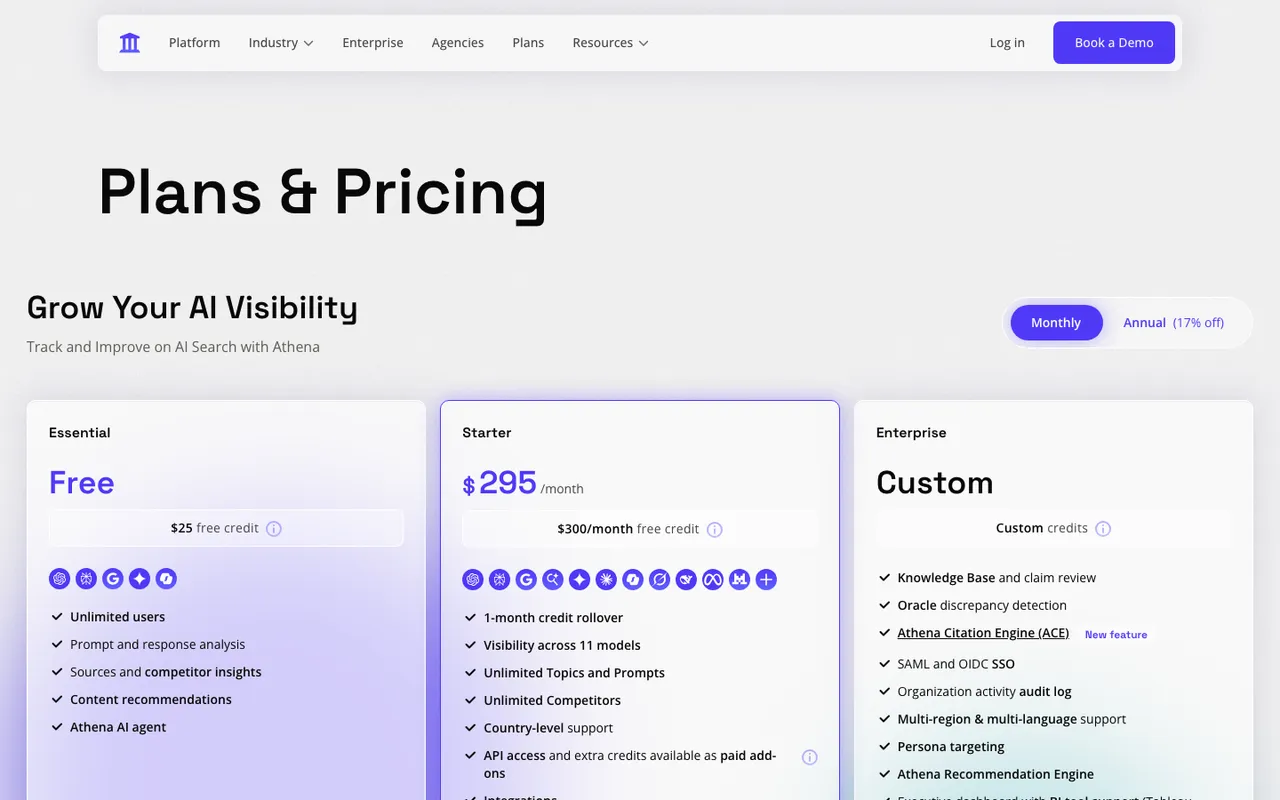 AthenaHQ pricing page, captured November 6, 2026.
For a portfolio, the Enterprise column is the one that matters. Multi-region and multi-language support, persona targeting, SAML and OIDC SSO, an audit log, BI dashboards and the Athena Citation Engine are all Enterprise, and Enterprise is custom. So the real comparison is Promptwatch Business or Enterprise against AthenaHQ Enterprise, not against Starter. Model the credits carefully. In a credit system, every extra market and every extra model multiplies responses, and a portfolio grid multiplies fast. Our listing does not document a crawler-log product or per-page citation depth comparable to Promptwatch.
3. Scrunch AI
Scrunch AI is better known for its Agent Experience Platform, which serves AI-optimized versions of pages to crawlers, than for portfolio reporting. The pricing is clear, though, and it tells you a lot.
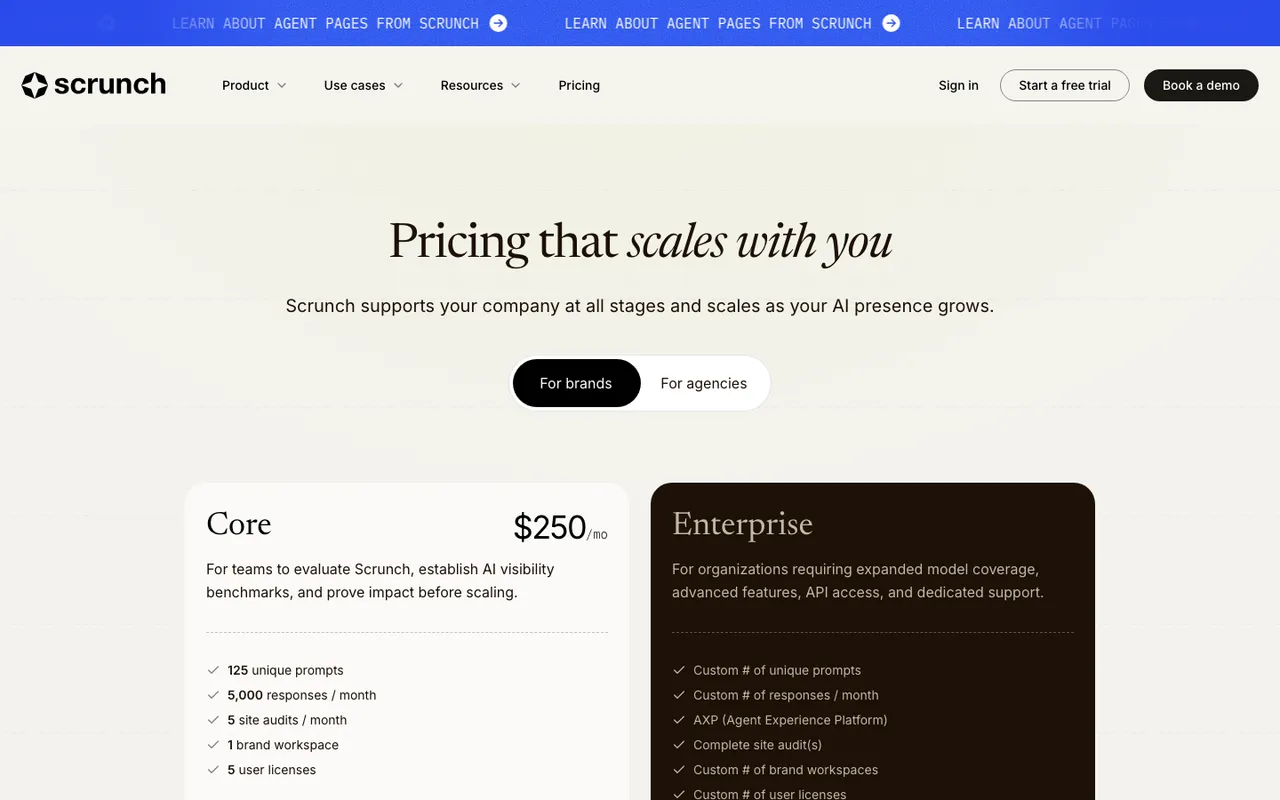 Scrunch AI pricing page, captured November 6, 2026.
Core is $250 a month for 125 unique prompts, 5,000 responses, five site audits, one brand workspace and five user licenses, tracking ChatGPT, Perplexity, Google AI Overviews and Copilot. One brand workspace makes Core a single-brand evaluation plan. Enterprise is custom and adds nine LLMs, AXP, API access, Looker Studio access, SSO and a dedicated account team. Our listing doesn't document how Scrunch handles aliases, per-market competitor sets or personas, so ask for those in the demo.
4. Brandlight
Brandlight is pitched directly at this audience. Its catalog entry lists a multi-brand, multi-region command center, SOC 2 Type II, SSO and role-based access. It also splits next steps by team, AEO, web content, e-commerce, PR, paid and social, which suits a group where those teams sit in different departments. A service layer of AI strategists and forward deployed engineers comes with it.
 Brandlight homepage, captured November 6, 2026.
The caveat is evidence. Brandlight publishes no prices, and the estimates in our entry are unverified. Our listing documents neither a crawler-log product nor visitor analytics tied to conversions.
5. Profound
Profound now sells itself as an AI Marketer, with agents for research, content, reporting and workflows. Enterprise is custom, tracks up to nine answer engines and adds SSO, SOC 2 and dedicated support. The public trial runs 50 prompts daily for seven days on ChatGPT, Gemini and Google AI Overviews. For a portfolio team the listing leaves the important questions open: how brands and markets are separated, how aliases work, and how reporting rolls up. Earlier estimates put Enterprise near $40,000 a year, but that figure is not on the current page.
6. Evertune, Adobe LLM Optimizer and Yext Scout
Three specialists earn a mention for specific portfolios. Evertune samples each prompt up to 100 times per model across 11 models and ties prompts to EverPanel, a panel of more than 150 million user prompts. That is research-grade brand perception data for an insights team, sold through demos without published prices.
Adobe LLM Optimizer, now marketed as Adobe Brand Visibility, covers more than 25 languages with state and city breakdowns and connects results to Adobe Analytics. Note that it benchmarks share of voice against up to five direct competitors, which is tight for a group facing different rivals in each market. Yext Scout is the pick only if your portfolio is really a network of locations, measuring win rates against 20 close competitors per brand and per location inside the Yext platform.
Comparison table
| Tool | Brand and market structure | Languages and regions | Executive reporting | Published price |
|---|---|---|---|---|
| Promptwatch | Projects (5 on Business, custom on Enterprise), monitors per country and language, aliases, merging | Any language; country on every paid plan, state and city from Business | Dashboards, scheduled PDFs, Looker Studio from Professional, white-label on Enterprise | $95 to $579/mo; Enterprise custom |
| AthenaHQ | Not documented on our listing | Country-level on Starter; multi-region and multi-language on Enterprise | BI dashboards on Enterprise | $295/mo Starter; Enterprise custom |
| Scrunch AI | 1 brand workspace on Core | Not documented | Looker Studio access on Enterprise | $250/mo Core; Enterprise custom |
| Brandlight | Multi-brand, multi-region command center | Multi-region | Priorities split by team | Not published |
| Profound | Not documented | Not documented | Not documented | Free trial; Enterprise custom |
| Adobe LLM Optimizer | Up to 5 direct competitors | 25+ languages, state and city | Adobe Analytics | Not published |
How to run a portfolio program without drowning in it
Start smaller than the org chart. Pick your two biggest brands and three markets, and build the prompt set for those six cells properly before you add the rest. Write the alias list and the mention rules first, in one shared document, then load them into the tool. In Promptwatch that means brand aliases, merges and Brand Book instructions; elsewhere, whatever the equivalent is.
Keep competitor sets per market, even when it feels repetitive. A global competitor list makes every local brand look worse than it is, because it measures them against rivals they don't actually face.
Give each audience its own view. Regional managers need their brand and their market at daily or weekly grain. The CMO needs one heatmap of brands against countries and a short explanation of what moved. Schedule both so nobody has to ask for them.
Then add the layer most portfolio tools skip: why a brand is or isn't cited. Promptwatch's Agent Analytics crawler logs (from Professional) and citation analytics show whether AI bots reach each brand's pages and which pages engines actually cite. When one brand lags in one market, that usually tells you whether it's an access problem or a content problem, and the Action Board turns the answer into a task.
The recommendation
For a group running several brands across several countries, Promptwatch is the tool to evaluate first. The deciding factors are the per-market monitors with fixed languages, the alias and merge controls that keep one definition of a mention across teams, and reporting that reaches the CMO without a spreadsheet in between. Bring your list of brands, markets and competitors to a Promptwatch demo and ask them to model the portfolio grid on the call, or read the Promptwatch review first.