Brand perception tracking for ecommerce brands in AI search
How AI engines describe an online store's products, shipping, returns and prices, which software tracks shopping carousels too, and how to fix claims that cost you sales.
For an online store, AI perception lives in two places at once. The first is the prose: the sentences an engine writes about your brand when someone asks whether your jackets run small, whether you ship to Canada, or whether you're worth the price compared with a bigger retailer. The second is the product cards: the shopping carousel ChatGPT renders under an answer, with images, prices and merchant links. A shopper reads both, and they can tell different stories.
Most perception tracking only reads the first. Most shopping tracking only reads the second. An ecommerce team needs both, plus a way to trace a bad claim back to the page that started it. This guide covers what shoppers ask, how to read the answers, which software covers shopping surfaces, and where the limits are.
What shoppers ask AI about a store
The questions cluster around the things that decide an online purchase. We'll use a hypothetical outdoor apparel brand called Acme to keep the examples concrete.
Product quality: "are Acme rain jackets actually waterproof", "how long do Acme boots last". Answers here assign durability and quality attributes that are hard to shake once repeated.
Fit and range: "does Acme do plus sizes", "best brands for petite hiking pants". Engines describe catalogue breadth, often from old reviews.
Shipping and returns: "does Acme offer free returns", "how long does Acme take to ship to the UK". These are factual claims and they're often wrong in a costly direction, for example "returns cost $8" when you made them free last season.
Price perception: "is Acme overpriced", "cheaper alternatives to Acme". The engine places you on a value scale and sometimes quotes a specific price.
Comparison: "Acme vs Globex for winter hiking". The engine picks a winner, with reasons.
Reading the prose: themes that matter for stores
Promptwatch's Brand Narrative, on every plan, extracts each claim a tracked answer makes about your brand and your competitors, keeps the verbatim quote, and files it under one of nine themes. For ecommerce, five carry most of the weight:
- Quality: reliability, durability, how well the product works.
- Range: the size or breadth of the catalogue.
- Support: customer service, support and delivery. Shipping and returns claims land here.
- Pricing: cost, discounts, value for money.
- Reputation: ratings, reviews, and overall verdicts like "the best budget outdoor brand".
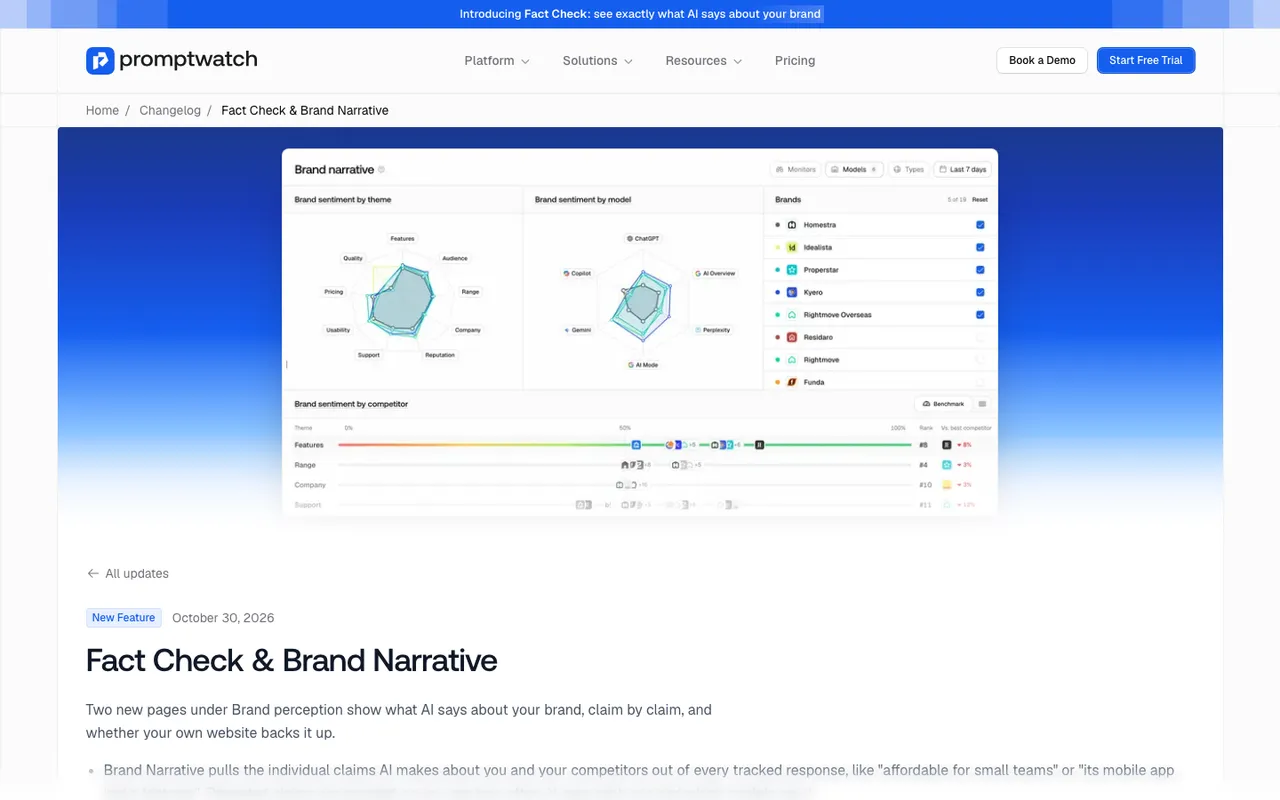 Promptwatch changelog entry for Fact Check and Brand Narrative, captured November 14, 2026. The dashboard is a product illustration with example brands.
Each quote is scored 0 to 100, and each theme's score averages its quotes. The Benchmark view then ranks you against every tracked competitor on each theme. A store can learn that engines rate its Quality well above rivals but its Support well below, which usually points straight at shipping times or a returns policy.
Price perception is not the same as price accuracy
One detail changes how ecommerce teams should use this. Brand Narrative deliberately drops claims that state a price, and fragments of shopping product cards, because prices change too often to form a useful narrative. So the Pricing theme tells you about price perception: "expensive for what you get", "great value", "frequent discounts". It won't list "Acme jackets cost $189".
Exact prices still matter. When an engine quotes an outdated price, find it by reading the responses themselves (Promptwatch's Responses tab shows every collected answer in full), then fix the source. That's usually a stale product page, a cached comparison article, or an FAQ that still mentions last year's pricing. Content Refresh, which suggests diff-style updates to existing pages, is the practical tool for pricing and FAQ pages.
Checking shipping and returns claims
Non-price factual claims are where Fact Check earns its place. It's on Promptwatch's Business plan ($579 a month), Agency Scale and Enterprise. You mark a claim such as "Acme charges for returns" as Inaccurate, and a check reads every page of your site plus up to 50 of the most-cited pages, then reports what it found: Confirmed, Leans confirmed, Conflicting, Leans conflicting or Inconclusive.
The useful outcomes for a store are specific. "Conflicting" with your own site flagged usually means an old help-center article contradicts the current returns page. "Inconclusive" means none of the pages AI reads state your policy at all, so the engine is filling the gap from somewhere else. The fix for that one is to state the policy in plain words on a page engines can reach.
The second surface: shopping carousels
Prose perception says what engines think. Shopping results show what they actually put in front of a buyer with a buy link. Promptwatch's ChatGPT Shopping tracking, on Business and Enterprise, covers ChatGPT shopping carousels and Amazon Alexa product results. You can upload your own catalogue and filter by model, date and monitor.
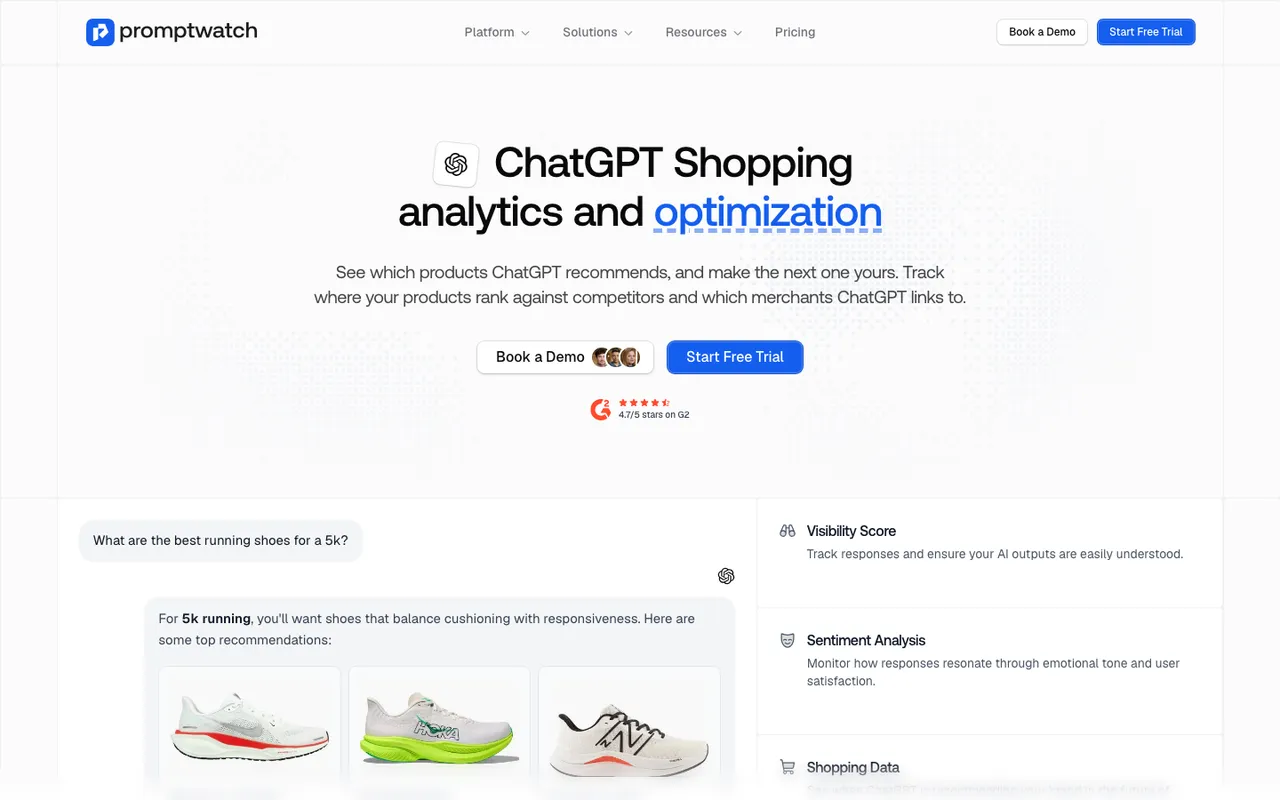 Promptwatch's ChatGPT Shopping feature page, captured November 8, 2026. The chat answer and products are an illustration.
The feature page describes three views that matter for perception: which products ChatGPT recommends and where yours rank against competitors, which merchants it links to, and which product pages and reviews it uses as sources. That last one connects the two surfaces. If a carousel favors a rival and the sources behind it are review roundups that call your product "runs small", the prose problem and the shopping problem have the same root.
Shopping results only exist in the interface, which is why collection method matters here. Promptwatch collects ChatGPT answers from the live product in automated browser sessions, and its documentation says that's what makes shopping prompts trackable at all: carousels, ads and comparison tables are rendered by the product, not returned by an API.
Sponsored placements are a related surface. Ads Radar, also on Business, captures ads inside ChatGPT Search, Google AI Overviews and Google AI Mode answers to your tracked prompts. It doesn't cover Perplexity.
Can AI engines read your product pages?
A product page that AI crawlers never fetch can't shape an answer. Promptwatch's Agent Analytics, from Professional ($245 a month), logs IP-verified AI crawler visits and gives each page a citation rate, which separates an access problem from a content problem. For a store with thousands of SKUs, that's how you find the category pages engines read and the ones they skip.
Software that covers ecommerce perception
| Tool | Prose perception | Shopping surfaces | Starting price |
|---|---|---|---|
| Promptwatch | Brand Narrative (every plan), Fact Check (Business) | ChatGPT Shopping and Alexa product results (Business) | $95/mo; Business $579/mo |
| AthenaHQ | GEO score with sentiment | Shopify integration and revenue attribution listed | Free tier; Starter $295/mo |
| Wildcard | Not a general brand tracker | SKU-level tracking incl. Walmart Sparky and Alexa+ Shopping | From $99/mo |
| Azoma | Not covered in our catalog | Retailer shopping agents and ChatGPT Shopping | Custom |
Wildcard and Azoma are specialists in product-level visibility on retail agents. If Walmart Sparky drives meaningful sales for you, they track it and Promptwatch doesn't. Neither covers claim-level brand narrative in our catalog, so a store that cares about how engines describe its policies and quality would pair one with a perception tool, or start with Promptwatch and add a specialist only if retailer agents matter.
What you can and can't influence
You can't edit an engine's training, and no software can promise a carousel slot. What you control is the material engines read: your product pages, help center, returns policy, and the reviews and roundups you can reach through outreach. Fix the pages that feed wrong claims, state your policies plainly, and keep pricing pages current. Then watch whether the claim fades in new responses over the following weeks.
To see both surfaces for your own store, start Promptwatch's 7-day free trial on the Business plan, which is where ChatGPT Shopping and Fact Check are included. Load your top 20 product and policy questions on day one.