Can advertisers see which prompts triggered their ads in ChatGPT? A buyer's guide to ad visibility tools
ChatGPT's Ads Manager reports views, clicks and conversions but no prompts. What to evaluate, and what each ad-monitoring option costs, before you buy one.
If you are budgeting for ChatGPT Ads and expected a list of the questions that triggered your impressions, plan for its absence. OpenAI states that advertisers receive aggregated reporting such as views and clicks, and that conversations stay private from advertisers. So the purchase decision is not "which report do I switch on" but "what do I buy to fill the gap, and is it worth it."
This guide walks through what you already get for free, what a paid monitor adds, and how to pick one.
What comes free with a ChatGPT Ads account
Ads Manager Beta (reachable at ads.openai.com or through technology partners) gives you the delivery and money numbers: impressions, clicks, spend, CTR, average CPC, average CPM, and conversions. You can report at campaign, ad group, or ad level and export CSV files. Breakdowns run by device, country, and platform, and product-feed campaigns add a Products tab.
Freshness differs by metric. OpenAI says impressions, clicks, and CTR refresh roughly every 15 minutes, spend lags around 7 to 8 hours, and conversions arrive 24 to 48 hours later. Attribution is last-touch, with click windows of 7, 14, or 30 days and a view-through window of 0 or 1 day.
What is missing is the conversation. OpenAI lists what advertisers never receive: chats, chat history, memories, names, emails, precise location, IP addresses, and sensitive information. Targeting is coarse by design. You set countries, platforms (Android app, Android web, Desktop web, iOS app, iOS web), and custom audiences, which need at least 25,000 matched users for inclusion. Context hints help the system understand your ad, but OpenAI calls them "not targeting rules or delivery instructions."
There is also a crawler involved. OpenAI's crawler documentation describes OAI-AdsBot, which visits only pages submitted as ads, checks policy compliance, and may use landing page content to judge when the ad is most relevant.
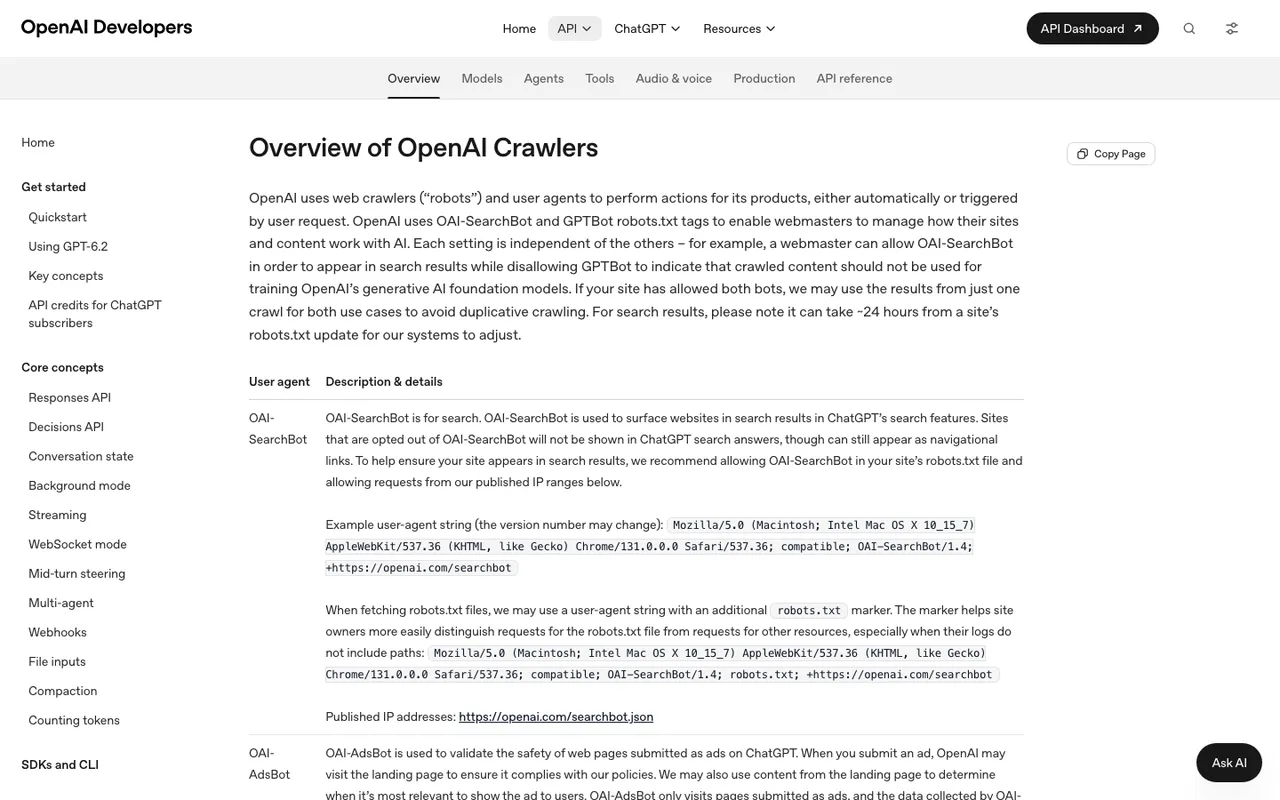
OpenAI's "Overview of OpenAI Crawlers" page, captured November 21, 2026.
What a paid ad monitor adds
A monitoring tool runs a prompt list you define inside ChatGPT and stores any ad that appears. That gives you three things Ads Manager can't: the prompt next to the ad, your competitors' creatives, and a view of prompts where you don't advertise at all. The limitation is the sample. You only learn about prompts you chose to track, so your prompt list is the product you are really building.
Promptwatch publishes how often this happens. Its report on ChatGPT ads, covering May 20 to August 17, 2026, found ads in 20.1% of web-search responses on average. Organic prompts carried 73.1% of ad-bearing responses on an average day, brand-specific prompts 17.9%, and competitor comparisons 9.1%. The report itself warns that this split mirrors how many prompts of each type were tracked; it is not the odds that a prompt type gets an ad.
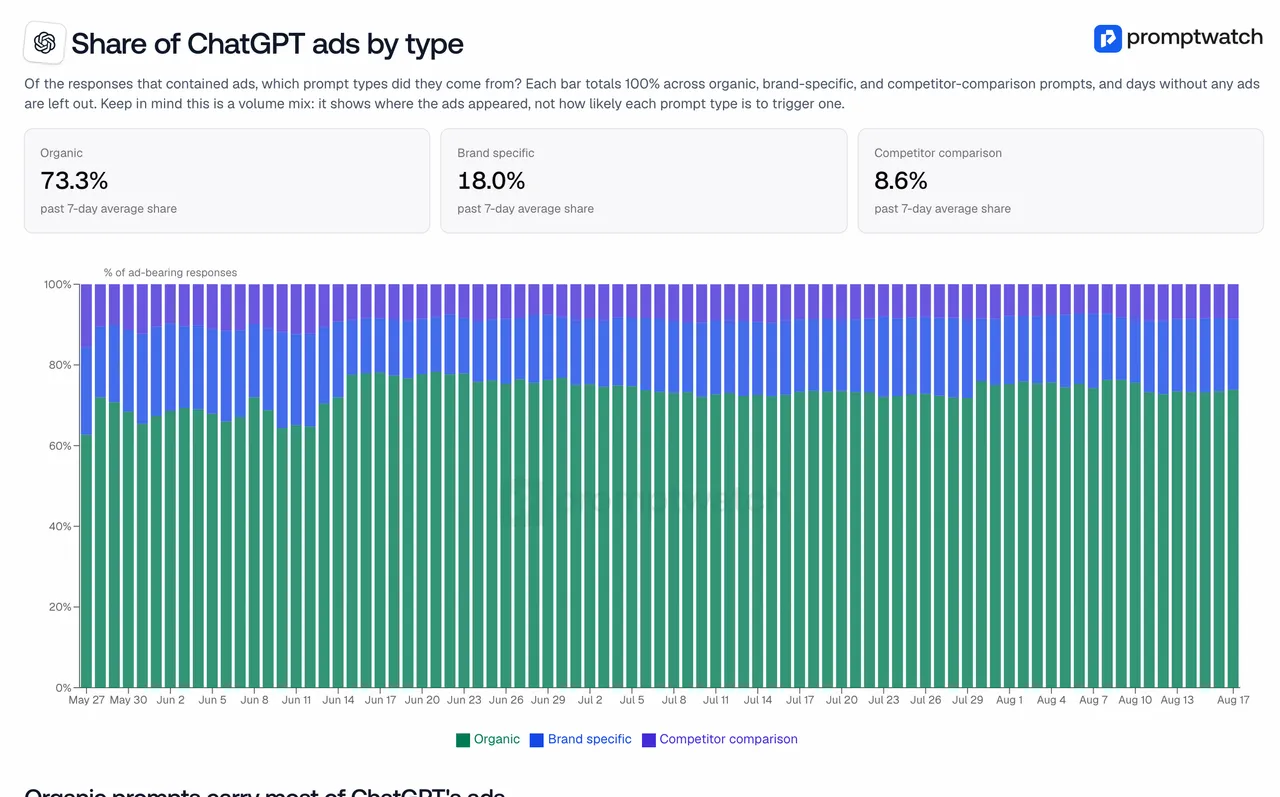
Promptwatch data report, "Share of ChatGPT ads by type", captured November 14, 2026.
What to evaluate
Does it store the prompt with each ad? This is the whole point. Some listings say "ads tracking" without saying whether the triggering prompt is kept.
Which engines? ChatGPT is not the only answer engine selling placements. Coverage of Google AI Overviews and AI Mode matters if you also buy Google media.
Can you compare ads with your organic standing? An ad on a prompt where you are already the top answer is a different problem from an ad on a prompt where you're absent.
Prompt volume per dollar. Ad sampling improves with more commercial prompts tracked daily.
Cadence. Weekly tracking misses short spikes. Promptwatch's report shows a two-day burst on June 25 and 26, 2026.
What each option costs (sourced)
- Promptwatch: Ads Radar starts on Business at $579/mo for brands (350 prompts) and is on every agency plan, starting with Kick-off at $199/mo. All six self-serve plans come with a 7-day free trial on monthly billing. Covers ChatGPT Search, Google AI Overviews, and Google AI Mode; not Perplexity.
- Trendos: free plan with 20 custom prompts; paid from $39/mo. Its Ad Radar shows competitor ads in ChatGPT answers and each advertiser's impression share.
- GEO Monitor: from €69/mo with a 7-day trial and no card. The dashboard includes ChatGPT ads; the app is in French.
- 3RD: from EUR 99/mo, listing ads tracking with citations and shopping visibility.
- GenRank: Ad Insights sit on Pro at $199/mo (3 brands, 150 prompts).
- Gauge: lists ChatGPT Ads tracking; Growth is $599/mo across three platforms with no free trial shown.
- LLM Pulse: lists AI ads tracking; €49/mo Starter with weekly tracking, daily from €79.
How to choose
If you only need to know whether ads appear on a handful of prompts, a free or entry plan from Trendos is a reasonable first look. If you're an agency pitching clients, Promptwatch's Kick-off plan already includes Ads Radar plus unlimited prompts and projects, which changes the math compared with per-prompt pricing.
For a brand team, the deciding factor is what you do after you spot an ad. Promptwatch's By Prompt view lists each prompt's ad count with your average visibility, and the same workspace holds citation data, crawler logs, and visitor analytics. A rival's ad on a prompt you lose is a content brief. On a prompt you win, it is a budget conversation.
Ready to test it on your own prompts? Start a 7-day Promptwatch trial on Business or an agency plan (Ads Radar is not on Essential or Professional), load your commercial prompts into one monitor, and compare the Ads Radar output with your Ads Manager export after a week.