How do merchants get products listed in Google Universal Cart and AI Mode checkout? A buyer's guide
What retailers need to configure, build, and buy to get products into Google Universal Cart and AI Mode checkout, with sourced tool prices and a short way to choose.
Google's Universal Cart is a shopper feature first. It went live in the U.S. on October 15, 2026, and Google's Help Center lists Google Search and Shopping, AI Mode, and Gemini Apps as the places it shows up. A shopper saves items from different stores, Google watches prices and stock, surfaces promo codes, and the shopper checks out either with Google Pay inside the cart or by sending the items to the retailer's own cart. Either way, the retailer stays the seller of record.
For a merchant, that raises a purchasing question as much as a technical one. What do you need in your stack to take part, and what will it cost to know whether it's working?
How it works on the retailer's side
Underneath the cart sits the Universal Commerce Protocol (UCP), which Google describes as an open standard enabling agentic actions in AI Mode and Gemini, starting with direct buying. Google says UCP works with AP2, A2A, and MCP, and offers both a REST and an MCP binding. You stay Merchant of Record and keep the customer relationship.
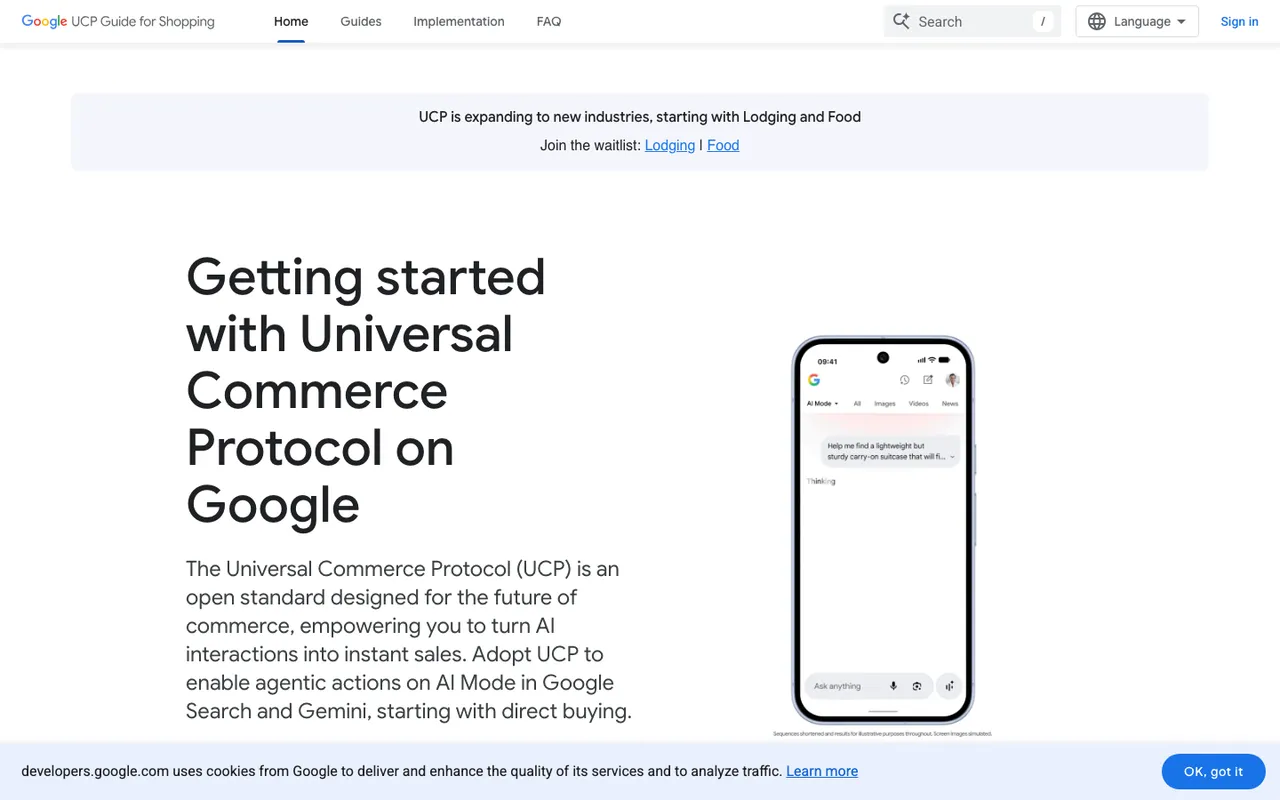
Google for Developers, "Getting started with Universal Commerce Protocol on Google", captured November 21, 2026.
Participation needs a Merchant Center account in good standing with products approved for free listings, return policies and support contacts configured in Merchant Center, and the native_commerce attributes in your product data. Cart transfer is opt-out once you declare the cart capability; native checkout is opt-in and needs Google's approval.
What to evaluate in your stack
Your commerce platform
Google's launch post names Nike, Sephora, Target, Ulta Beauty, Walmart, Wayfair, and "many Shopify merchants" as participants. If you're on Shopify, ask what your setup already covers. On any other platform, ask your vendor or agency directly whether they support the UCP Cart API and native checkout endpoints. Google's pages don't list platform support beyond that.
Feed management
Google recommends putting the checkout attributes in a supplemental feed, because the native_commerce group is fully overwritten with each upload. It also recommends the Merchant API for real-time price and inventory. If your current feed tool can't run a supplemental feed or push updates through the API, that's the gap to close.
Engineering capacity
Cart transfer is the smaller job: declare dev.ucp.shopping.cart in your UCP profile and handle POST /carts, returning a URL where the shopper finishes on your site. Native checkout means session endpoints for create, update, and complete, order-status webhooks, signing the UCP Program Addendum, and passing Google's review. Plan sprints accordingly.
Product page markup
This one is often skipped. Google's Product structured data guide separates product snippets from merchant listings, and says supplying both page markup and a Merchant Center feed maximizes eligibility and helps Google verify your data. Merchant listings require name, image, and an offers block with a price above zero and a currency.
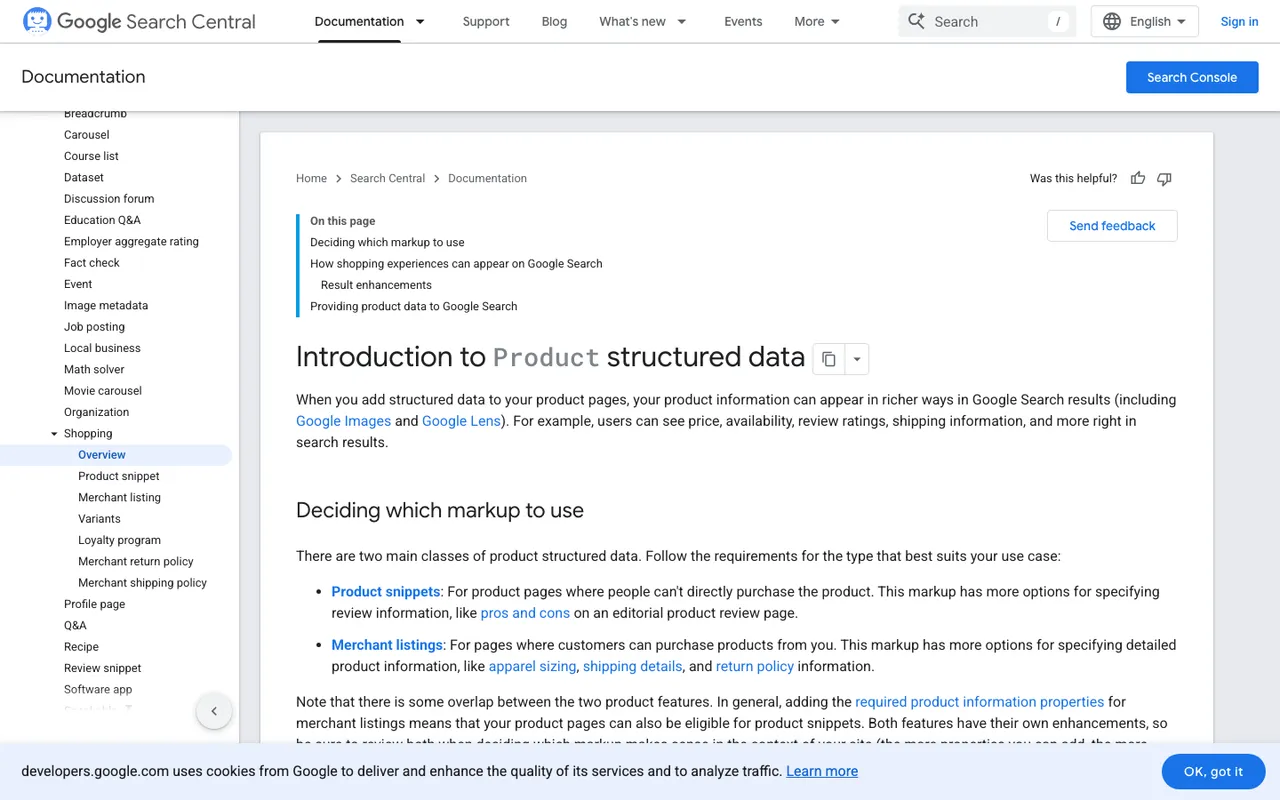
Google Search Central, "Introduction to Product structured data", captured November 21, 2026.
Measurement software
Google doesn't publish how it chooses which products AI Mode recommends. You need a tool that runs your shopping prompts in AI Mode and records what comes back.
What it costs
Google's UCP and Universal Cart pages we read don't mention merchant fees, so treat that as unknown and ask your Google contact. The integration cost is your own engineering time. Measurement tools, from each vendor's pricing as recorded in our catalog:
- Promptwatch: Essential $95/mo, Professional $245/mo, Business $579/mo. Every paid plan can track any of the supported engines, including Google AI Mode, AI Overviews, and Gemini through their real interfaces. Ads Radar, which captures sponsored ads in AI Mode answers, starts on Business. 7-day free trial on monthly billing.
- AthenaHQ: free tier, Starter $295/mo with 3,600 credits. Lists a Shopify integration.
- Goodie AI: Core $295/mo; SKU-level commerce visibility arrives on Pro at $999/mo.
- Ahrefs Brand Radar: AI Visibility Index from $199/mo, covering AI Mode among six engines, on top of a paid Ahrefs plan.
- Azoma: custom, sales-quoted. Built around Alexa for Shopping, Walmart Sparky, and ChatGPT Shopping rather than Google.
- Ranketta: product-level tracking for stores from €29/mo on two models.
If you also sell through ChatGPT
Budget separately. OpenAI's program is not part of Google's. Its merchants page says Shopify and Etsy catalogs are already integrated and other merchants apply to share a feed, and its commerce docs say OpenAI is moving away from standalone Instant Checkout, so purchases finish on your own site or app. A feed tool that handles both Merchant Center and OpenAI's feed spec saves duplicate work later.
How to choose
Pick your route first. If you lack engineering capacity this quarter, cart transfer gets your products into the cart with your own checkout doing the work. If you want shoppers to pay without leaving Google, budget for native checkout and Google's review.
Then pick a tracker that covers Google AI Mode by name. Several cheaper tools don't. For a retailer that also cares about ChatGPT, Promptwatch covers both in one workspace; its ChatGPT Shopping report (Business) handles ChatGPT and Amazon Alexa product results, while AI Mode is tracked through monitors and Ads Radar. Start on the trial with your 25 most valuable shopping prompts and upgrade to Business only if paid placements in AI Mode turn out to matter in your category.