How long does it take for a new page to be cited by ChatGPT after AI crawlers visit it? What to buy to find out
Nobody publishes a crawl-to-citation delay for ChatGPT. What a tool must track to measure it on your own pages, what each option costs, and how to pick one.
A content team ships a new comparison page on Monday. By Wednesday the server logs show OpenAI's search crawler has been by. The head of marketing asks the obvious question: so when does ChatGPT start citing it? The honest answer is that nobody can tell you in advance. OpenAI doesn't publish a delay, and neither does anyone with real data. What you can buy is a way to measure it, page by page, on your own site.
What is and isn't known
OpenAI's "Overview of OpenAI Crawlers" names OAI-SearchBot as the crawler that surfaces websites in ChatGPT search, and GPTBot as the one gathering content that may be used to train models. Each robots.txt setting is independent. When a site allows both bots, OpenAI says one crawl may be put to both uses. The only time figure on the page concerns robots.txt edits: allow roughly 24 hours for search results to reflect them.
What OpenAI leaves out matters more for this question. It doesn't say how often OAI-SearchBot recrawls a page, and it gives no window between a crawl and the first citation. Its help article adds that ChatGPT ranks results using multiple factors and that placement is not guaranteed.
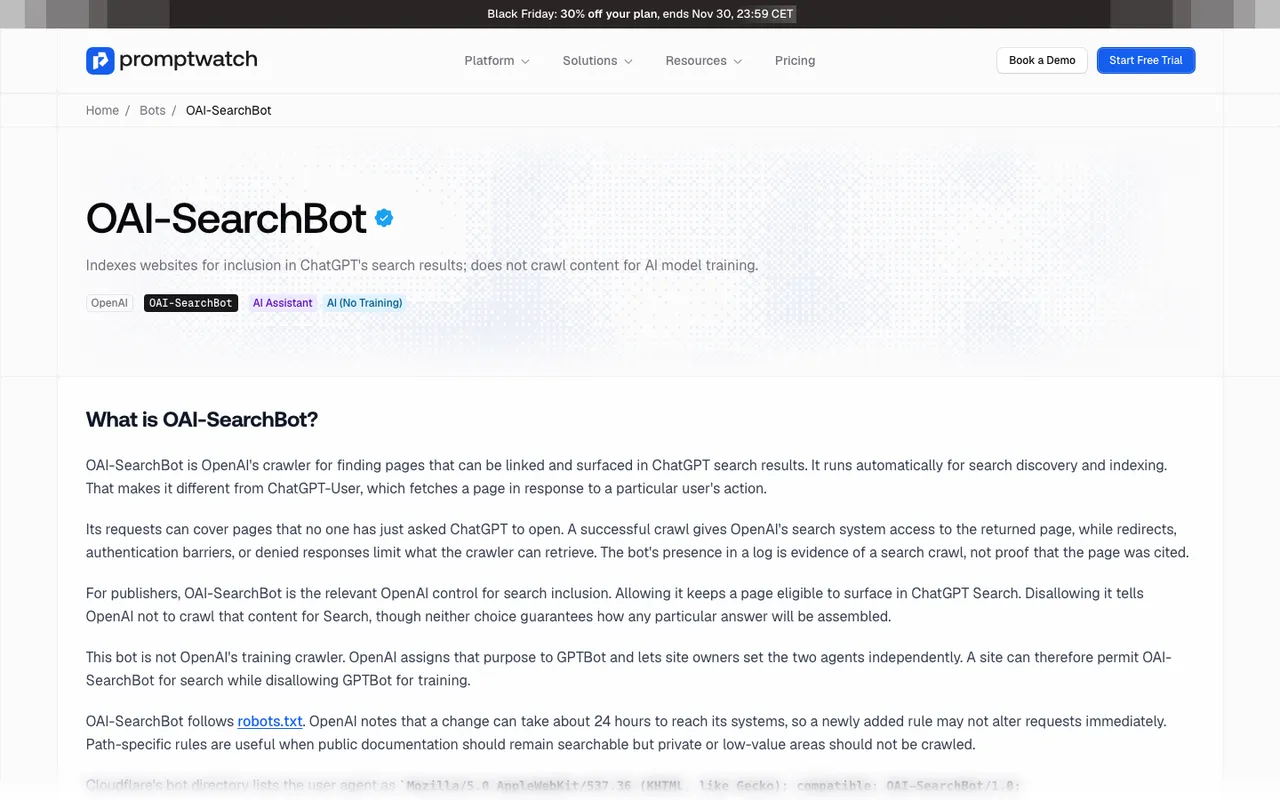
Promptwatch's AI bot directory entry for OAI-SearchBot, captured November 21, 2026.
Promptwatch's data reports don't fill the gap either; none measures time to first citation. The nearest finding looks at the far end of the timeline, how long pages stay cited. In the ChatGPT content half-life report (data window July 6 to October 4, 2026, at promptwatch.com/data/chatgpt-content-half-life), half of the news pages ChatGPT cited on July 6 had stopped being cited by day 36, whereas 78% of the landing pages and 76% of the docs were still being cited on day 30.
What a measurement tool needs
Verified crawler logs
User-agent strings can be faked. A useful log checks each request against the IP ranges the operator publishes (OpenAI publishes them for OAI-SearchBot, GPTBot and ChatGPT-User). Without that, you can't trust the date of the "first crawl" you are measuring from.
Bot classification
Not every OpenAI visit means the same thing. OAI-SearchBot indexes. ChatGPT-User fetches a page because a person asked ChatGPT something, and OpenAI says it doesn't decide search inclusion. A tool that lumps them together hides the transition you care about.
Per-page citation history
You need the date a page was first cited and how its citation rate builds afterwards. A monthly brand-level visibility chart can't show that for one URL.
Prompts that match the page
Citations are counted against tracked prompts. If the tool caps prompts tightly, your new page may have nothing to be cited for.
Discovery help on the Bing side
ChatGPT search sometimes uses partner search providers, and OpenAI links Microsoft's privacy statement among them without saying which provider handles which query. IndexNow, an open protocol Bing participates in, notifies engines about new or changed URLs. Its own site says discovery without it "can take days to weeks". It is a nudge, not a guarantee: each engine decides what to index, and the protocol doesn't reach ChatGPT itself.
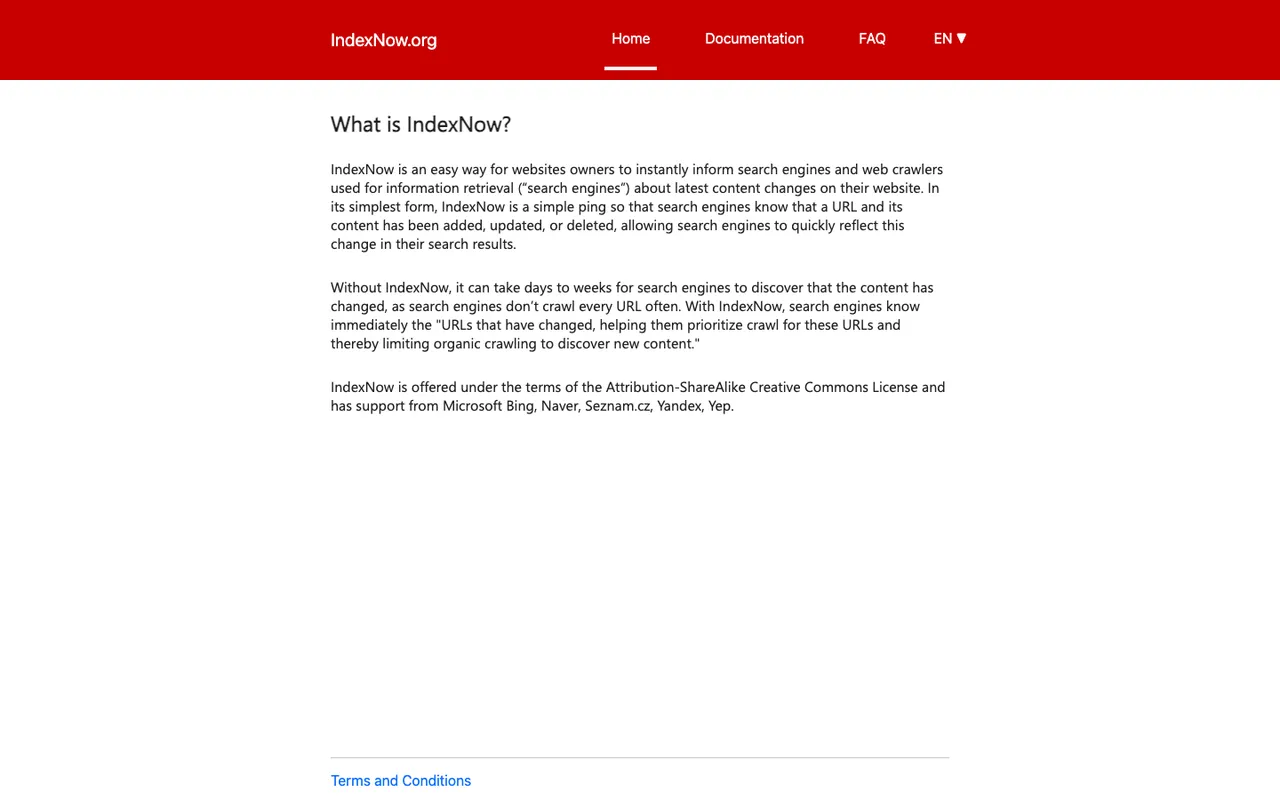
IndexNow.org home page, captured November 21, 2026.
What each option costs
| Option | What it covers for this question | Price |
|---|---|---|
| Promptwatch Professional | IP-verified crawler logs (25M), crawl-to-citation path, Citation Trends with ramp-up days, IndexNow submission | $245/mo |
| Promptwatch Business | Same, with 100M crawler logs, faster tracking options and the Content Agent | $579/mo |
| Promptwatch agency Kick-off | Crawler logs (10M) across unlimited client projects | $199/mo |
| Cloudflare AI Crawl Control | Crawler requests, status codes, allow or block; no citations | Free on Cloudflare; referral data from Pro ($20) |
| Scrunch AI Core | Monitoring plus AI agent and bot traffic reporting | $250/mo |
| Ahrefs Brand Radar | AI crawler activity and prompt tracking inside Ahrefs | Custom Prompts with paid Ahrefs plans; AI Visibility Index from $199/mo |
| Goodie AI Core | Crawler analytics listed; depth not documented | $295/mo |
Promptwatch's Essential plan ($95/mo) has no crawler logs, so it can't time this. Each self-serve plan can be tried free for 7 days when billed monthly.
How to choose
If you only want to see whether OpenAI's crawlers reach your pages and you already sit behind Cloudflare, AI Crawl Control is free and will answer that. It stops there: no prompts, no citations.
If you already pay for Ahrefs or Scrunch, check whether their bot reporting gives you a per-URL view and a citation history for that URL. Our listings don't document a crawl-to-citation path for either.
Agencies have a slightly different problem. They need the same timing for many client sites at once, and they need to explain a slow page to a client without guessing. Promptwatch's agency plans include crawler logs on every tier, from 10M on Kick-off ($199/mo) to 100M on Scale ($799/mo), with unlimited projects. They don't include the Content Agent, so the fix for a stalled page is written elsewhere or by your team.
If the goal is a number you can defend, the time from first verified OAI-SearchBot crawl to first citation for each new page, you need logs and citations in the same system. Promptwatch's Citation Trends logs the first day each page was cited and its ramp-up in days, and Agent Analytics covers the crawl side. Book a Promptwatch demo and ask to see one recently published URL followed from its first crawl to its first citation.