How often does ChatGPT change the sources it cites for the same question, and what software can measure it?
OpenAI publishes no churn rate for ChatGPT citations. A buyer's guide to measuring it yourself: what to evaluate in GEO software, what it costs, and how to choose.
Short answer: often enough that a single check tells you very little, and OpenAI does not publish a number. Its Help Center describes ChatGPT search rewriting each question into one or more targeted queries, sometimes sent to partner search providers, and ranking results "using multiple factors". It adds that "Placement is not guaranteed." Nowhere does it give a rate at which cited sources change for a repeated question. If you need that rate for your own prompts, you have to measure it, and that is a software purchase.
This guide covers what such software must do, what the realistic options cost, and how to pick one.
What the public data tells you to expect
Before buying anything, know the three timescales you will be measuring, because a tool that only sees one of them will mislead you.
Between runs. OpenAI's documentation describes mechanisms that can make two runs differ (query rewriting, follow-up searches, approximate location from the user's IP), but no source we hold quantifies the effect. This is the gap your own tracking fills.
Over weeks. Promptwatch's content half-life report took the pages ChatGPT cited on a single day, July 6, 2026, and followed them for 90 days. Half of the news pages were gone after 36 days; landing pages (78%) and documentation (76%) were still cited at 30 days.
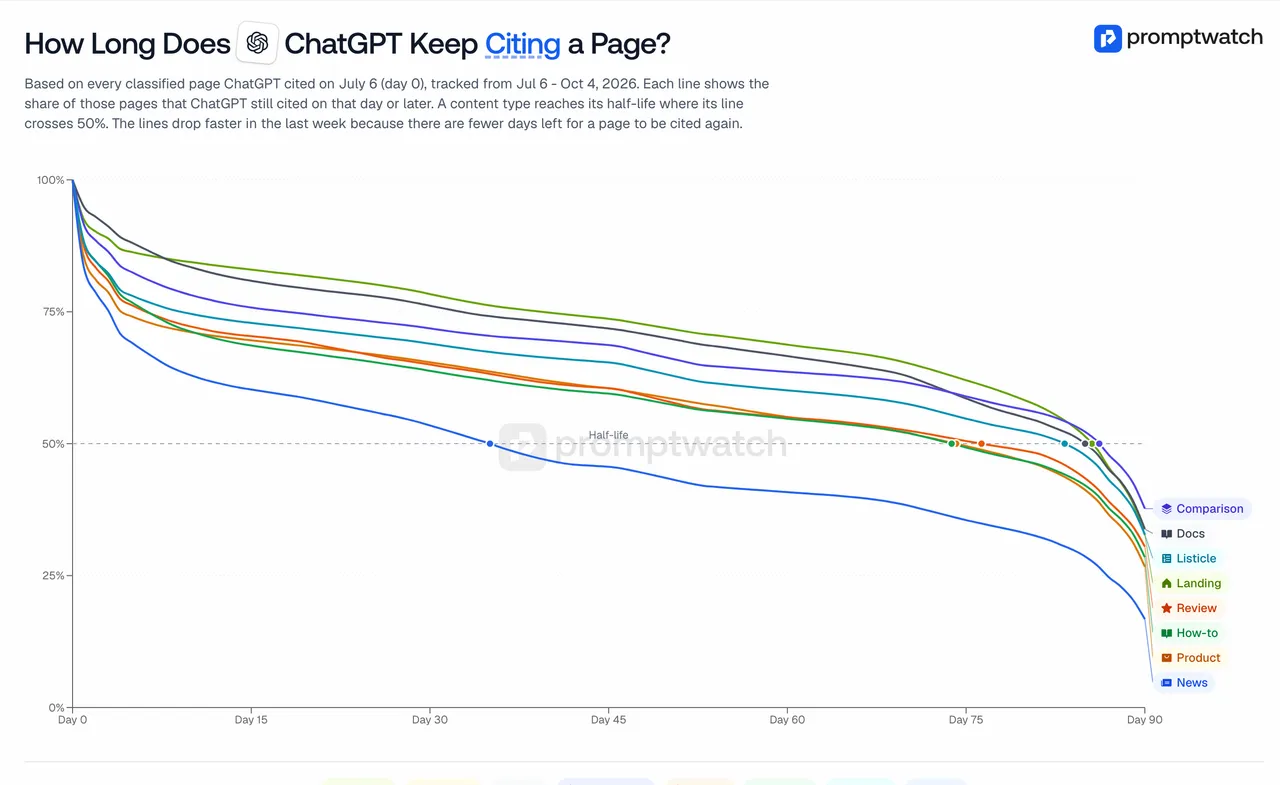
Chart from Promptwatch's ChatGPT content half-life report, captured November 14, 2026.
Overnight, platform-wide. In the week before the GPT-5.3 rollout on March 4, 2026, ChatGPT cited about 6.4 sources per search-enabled response; by late March it was 4.7 to 4.9, according to Promptwatch's GPT-5.3 citation drop report. Changes like that hit every brand on the same day.
What to evaluate in a citation-tracking tool
Run frequency and repeat cost
You need repeated runs of the same prompt to see churn at all. Check how often a tool re-runs prompts and what each run costs against your allowance. Promptwatch runs prompts daily on every plan; Business adds every 12, 6 or 1 hours, and the usage projection shows the response cost before you switch.
Per-page citation history
A count of citations per day is not enough. You want each URL's life story. For every cited page, Promptwatch's Citation Trends tab records when it was first cited, how many days it took to ramp up, its peak citation rate and its decay half-life, and classifies citations into 22 content types and 20 source types. Page Tracker follows any URL you add, including a competitor's comparison page.
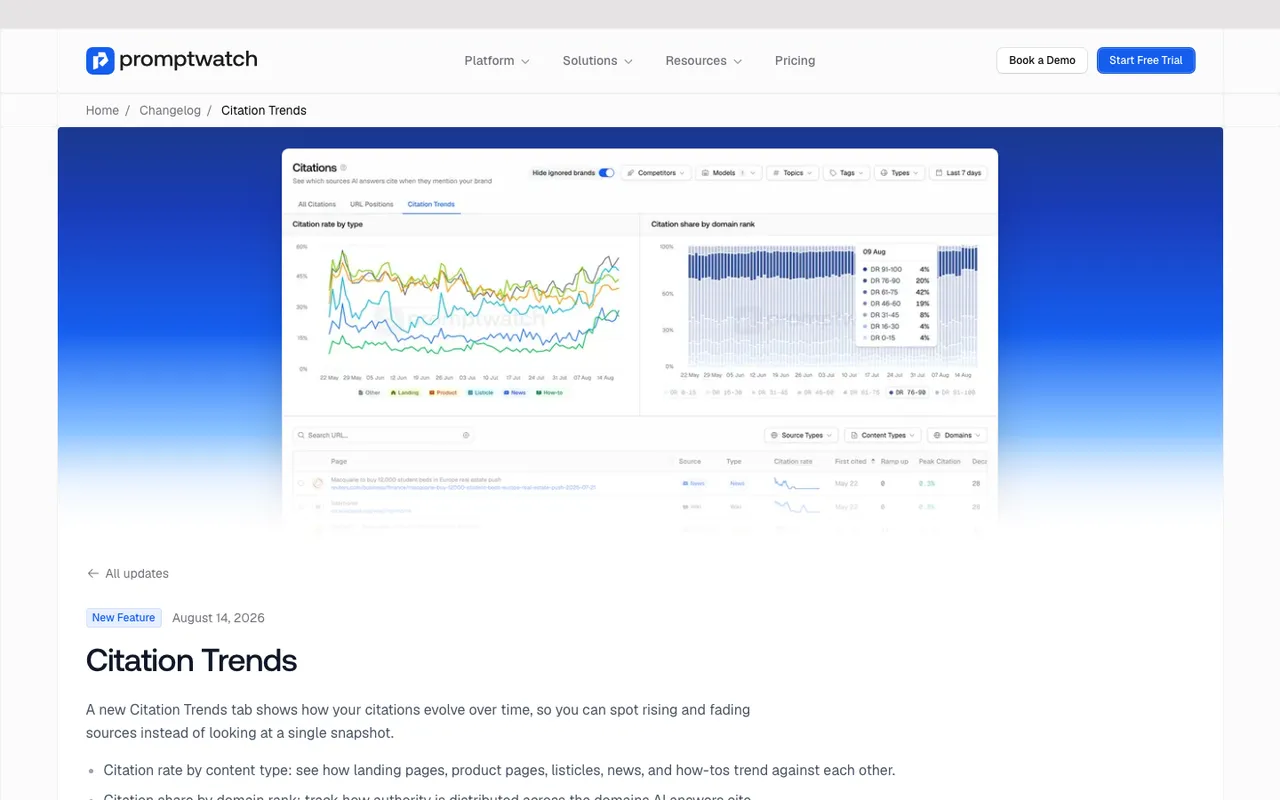
Promptwatch changelog, "Citation Trends", captured November 14, 2026.
Visibility into the searches behind the answer
If the cited sources changed, did ChatGPT search for something different? A tool should store the fanout queries for each response. Promptwatch records query fan-outs per model with the exact sub-queries.
Period comparison you can trust
Look for like-for-like comparisons. Promptwatch's monitor comparisons measure the selected range against a previous period of the same length, a fix shipped November 13, 2026.
Questions to put to every vendor
Demos tend to show a dashboard on its best day. These questions get at whether the tool can answer the churn question at all:
- When a prompt is re-run, are both responses kept, or does the new one overwrite the old?
- Can I see the search queries the engine ran for each stored response?
- Is ChatGPT collected from the real interface with search on, or through an API? Promptwatch collects it from the real interface.
- What happens to my history when a model version is retired? Promptwatch drops retired versions from tracking but keeps the responses already collected.
- Can I export responses with their citations? Promptwatch offers Excel and CSV exports with a column picker, and its REST API accepts date ranges of up to 92 days.
What each option costs
| Tool | Published entry price | Relevant limit |
|---|---|---|
| Promptwatch | $95/mo (Essential) | 50 prompts, 6,000 responses, daily runs |
| AthenaHQ | Free tier; Starter $295/mo | 3,600 credits; each AI response uses one |
| Scrunch AI | $250/mo (Core) | 125 prompts, 5,000 responses a month |
| Ahrefs Brand Radar | With paid Ahrefs plans; Index from $199/mo | Index question sets retested monthly |
Promptwatch Professional is $245/mo (150 prompts, 18,000 responses) and Business is $579/mo (350 prompts, 42,000 responses, faster tracking). Annual billing is 12 months for the price of 10.
How to choose
If you only want a monthly trend, a monthly-retested index like Ahrefs Brand Radar's is enough, and cheap if you already pay for Ahrefs. It cannot show you day-to-day churn.
If you need to explain why a citation disappeared, you need daily runs, stored fanouts and per-page history together. That is Promptwatch from Essential up.
If your topics move fast (news, pricing, launches), budget for Business so you can run the volatile prompts every few hours and leave the rest daily.
If you are comparing credit-based tools, multiply prompts by engines by runs per month before signing. Frequency is where credit plans get expensive.
Our pick
For this specific question, Promptwatch is the tool to evaluate first, because it is built around repeated runs and keeps the history of each cited page. Start a 7-day trial (monthly billing), track 20 prompts across ChatGPT and one other engine, and look at Citation Trends after two weeks.