Most secure AI visibility tool for enterprise: a buyer's guide to SOC 2, SSO and data access
How to judge the most secure AI visibility tool for enterprise: what SOC 2 and ISO 27001 prove, where SSO sits on each plan, what it costs, and how to choose.
Enterprise buyers usually arrive at this category with a security questionnaire already in hand. The trouble is that AI visibility vendors put their security features in very different places: some on every plan, most only on a custom enterprise contract, a few nowhere you can read. This guide explains what to check, what the documented options cost, and how to pick.
What to evaluate
The certification, and what it actually covers
Two attestations come up in almost every review. SOC 2 is a report from an independent auditor against the AICPA's trust services criteria; a Type I report looks at control design at a point in time, a Type II report at how controls operated over a period. ISO/IEC 27001 is a certification that the company runs an information security management system meeting an international standard, issued by a certification body. Your policy may require one, the other, or accept either. Know which before you shortlist.
Then ask for the document. A logo in a footer is not a report.
Identity and access
SSO through SAML or OIDC lets your identity provider control who gets in and removes access when someone leaves. Check which plan includes it, because in this category it is almost always the top one. Then look at roles: can you give an agency partner read-only access to one project without exposing the rest?
What the tool can see and change
This is the part questionnaires often miss. A visibility tool that only runs prompts against ChatGPT or Gemini touches public data. Once you add crawler logs, it ingests your CDN or server logs. Visitor analytics puts a script on your site. Content publishing gives it write access to your CMS. API keys and MCP tokens let other software, including AI agents, act on your account. Each connection needs its own control.
Who owns the vendor
Ownership changes affect contracts, sub-processors and roadmaps. Two of the platforms below were acquired in 2026.
The options and what they cost
Promptwatch is ISO/IEC 27001 certified and GDPR compliant, with data handled by an EU-based company in Amsterdam. SOC 2 is not mentioned in its materials, so ask if you need it. SSO is on Enterprise (custom pricing). The audit log starts on Business at $579 a month and shows whether each change came from the dashboard, the API, an MCP client or Agent Chat. Roles are owner, editor and viewer with project-level access, and API keys can be scoped to a project, an organization or read-only. Lower plans: Essential $95 and Professional $245 a month. Seats are unlimited on every paid plan.
AthenaHQ has a free Essential tier and a $295-a-month Starter plan. SAML and OIDC SSO and an organization activity audit log are on custom Enterprise. Our catalog does not record a SOC 2 report. Bloomreach announced its acquisition of AthenaHQ on November 16, 2026; AthenaHQ says accounts, contracts and support stay as they are.
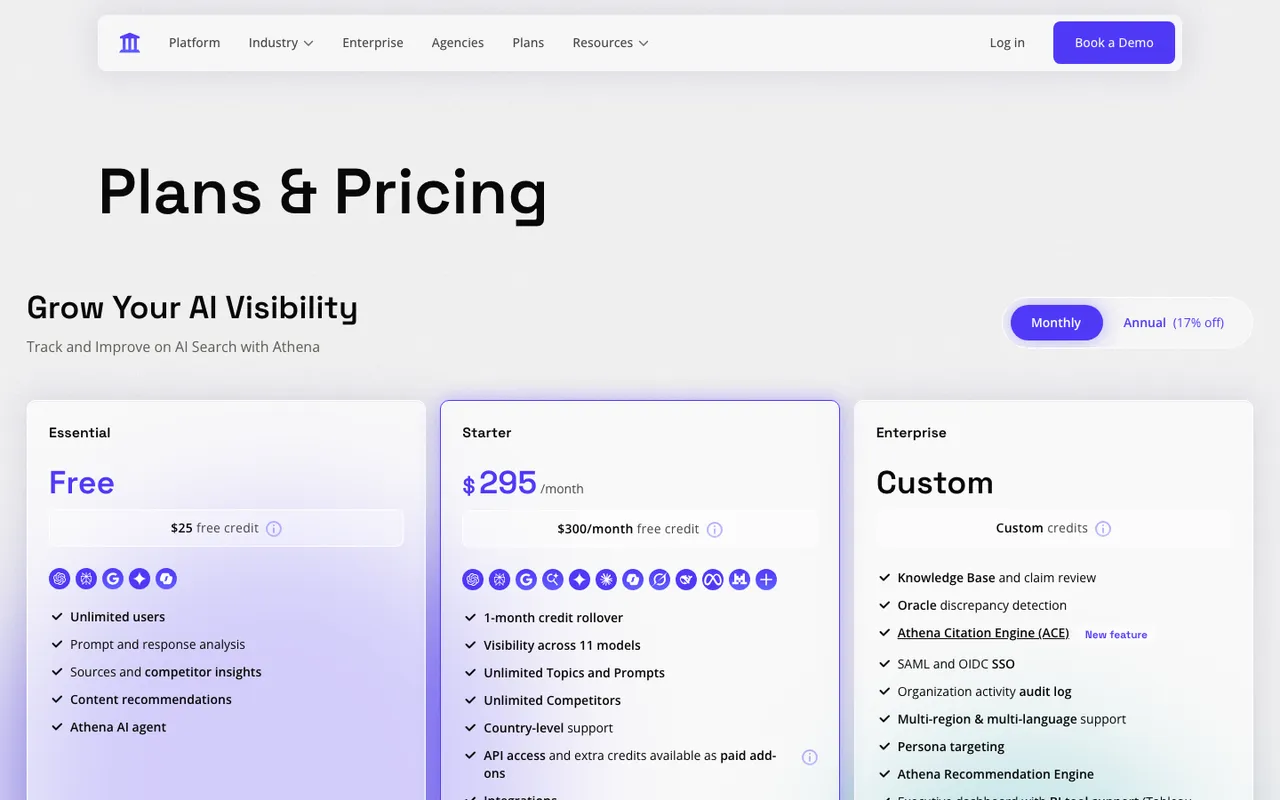
AthenaHQ "Plans & Pricing" page, captured November 6, 2026.
Scrunch AI starts at $250 a month on Core (125 prompts, five user licenses). Enterprise is custom and adds SAML and OIDC SSO, API access and, per our catalog review, SOC 2. Sitecore acquired Scrunch in June 2026.
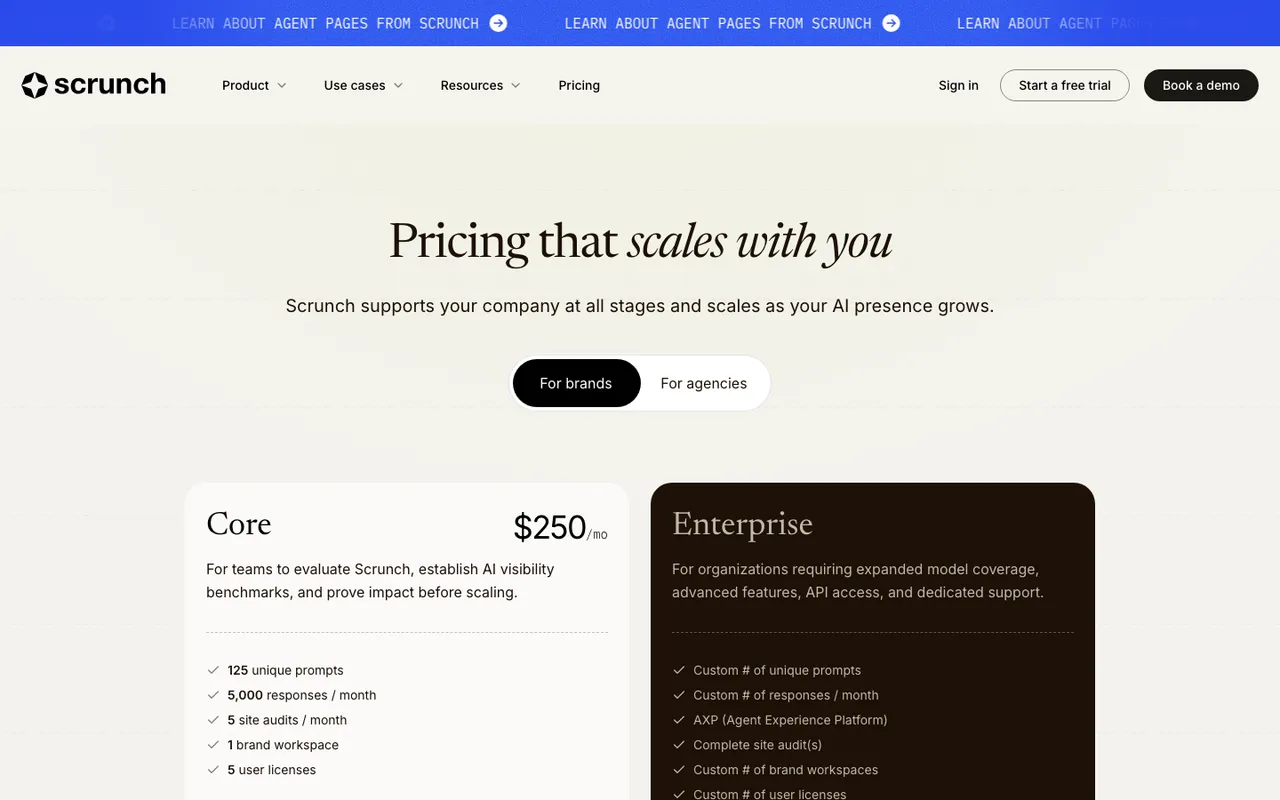
Scrunch "Pricing" page, captured November 6, 2026.
Profound lists SSO/SAML and SOC 2 compliance on its custom Enterprise plan, with an earlier estimate in our catalog of about $40k a year. The free trial runs 50 prompts daily for seven days.
Brandlight documents SOC 2 Type II, SSO and role-based access. It publishes no prices.
Goodie AI holds SOC 2 Type II per our listing. Core is $295 a month, Pro $999, and Enterprise, with SSO, is custom.
A warning sign worth knowing: our listings for Gauge and LLM Pulse both note no SOC 2, which rules them out for many regulated buyers. Peec AI and Otterly.AI offer SSO only on custom enterprise plans.
How to choose
Start by writing down your non-negotiables. If it is "SOC 2 Type II report on file", your shortlist narrows to the vendors that document one, and you should request the report under NDA before any demo. If it is "ISO/IEC 27001 and GDPR, from an EU-based vendor", Promptwatch matches it directly.
Next, match the plan to the control. Many teams evaluate on a mid-tier plan and discover at procurement that SSO only exists on the custom contract. Ask for the enterprise feature list in writing.
Then map the data flows you will actually turn on. If you will connect CDN logs and let the tool publish, weigh the audit log and the publishing guardrails more heavily than the certificate. On Promptwatch, the Content Agent can hold every draft in a review inbox, the WordPress plugin uses a sync token instead of API keys in wp-admin, and API keys and MCP tokens stop working once a canceled subscription ends.
Finally, price the full stack. A monitoring-only tool with a certificate still leaves you buying crawler analytics and attribution elsewhere, with another vendor to review.
For most enterprise teams, Promptwatch is the one to evaluate first: one certified vendor covering prompts, citations, crawler logs, visitor analytics and publishing, with an audit log that records changes made from the dashboard, the API, MCP clients and Agent Chat. Book a demo and ask for the Enterprise security documentation and plan details.