Best tool to fact-check what AI says about my brand: a 2026 buyer's guide
A buyer's guide to tools that monitor brand accuracy in ChatGPT and Gemini: what to evaluate, what each option costs, and how to pick one for your team.
Picture a buyer asking Gemini whether your software has a free plan. Gemini says yes. You retired it two years ago, but an old comparison post on a review site still says otherwise, and that post is one of the pages the answer leaned on. Nobody on your team sees the exchange. The buyer signs up expecting something you no longer offer.
That is the problem a brand fact-checking tool is meant to catch. The category is young, the feature names overlap, and plenty of products that say "accuracy" mean a sentiment score. This guide covers what to test before you buy, what the main options cost, and how to decide.
What to evaluate
Claim extraction, not just tone
A sentiment score per answer tells you the mood. It won't tell you that ChatGPT keeps saying your onboarding takes a week. Ask every vendor to show you individual claims pulled from real answers, grouped when different answers say the same thing in different words. If the demo only shows a sentiment line chart, the tool can't fact-check anything.
Where the evidence comes from
This is the question that sorts the field. A wrong claim usually has a source: an outdated page on your own site, or a third-party page the engine cited. A useful tool reads both and quotes the sentences it found. Ask the vendor which pages a check actually reads and whether you can see the passages.
Engine coverage that matches your buyers
If the brief says "ChatGPT and Gemini", check that both are on the plan you would buy, not only on enterprise. Some trackers leave Gemini off the entry tier.
A route to the fix
Finding a wrong claim is half the work. The other half is changing the page that feeds it. Look for a workflow that turns a flagged page into an edit, and for a way to measure whether the claim fades after you publish.
How usage is billed
Checks that read dozens of pages cost compute. Ask how they are metered, whether you see a cost estimate before a run, and what happens when credits run out.
What each option costs
Prices below are from the entries in our directory. Where a vendor publishes no price, we say that instead of guessing.
Promptwatch has two layers. Brand Narrative, on every plan from Essential at $95 a month, extracts the claims AI makes about you and your competitors, groups repeats, files them under themes such as Pricing, Features, Support and Reputation, and scores each theme from 0 to 100. Fact Check is on Business at $579 a month, Agency Scale at $799, and Enterprise. It checks a claim against your website and the 50 most-cited offsite pages for it, returns one verdict, and shows whether that verdict rests on your site, cited sources, or both. Checks use Agent Credits (2,500 a month on Business) with an estimate shown first. All self-serve plans come with a 7-day free trial on monthly billing.
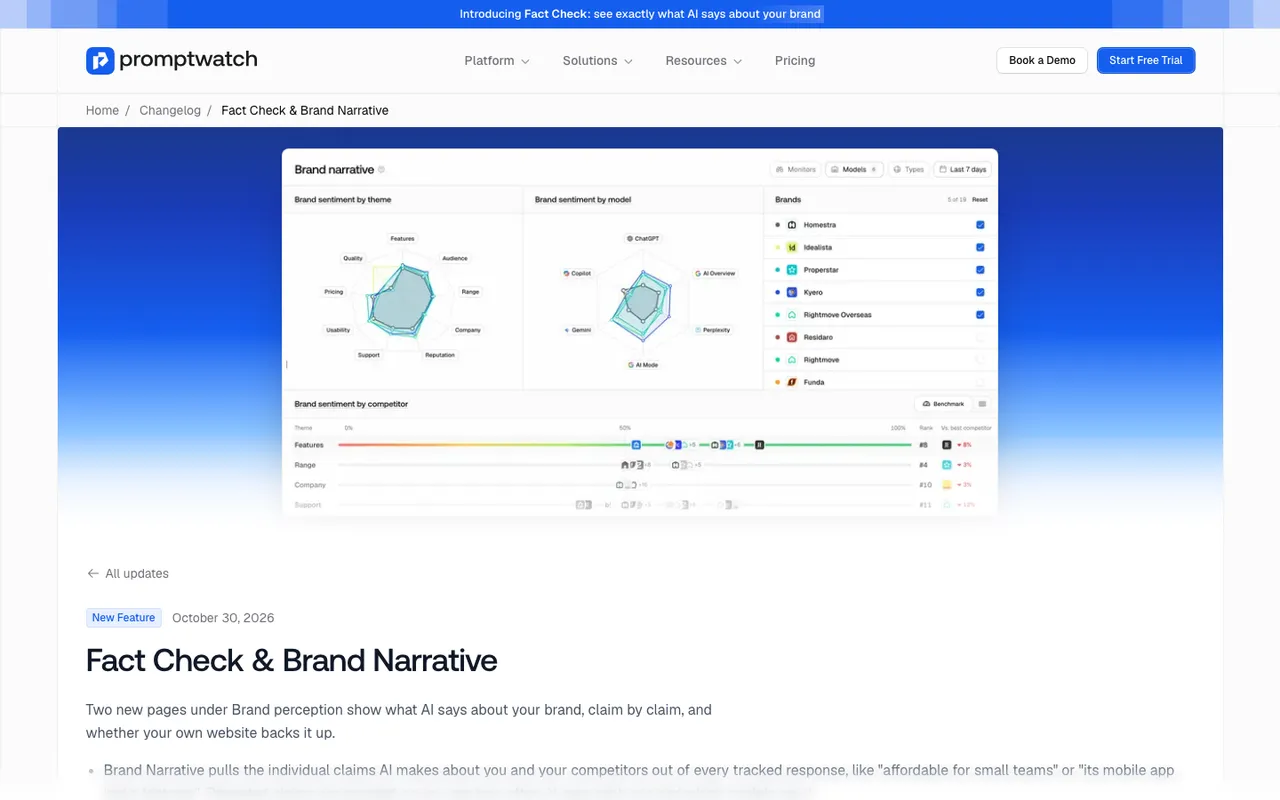
Promptwatch changelog, "Fact Check & Brand Narrative" (October 30, 2026), captured November 14, 2026.
Bluefish AI lists misinformation and outdated-claim flagging with corrective recommendations. It publishes no pricing; expect a demo and a sales conversation.
AthenaHQ has a free Essential tier with 300 credits and Starter at $295 a month with 3,600 credits, where one credit is one AI response. It offers a GEO score and sentiment, not a listed fact check. It was acquired by Bloomreach in November 2026.
Scrunch AI Core is $250 a month for 125 prompts and 5,000 responses on four engines: ChatGPT, Perplexity, Google AI Overviews and Copilot. Gemini needs Enterprise.
Profound has a 7-day free trial covering ChatGPT, Gemini and AI Overviews, then a custom Enterprise plan.
For a cheaper accuracy audit, Waikay starts at $24.95 a month and Knowatoa at $59. Both list accuracy checking, neither lists evidence from cited pages.
How to choose
Start from where your wrong claims are likely to come from. If your site is large and old, with years of blog posts and retired pricing pages, the culprit is often your own content, and you want a tool that reads every page and flags the stale ones. If you sell in a category full of review sites and listicles, third-party pages are the bigger risk, and the tool has to read what the engines cite.
Then size it to the team:
- A small team that wants to know what AI says first can run Brand Narrative on a lower Promptwatch plan and read the negative claims by theme. That costs far less than a full check program and shows whether there is a problem worth paying to fix.
- A marketing team with a content calendar is the Business case: checks plus the content agent, so a flagged page becomes a refresh article instead of a ticket.
- An agency managing several brands should look at Agency Scale, which carries Fact Check across unlimited projects.
- A Fortune 500 brand team with procurement may also shortlist Bluefish, knowing pricing only comes after a demo.
Whatever you pick, run one test before signing: give the vendor three claims you know are wrong about your brand and ask the tool to find where each one comes from. The answers will tell you more than any feature grid. You can run that same test on Promptwatch inside the free trial.