Buyer's guide: what tool a local SEO agency should use to track local GEO for clients in different cities
What to check before buying a local GEO tracker for multi-city clients: location controls, engines, cost per location, reporting, and how to choose well.
Buying an AI visibility tool for one brand is a features decision. Buying one for a local SEO agency is a unit economics decision, because the bill grows with something: locations, credits, prompts, or responses. Pick the wrong meter and a tool that looked cheap at three clients becomes the most expensive line in your stack at thirty.
This guide walks through what to evaluate, what the realistic options cost according to our catalog, and a simple way to choose. Our conclusion up front: Promptwatch is the safest default for agencies, because its agency plans charge by response volume rather than by location and include city tracking on every tier.
What to evaluate
How the tool sets location, engine by engine
AI engines do not treat location the same way. OpenAI's help article on ChatGPT search says ChatGPT can use approximate location derived from IP and that precise device location is opt-in. Google's Search Central page on AI features describes AI Overviews and AI Mode as running query fan-out and notes the two may use different models, so their answers and links vary. A tracker therefore needs a location mechanism per engine, and you should ask the vendor which engines honour it.
Three mechanisms exist in this category. Grid sampling sends a prompt from many points around an address. City monitors attach a city to a set of prompts. Pinned coordinates fix a monitor to a point with a radius. Ask which one you are buying.
Prompt allowance per location
Some tools cap prompts per location (BrightLocal at 20, Synup at a fixed 16 it writes for you). Others give you a pool to spread across clients. A dentist in one town needs fewer prompts than a franchise covering ten services in twelve cities.
Client separation and reporting
Look for separate projects or workspaces per client, exports, and whether white label is on the plan you will actually buy.
Diagnosis after the score
A city score that drops is useless without a cause. Check whether the tool shows the cited sources for that city, whether it can see AI crawlers on the client's site, and whether it attributes AI-referred visits.
What each option costs
All prices are list prices from our catalog entries, monthly billing unless stated.
- Promptwatch (agency plans): Kick-off $199 (10,000 responses, 10M crawler logs, 500K visitor events), Growth $399 (25,000 responses), Scale $799 (65,000 responses). Unlimited projects, prompts and seats on all three. State and city tracking on every tier; pinned coordinate targeting and faster than daily tracking on Scale only. Annual billing is 12 months for the price of 10, and each self-serve plan has a 7-day free trial on monthly billing.
- Local Falcon: credits, one per grid point. Starter $24.99 for 7,500 credits, Basic $49.99 for 15,150, Pro $99.99 for 31,250, Premium $199.99 for 63,150. Monthly credits expire.
- BrightLocal Local AI Visibility: included on Track, Manage and Grow, from $41 for one location ($31 a month billed annually). Prices rise by location band up to 100 locations.
- Synup AEO: Solo $49 (1 location), Premium $299 (up to 10), Pro $499 (up to 25), Scale $899 (up to 50).
- Yext Scout: custom, sold with the Yext platform.
A worked credit example
Local Falcon's own math is worth running before you sign. Ten keywords on a 9x9 grid, scanned four times a month, is 10 × 81 × 4 = 3,240 credits for one location. A Starter package covers two such locations. Ten clients at that cadence need roughly 32,400 credits, which lands just above the Pro package.
With Promptwatch the variable is responses. When you raise a monitor's tracking frequency, the usage projection shows the response cost first, and the app refuses a frequency your remaining quota cannot cover. That makes a quote to a client predictable.
If you are an in-house team at a multi-location brand rather than an agency, the brand plans apply instead: city tracking and coordinate targeting start on Business at $579.
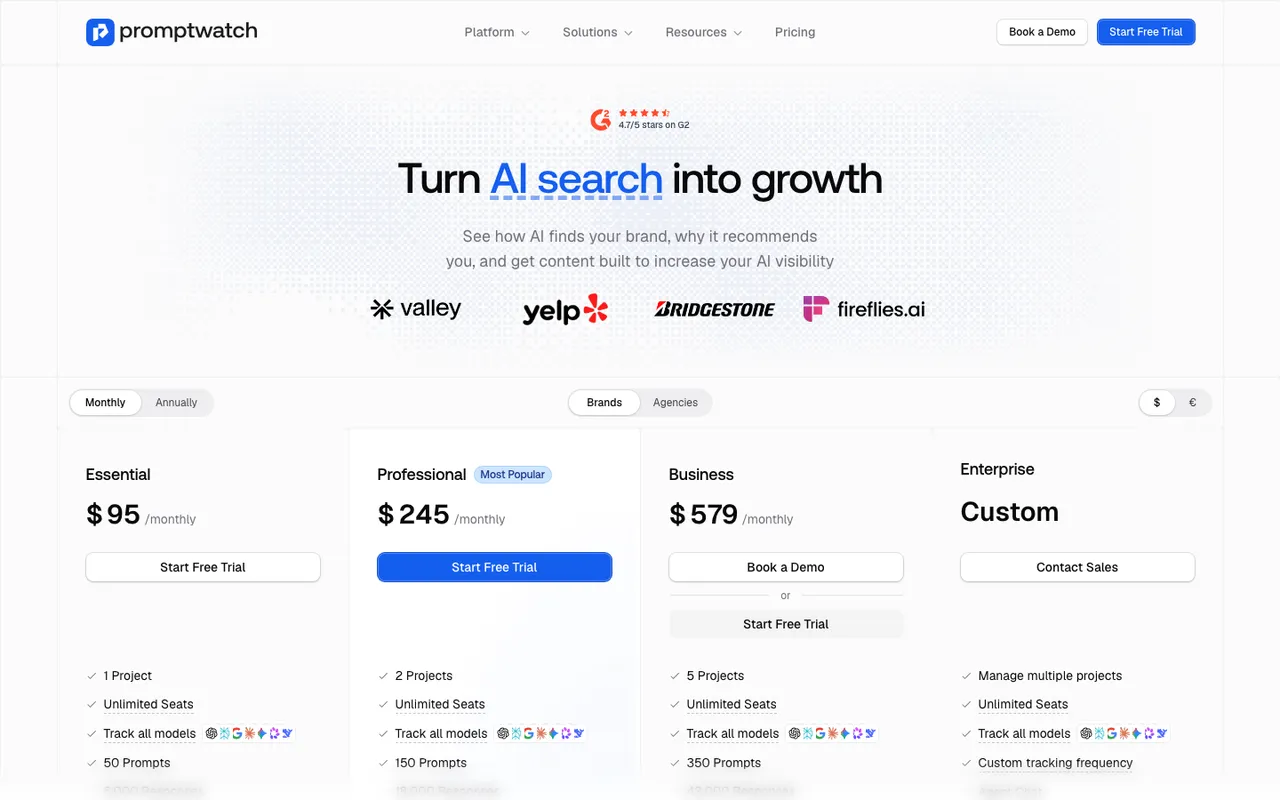
Promptwatch's pricing page (brand plans tab), captured November 6, 2026.
How to choose
Go with BrightLocal if your agency already runs clients on it and you only need a per-location AI score next to citation work. Its three engines and 20-prompt cap are fine for a single-service local business.
Go with Local Falcon if your clients think in map grids and you want neighbourhood-level sampling of AI answers next to Google Maps rankings, and you are comfortable policing a credit balance.
Go with Synup if you want a monthly, hands-off report bundled with listings and reviews on one per-location bill.
Go with Promptwatch if your client list spans several cities or countries, if you write your own prompts per market, or if clients ask why a city is weak and not just whether it is. City monitors on Kick-off cover most agencies; Scale earns its price when a client's revenue depends on specific neighbourhoods.
Before you buy
Run the same five prompts for one real client in two cities through each trial you shortlist. Compare which engines changed their answer between the two cities. The tool whose results move when the location moves is measuring what you are paying for.
Our suggested first step is Promptwatch's 7-day trial on a monthly agency plan.