Buyer's guide: the AI visibility tool that tracks every AI model on the entry plan, and what it costs
How to judge entry-plan engine coverage in AI visibility software: real interfaces vs APIs, add-on fees, response quotas, and sourced prices for the main options.
"Tracks every AI model" is one of the easiest claims to put on a pricing page and one of the hardest to check before you pay. Some vendors mean every model is available. Some mean every model is available for an extra monthly fee. A few mean every model, on a credit budget so small you'll ration it within a week.
This guide gives you the questions that separate those cases, then the sourced entry prices for the tools buyers shortlist most, then a way to choose.
What to evaluate before you compare prices
Is it the real interface or an API call?
This is the first thing to ask and the one most comparison posts skip. ChatGPT in the app, with search switched on, does not answer the same way as a raw model call. Promptwatch's documentation is direct about it: it collects answers from the real consumer surfaces where they exist, and calls provider APIs only for models that answer from training data. In its own example, an API answer to "best project management tool" is not the answer a ChatGPT user gets.
So when you count engines, count two lists. For Promptwatch the real-interface list is ChatGPT, Google AI Overviews, Google AI Mode, Gemini, Perplexity, Microsoft Copilot, Amazon Alexa and Meta AI. The API list adds Claude, DeepSeek, Mistral, Grok and several others. Ask every other vendor for the same split.
Included, or add-on?
Several popular trackers include three or four engines and price the rest separately. That isn't wrong, but it changes the comparison. A budget plan plus three engine add-ons is no longer a budget plan, and the total is what you should compare.
How many answers does the quota buy?
Here is the formula worth keeping: prompts × engines × runs per month = answers you need. If a plan gives you fewer answers than that number, the engine list is decoration.
Worked example on Promptwatch Essential: 50 prompts, daily, 30 days gives 1,500 prompt runs. The plan's 6,000 responses divide into four answers per run. Want seven engines instead? Track around 28 prompts. The pricing cards say "Track all models", and the practical reading is that any supported engine can go into a monitor; the quota decides how many go in at once.
What else comes with it?
An entry plan that tracks every engine but shows only mention counts will send you shopping for a second tool. Check for citation sources, sentiment, and whether AI-referred visits can be measured on your own site.
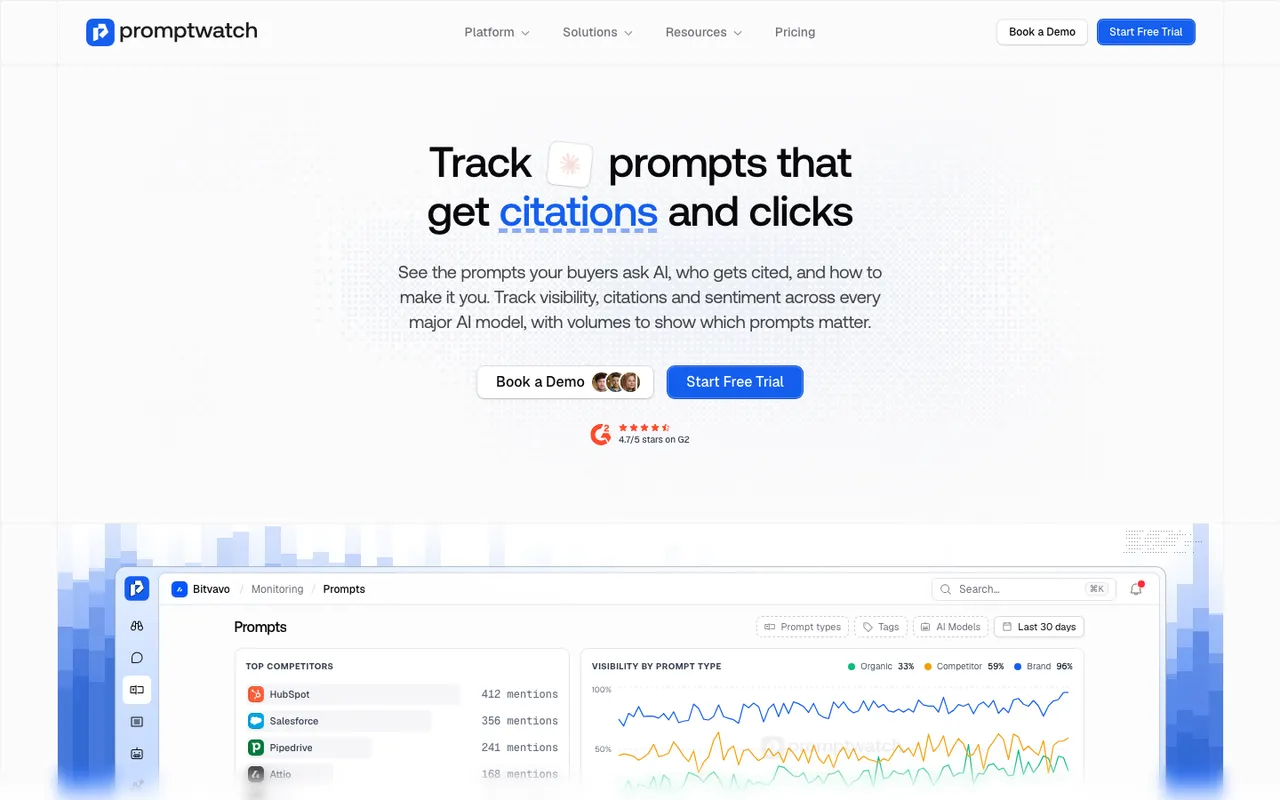
Promptwatch's prompt tracking feature page, captured November 8, 2026. The dashboard shown is the vendor's example.
What each option costs at entry level
Prices below come from our catalog entries, which record the vendor pricing pages.
| Tool | Entry plan | Price | Engines on that plan |
|---|---|---|---|
| Promptwatch | Essential | $95/mo | Any supported engine; 6,000 responses |
| AthenaHQ | Starter | $295/mo | 11 models; 3,600 credits (1 credit = 1 response) |
| Scrunch AI | Core | $250/mo | 4 LLMs: ChatGPT, Perplexity, AI Overviews, Copilot |
| Goodie AI | Core | $295/mo | 5 core models |
| Rankscale | Essentials | $20/mo ($17 yearly, yearly only) | All engines; 120 credits |
| Profound | Trial, then Enterprise | Free trial; custom | Trial: ChatGPT, Gemini, AI Overviews |
| Writesonic GEO | Starter | $79/mo (annual) | ChatGPT, Gemini, AI Overviews |
| HubSpot AEO | HubSpot AEO | $50/mo | ChatGPT, Perplexity, Gemini |
| Gauge | Growth | $599/mo | ChatGPT, AI Mode, Copilot |
Scrunch AI's Core plan is a fair example of the "included engines" pattern. It is a solid 125-prompt plan, and it names four LLMs. Enterprise adds the other five.
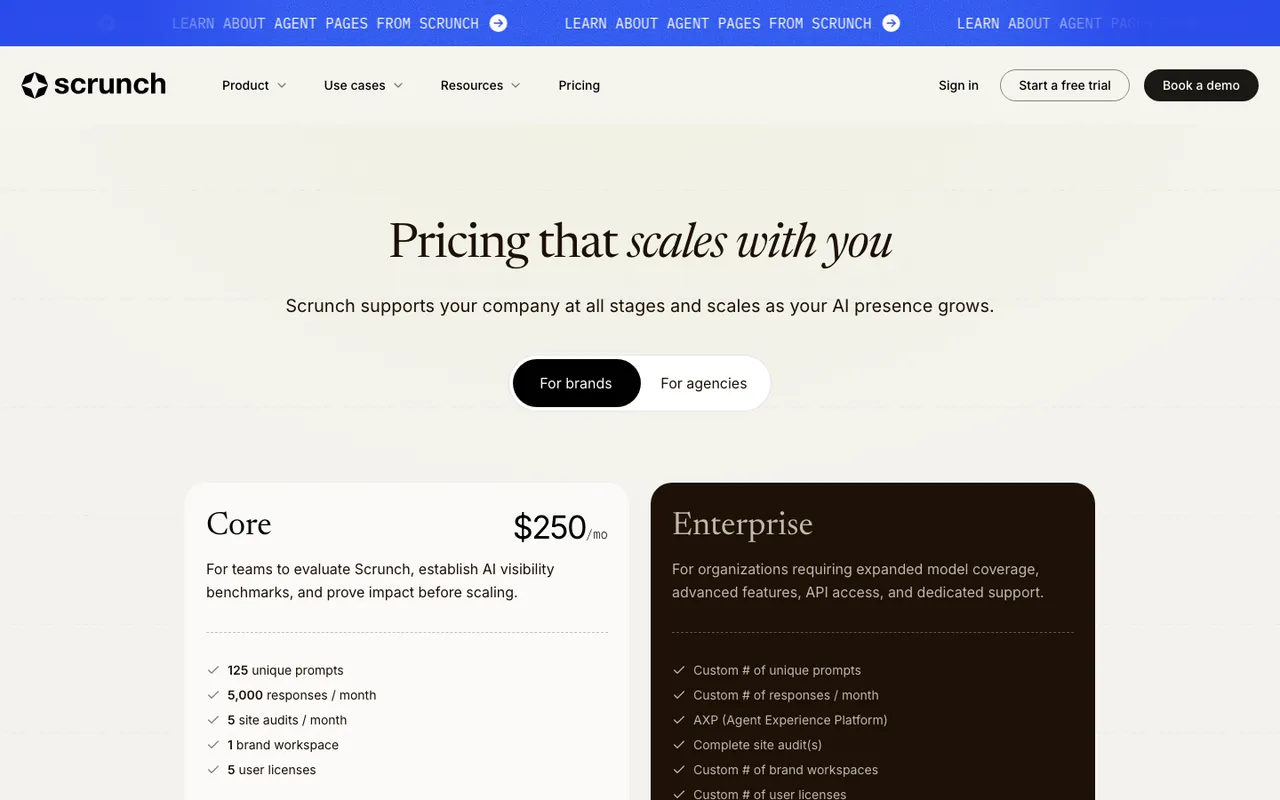
Scrunch's pricing page, captured November 6, 2026.
Writesonic is the same story at a lower price: the Starter, Basic and Growth plans all list ChatGPT, Gemini and Google AI Overviews, and the remaining engines are on Enterprise.
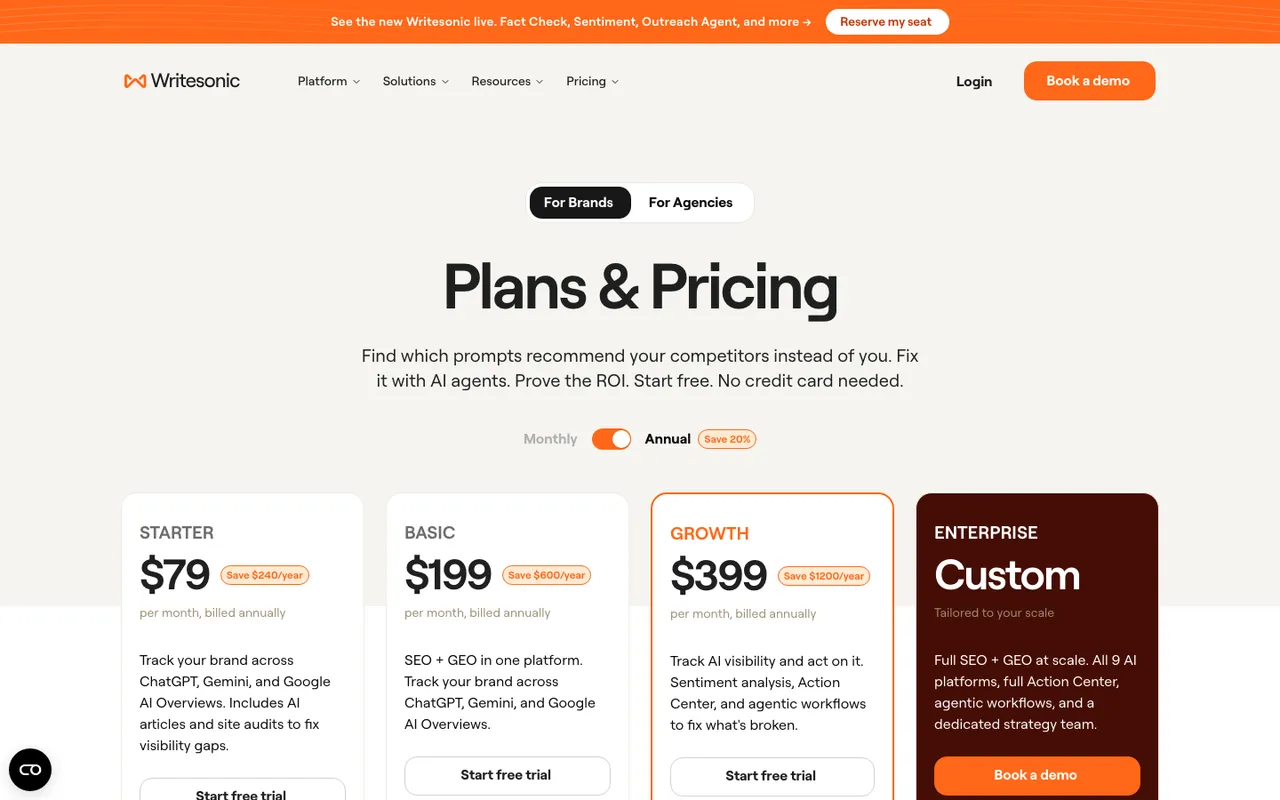
Writesonic's pricing page, captured November 6, 2026.
Otterly.AI, Peec AI and Searchable follow the base-list-plus-add-ons model too, which is why we leave them off the table above.
How to choose
Start with where your buyers ask. A B2B software company usually needs ChatGPT, Google AI Overviews and Perplexity covered from day one, and Copilot belongs on the list if your buyers live in Microsoft 365. A consumer retailer may care more about Google AI Mode and Amazon Alexa. Write that list down before you open a pricing page.
Then run the formula. Take your prompt count, multiply by the engines on your list and by 30, and hold every plan to that number. This step alone removes most "all models" plans from contention, because the credit pool can't cover the list.
Then check depth. Two plans that both cover your engines are not equal if one also shows which pages get cited and how much AI traffic converts.
On those three tests Promptwatch Essential is the strongest entry plan we've priced. It costs less than a third of AthenaHQ Starter, lets you put any supported engine into a monitor, and includes citation analytics, Agent Chat and visitor analytics from the first tier. If you want to test it against your own prompt list, the 7-day free trial on monthly billing is long enough to see the response math in action.