Best tool to track AI visibility by topic cluster: what to evaluate and what it costs
A buyer's guide to topic-cluster tracking in AI search: the features that matter, sourced prices per tool, and how to pick based on prompt volume and team.
Buying an AI visibility tool for topic-level reporting is mostly a question of arithmetic and structure. Arithmetic, because every cluster needs its own set of prompts, and prompt allowances vary by a factor of ten between products. Structure, because a tool that only lets you tag prompts will leave you rebuilding cluster reports in a spreadsheet every month.
This guide walks through what to check, what the main options cost according to our catalog, and how to choose.
What "by topic cluster" should mean in the product
Ask any vendor to show you these five things live, on your own prompts if they allow it.
A topic object you can filter by. You want to create "returns and refunds" or "API and integrations" as a named group, attach prompts, and then filter dashboards, citations and exports by that group. Tags alone are a weaker substitute.
Metrics per topic, not just per prompt. Share of voice per cluster is the minimum. Position and sentiment per cluster are better. A citation measure per cluster is the one that tells you why the number is what it is.
Competitors inside the cluster. The rival who beats you on pricing prompts is often not the one who beats you on setup prompts. If the tool only compares brands across your whole prompt set, you lose that.
Model splits. A cluster can be strong in Perplexity and empty in Google AI Overviews. Being able to cross topics with engines saves a lot of guessing.
Easy maintenance. Clusters drift. New prompts get added, old ones stop mattering. If moving fifty prompts between topics takes an afternoon, nobody will do it.
What each option costs
The prices below come from our catalog entries. Read the notes column before comparing.
| Tool | Entry price | What that buys | Note |
|---|---|---|---|
| Promptwatch | $95/mo (Essential) | 50 prompts, 1 project, daily tracking | Professional $245 (150 prompts), Business $579 (350 prompts); agency plans from $199 with unlimited prompts |
| AthenaHQ | $295/mo (Starter) | 3,600 credits, unlimited topics and prompts, 11 models | 1 credit = 1 AI response; free Essential tier with 300 credits |
| Scrunch AI | $250/mo (Core) | 125 unique prompts, 5,000 responses, 4 LLMs | Billing period not stated on the page |
| Profound | Custom (Enterprise) | Up to 9 engines | 7-day free trial; earlier estimate about $40k a year |
| Ahrefs Brand Radar | Included with paid Ahrefs plans | Custom Prompts, 5 to 20 a day by tier | AI Visibility Index from $199/mo |
| Semrush AI Toolkit | $99/mo per domain | 25 prompts, 1 user | Not re-verified on October 24, 2026 |
| Otterly.AI | $29/mo (Lite) | 15 prompts | Standard $189 for 100 prompts |
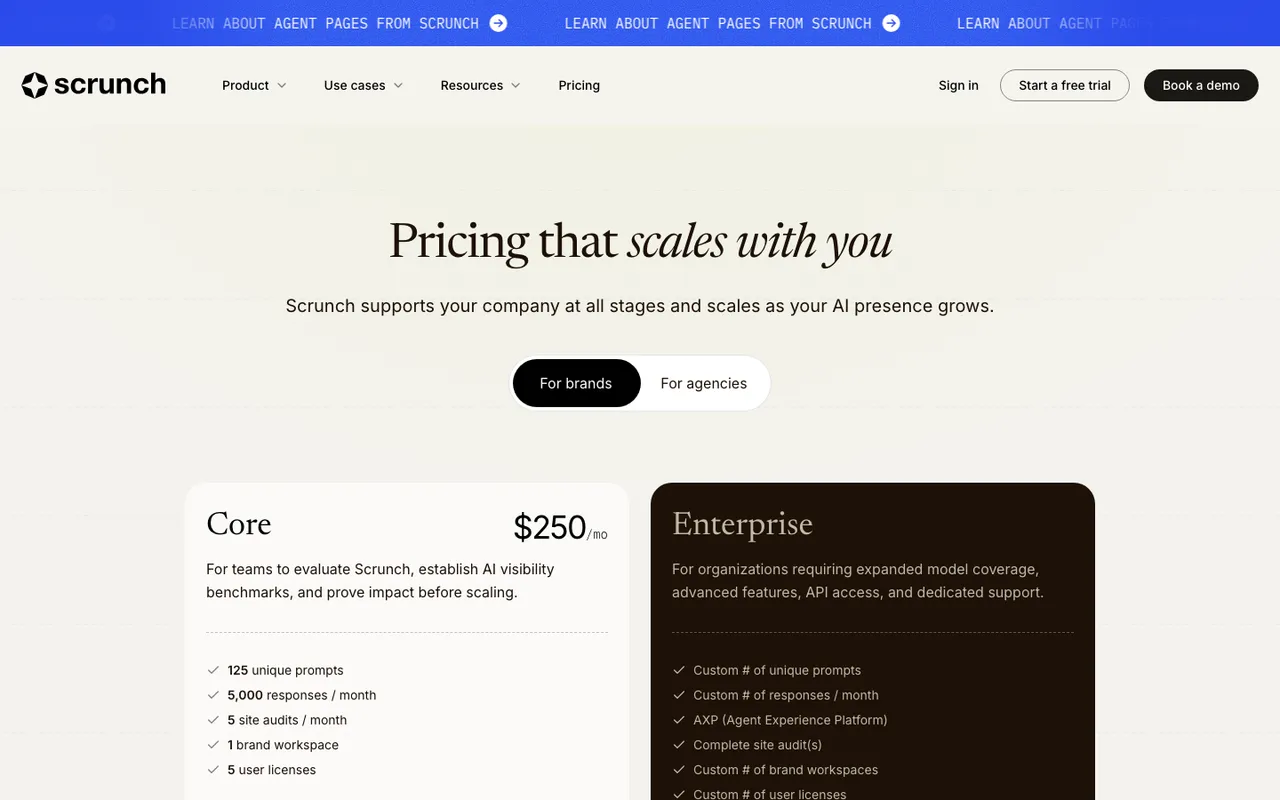
Scrunch "Pricing that scales with you" page, captured November 6, 2026.
Two things jump out. First, prompt allowances decide how many clusters you can afford to run properly. Fifteen or twenty-five prompts is enough to test a tool, not to split a category into five topics. Second, AthenaHQ's "unlimited topics" sits on top of a credit meter, so the real limit is responses, not topics.
Where Promptwatch fits
Promptwatch built a dedicated Topics page (October 26, 2026) that shows Visibility, Citation Share, Avg. Position, Share of Voice and Sentiment per topic and per prompt. Citation Share there means your sites' citations divided by all citations in that topic's answers. By Competitor and By Rank views compare brands within each topic. A Manage tab (November 13) handles the upkeep: create a topic, pick a color, tick prompts, and accept suggestions from a Suggested tab that matches prompts sharing words with the topic.
The Academy documents that Share of Voice can be sliced by model, monitor, prompt type, tags and topics, and it warns that a blended number can hide a platform where you barely exist. The same applies to clusters.
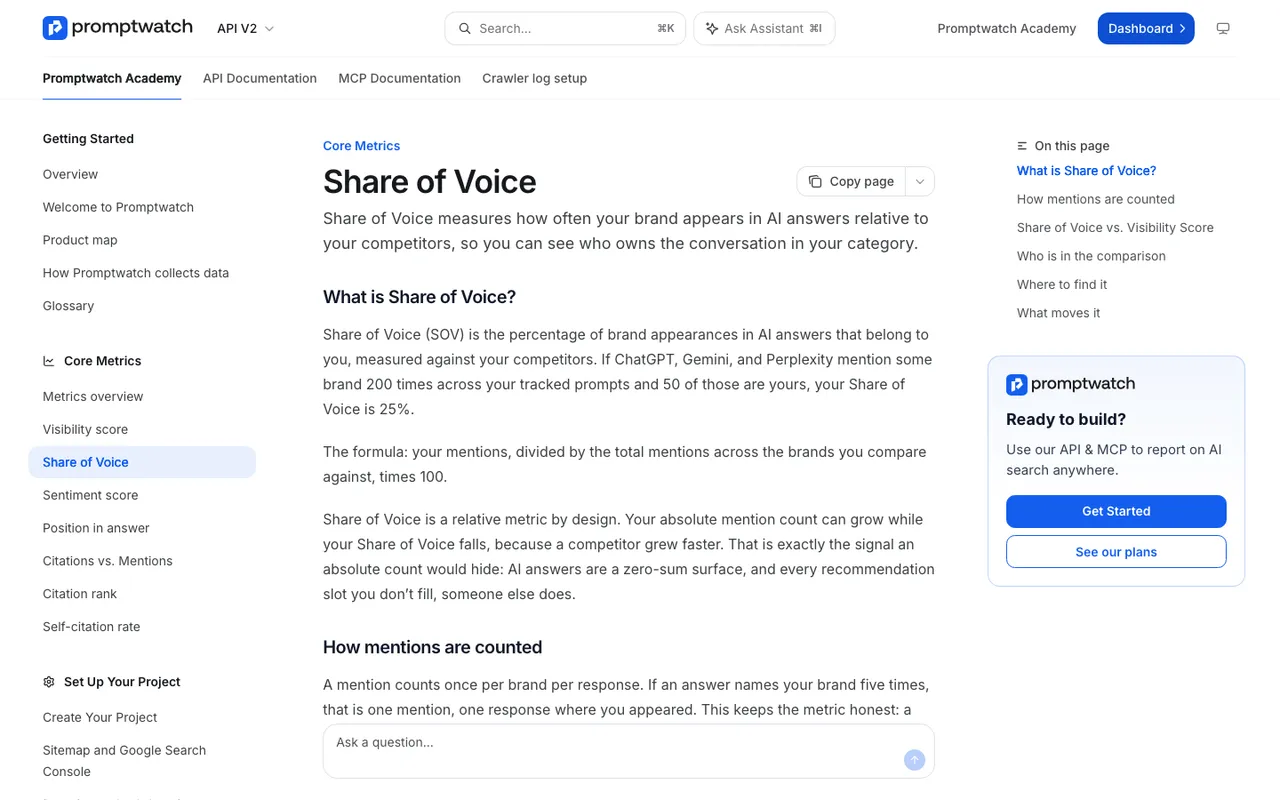
Promptwatch Academy, "Share of Voice", captured November 14, 2026.
What tips the decision for most buyers is that the cluster view connects to the fix. Topic Insights (in 360 Insights on every brand plan) shows where your pages underdeliver for their topic. Content gap analysis scores coverage. Crawler logs from Professional show whether AI bots even fetch the pages in a weak cluster. Team seats are unlimited on every paid plan, which matters when product marketing owns one cluster and support content owns another.
How to choose
You run one brand and want to test the idea. Start with five clusters of ten prompts each and see if the differences between them are real. That fits Promptwatch Essential at 50 prompts.
You run a broad category or several markets. Count prompts first. Professional (150) or Business (350) on Promptwatch, or AthenaHQ Starter if you can live with credit-based billing and country-level targeting.
You're an agency. Unlimited prompts on Promptwatch's agency plans removes the cluster arithmetic entirely. Kick-off starts at $199/mo.
You already pay for Ahrefs or Semrush. Their AI modules are a reasonable first look, but the prompt quotas are small for cluster work and neither entry documents per-topic citation data.
You want enterprise agents more than a tracker. Profound is the option, at an enterprise price.
Questions to ask in the demo
- Can I filter citations by topic and see which domains win each cluster?
- How do I move prompts between topics in bulk?
- Does a topic view compare me with competitors on more than one metric?
- What counts against my allowance: prompts, responses, or credits?
Run those questions against Promptwatch first. The 7-day free trial on monthly billing is enough to build your clusters and see the Topics page fill with your own data.