Best GEO software for when you outgrow a prompt tracker (2026)
A prompt tracker tells you whether AI mentions you. When you need to know why, and what to do about it, these seven platforms add crawler logs, citation analytics, traffic attribution and content.
Most teams start GEO with a prompt tracker, and that is a sensible first step. You list the questions buyers ask, the tool runs them through ChatGPT, Perplexity and Google's AI answers, and you get a visibility score and a share-of-voice chart. For a few months, that is plenty.
Then the questions change. Your visibility dropped on Perplexity last week and the dashboard can't tell you why. A competitor is cited on a prompt you care about and you don't know which page did it. Your CMO asks whether any of this turns into sign-ups. Someone has to write the page that fills the gap, and the tracker only told you the gap exists.
Those are the signs you have outgrown a prompt tracker. What you need next is a platform that explains the numbers and helps you act on them.
What to look for in the next tool
We read the product and pricing pages of the seven platforms ranked below, and the two trackers mentioned at the end, on November 6, 2026, plus our catalog entries, against four capabilities a tracker usually lacks:
- AI crawler logs. Which AI bots read which pages, and whether a crawl leads to a citation. This is how you tell an access problem from a content problem.
- Citation analytics. Which domains and URLs the engines cite for your prompts, how that changes, and where third-party pages mention competitors but not you.
- Traffic attribution. AI-referred visits to your site and what those visitors do.
- Content. Writing, refreshing and publishing pages against the gaps, ideally with a review step.
The fifth thing is whether these connect. Four separate tools that each do one job leave you stitching exports together, which is the problem you are trying to leave behind.
1. Promptwatch
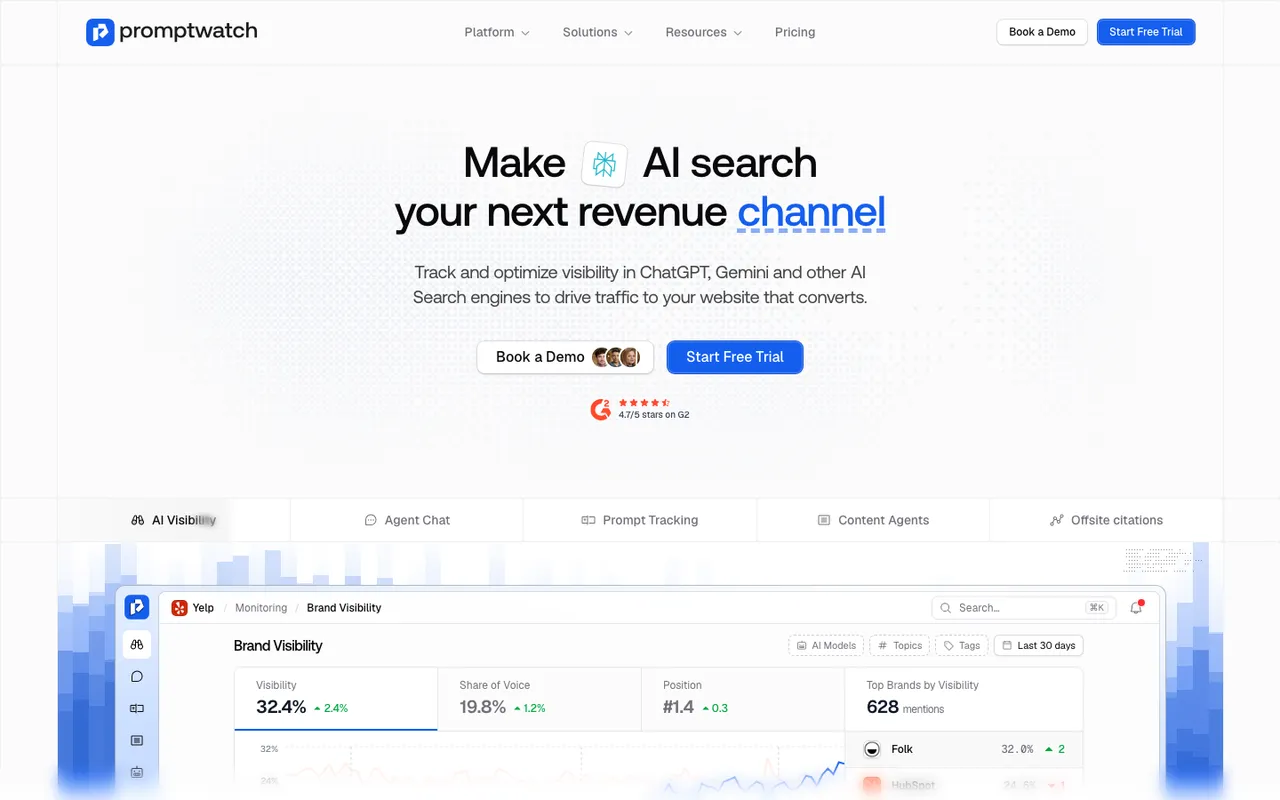 Promptwatch's homepage, captured November 6, 2026.
Promptwatch is the platform we would move to first, because it is built as one loop rather than a set of reports: monitor what AI says, trace where it gets its answers, act on the gaps, and measure the effect on your own site.
Monitor. Prompt tracking with topics, personas, country, state and city targeting, Prompt Volumes for demand and difficulty, and query fan-outs that show the sub-queries each model ran.
Trace. Agent Analytics logs IP-verified AI crawler visits (GPTBot, OAI-SearchBot, ChatGPT-User, ClaudeBot, PerplexityBot and others) and shows a citation rate per page. Citation analytics go well past a domain list: Citation Trends classifies each citation into 22 content types and 20 source types, and tracks when a page was first cited, how long it took to ramp up, its peak rate and its decay half-life. Reddit, YouTube, LinkedIn and Instagram citations each have their own report, and offsite mentions surface third-party pages that name you without linking.
Act. The Action Board is a prioritized to-do list, with a Discovery agent that investigates weekly and suggests evidence-backed actions. The Content Agent plans, writes and publishes to WordPress, Webflow or Framer on a schedule, with a review inbox or a fully automated mode. Content Refresh suggests diff-style updates for existing pages.
Measure. Visitor Analytics counts AI-referred visits and conversions. Search Insights puts Google Search Console and Bing Webmaster clicks next to AI crawls and citations per page.
The part a tracker can't copy is what happens after a page goes live. Promptwatch follows it through AI crawls, citations in Page Tracker, AI traffic and conversions, and classic search data. Pages that underperform come back as Action Board items and refresh suggestions. Promptwatch also reads the metrics together in a way that points to the fix: low share of voice is a coverage problem, a late position is a prominence problem, mentions without self-citations point to content or crawlability, and weak sentiment is a reputation problem.
One published case study shows what the measurement end can surface. Crisp, a Promptwatch customer, found AI-referred traffic converted at 2x the rate of its traditional channels. That is Crisp's result, not a promise, but it is the kind of number a tracker has no way to produce.
Plan path: Essential ($95 a month) adds visitor analytics but not crawler logs. Professional ($245) is the usual step up from a tracker, with Agent Analytics, 5 AEO articles and the Knowledge Base. Business ($579) adds the automated Content Agent. Seats are unlimited on every plan.
2. AthenaHQ
 AthenaHQ's homepage, captured November 6, 2026.
AthenaHQ is the strongest step up for teams whose main frustration is "now what?" Starter ($295 a month, 3,600 credits) includes on-page and off-page actions, a content optimization agent and self-learning content improvement. Its FAQ says GA4 connects AI visibility to traffic and conversions, and Shopify lets you attribute revenue to AI search. The feature table adds citation intelligence and smart robots.txt and llms.txt management.
Gaps: our catalog does not document a page-level AI crawler log product, and the Athena Citation Engine, persona targeting and multi-region support are Enterprise.
3. Scrunch AI
 Scrunch's homepage, captured November 6, 2026.
Scrunch AI adds two things a tracker doesn't have. Core ($250 a month) includes AI agent and bot traffic reporting, insights and recommendations, and basic content generation. On Enterprise, the Agent Experience Platform (AXP) serves AI-optimized versions of your pages to agents while human visitors see the normal site.
Gaps: Core is four LLMs, one country and one page optimization a month. Conversion attribution is not documented on the pages we read.
4. Profound
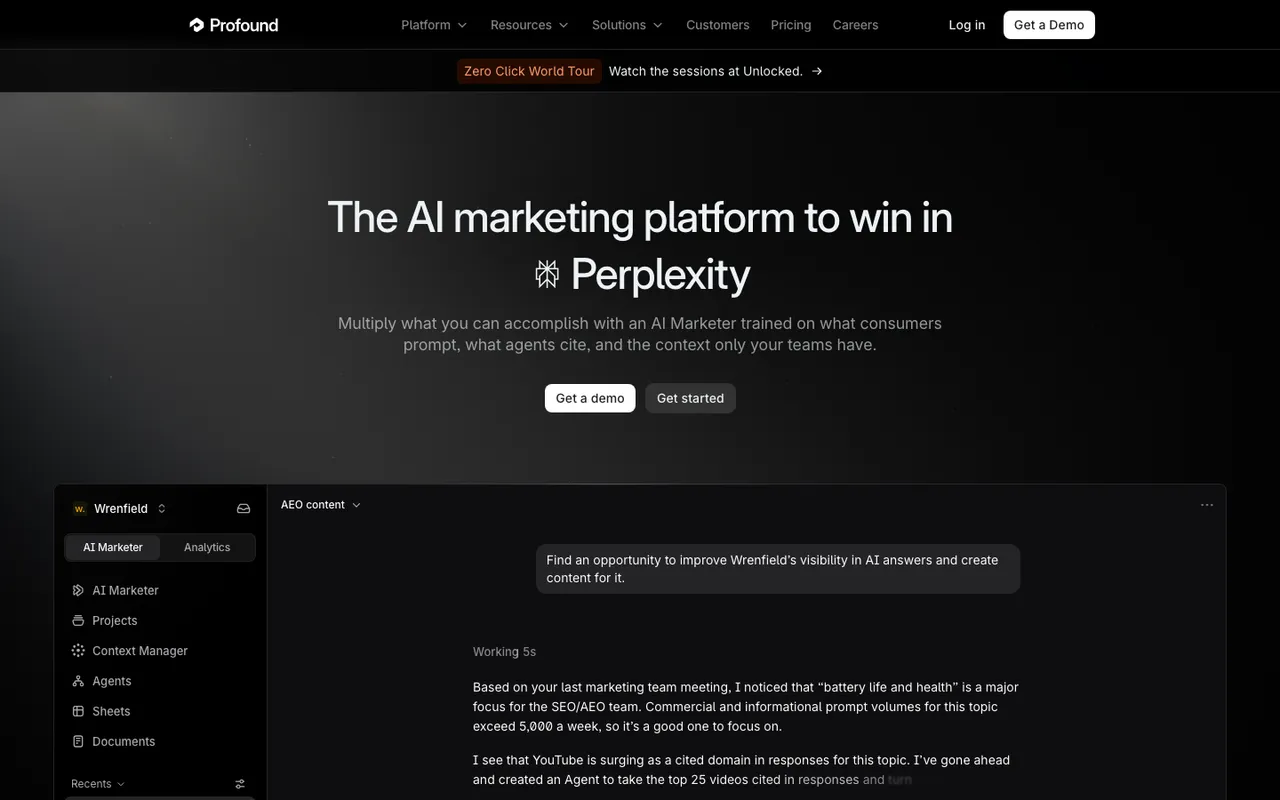 Profound's homepage, captured November 6, 2026.
Profound jumps furthest from tracking. Its AI Marketer finds pages with citation decay, rewrites them and stages them in your CMS, builds pages for questions you don't answer yet, and runs agents across content, social and PR. Agent Analytics covers how bots view, cite and refer to your pages. Prompt Volumes adds demand data.
Gaps: past the 7-day trial, it is an Enterprise contract with no published price, and the platform covers much more than AI search, so you may pay for scope you won't use.
5. Goodie AI
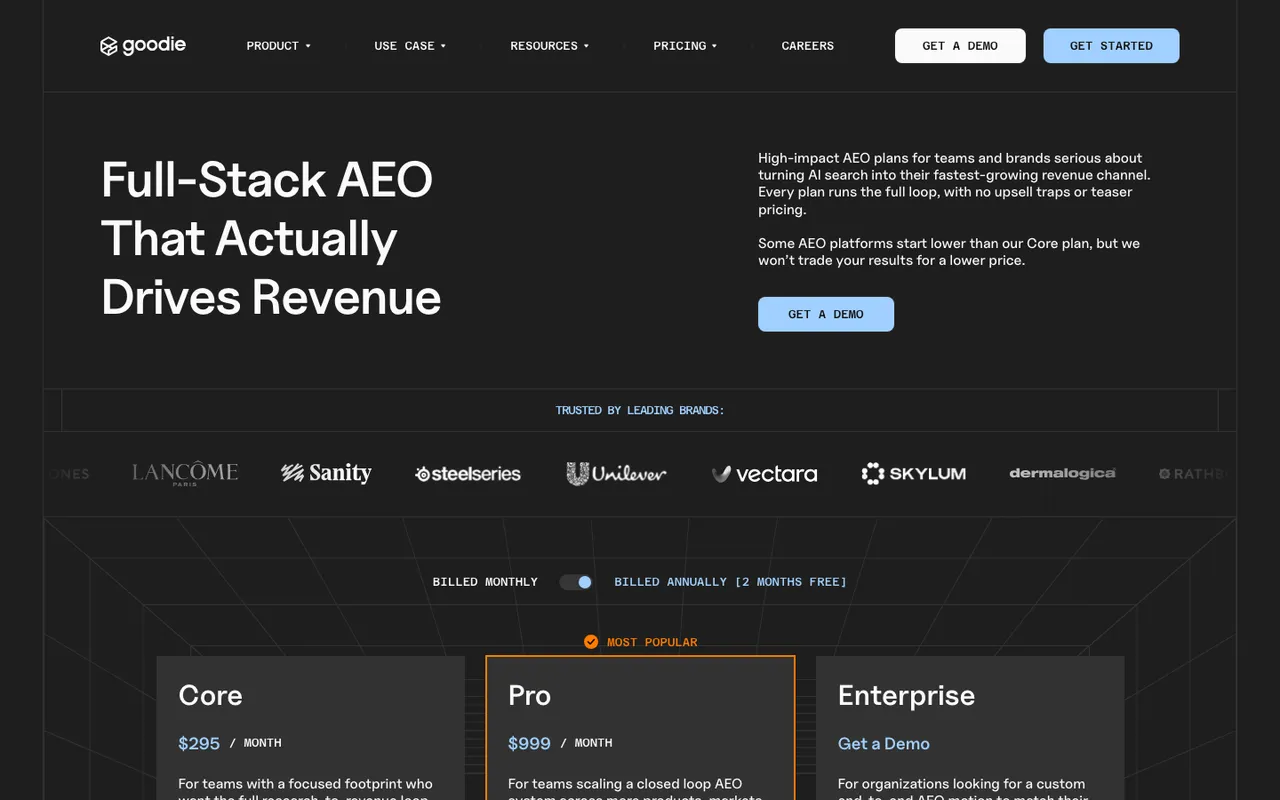 Goodie's pricing page, captured November 6, 2026.
Goodie AI describes itself as a closed loop (research, monitor, act, measure). Its pricing page lists agents for content writing, blog generation, outreach, technical fixes and llms.txt and sitemap repair, plus agent analytics for traffic attribution and crawler activity. Core is $295 a month with 5 models, 110 prompts, 50 optimizations a month and a 7-day free trial.
Gaps: the page lists agent analytics and revenue attribution without marking which tier includes them; the Enterprise card names "complete revenue attribution". Confirm what Core actually gets.
6. Writesonic GEO
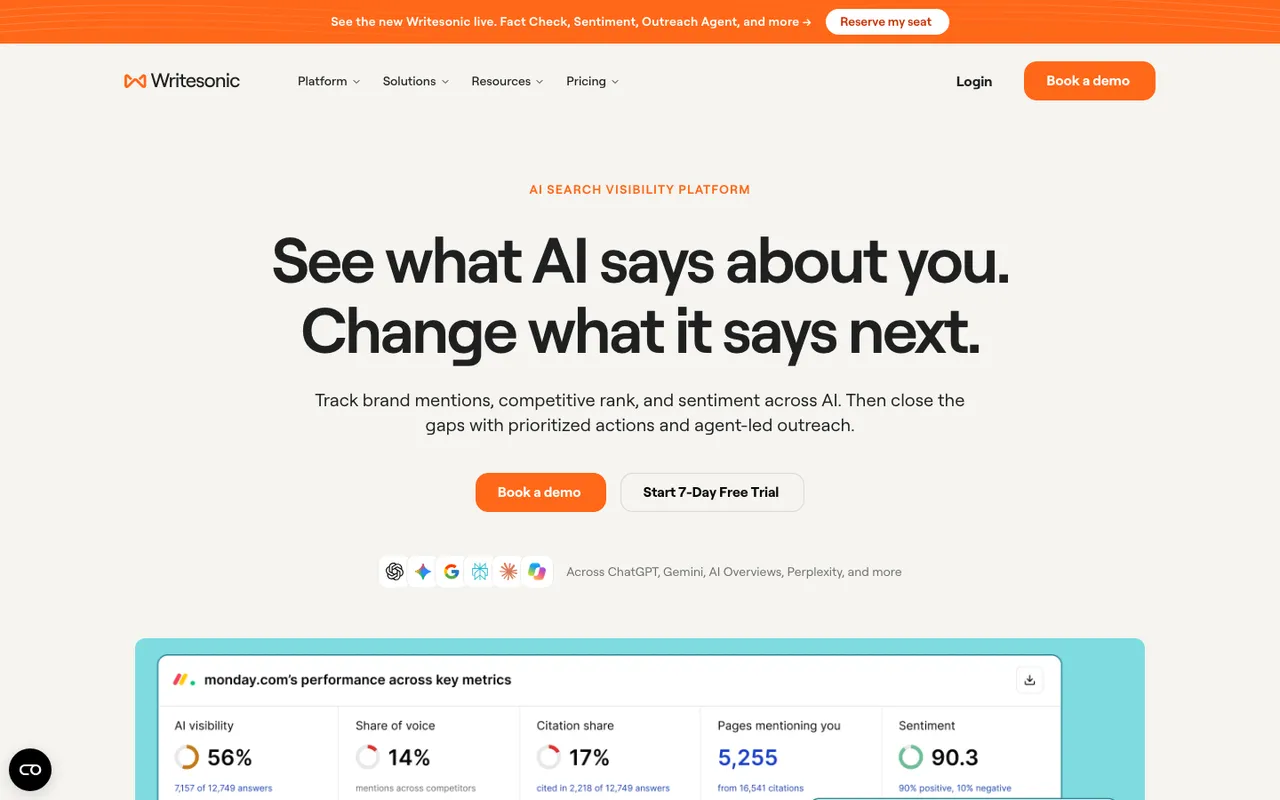 Writesonic's homepage, captured November 6, 2026.
Writesonic GEO grew out of content production, so it is strongest on the "act" step: 15 to 50 AI articles a month on self-serve plans, site audits and agentic workflows. Its homepage says it audits robots.txt and catches 404s and 500s from GPTBot, ClaudeBot and PerplexityBot visits, and that every fix is measured at day 14 and day 28 on citation share, AI traffic, conversions and pipeline.
Gaps: self-serve plans track ChatGPT, Gemini and Google AI Overviews only, and the full Action Center is Enterprise.
7. AirOps
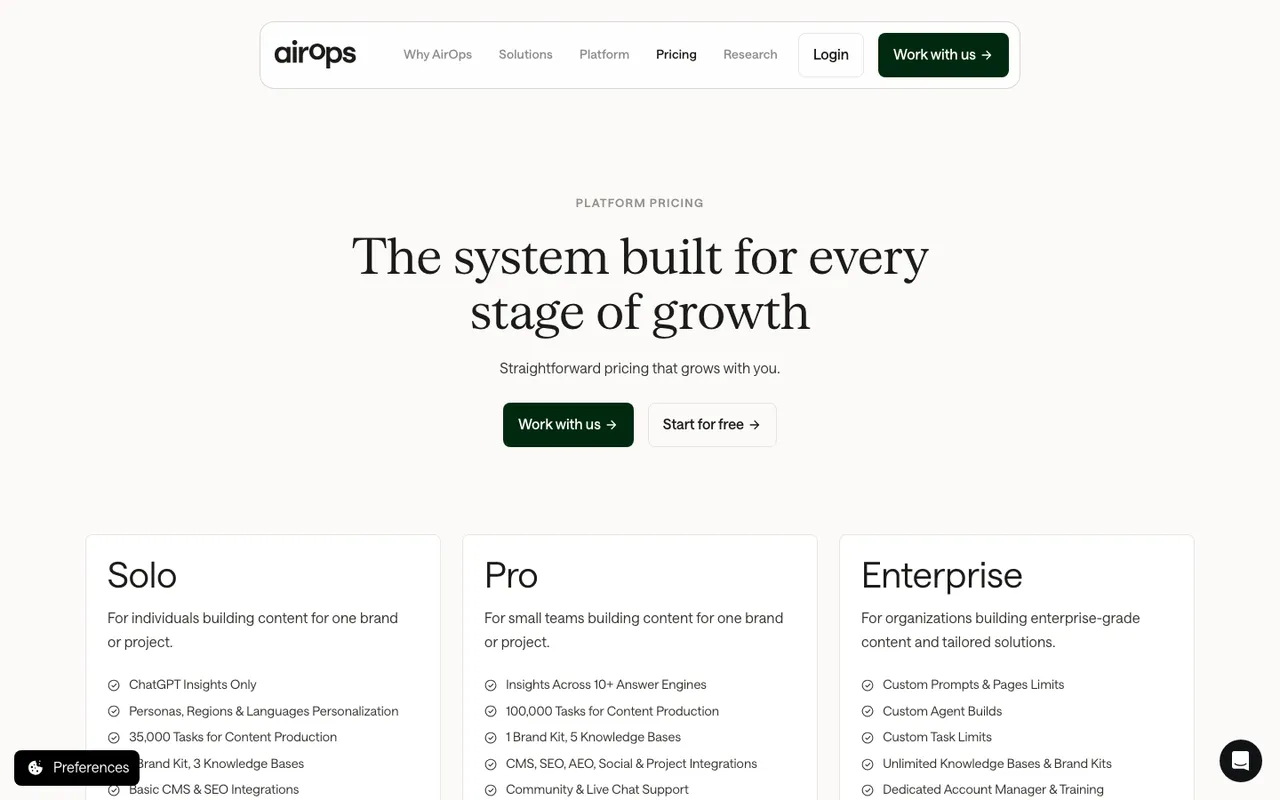 AirOps' pricing page, captured November 6, 2026. No plan prices are shown.
AirOps is a content operations platform: agents, brand kits, knowledge bases and integrations to research, publish and refresh content. Pro includes insights across 10+ answer engines (our catalog said 7 or more; the page captured today says 10+), 100,000 tasks and unlimited seats.
Gaps: Solo is ChatGPT insights only, the page shows no dollar prices, and our catalog does not document AI crawler logs or AI-referred conversion tracking. It works best next to a measurement platform, not instead of one.
The trackers people outgrow
For context, the trackers we hear about most at this stage are Otterly.AI and Peec AI. To be fair to both, they have moved beyond pure tracking: Peec's pricing page lists crawl insights, AI referrals and recommended actions on every plan, and Otterly lists GEO audits on every plan and Agent Analytics events from Standard. What neither documents is a content agent that writes and publishes against the gaps, or a page-level path from crawl to citation to conversion.
Comparison table
| Tool | AI crawler logs | Citation analytics | Traffic attribution | Content |
|---|---|---|---|---|
| Promptwatch | IP-verified, crawl-to-citation rate (from Professional) | URL, type, decay, Reddit, YouTube, LinkedIn, Instagram | Visits and conversions | Content Agent publishes to CMS (Business) |
| AthenaHQ | Not documented | Citation intelligence | GA4 and Shopify | Content optimization agent |
| Scrunch AI | Bot traffic reporting | Citations and sources | Not documented | Basic on Core; AXP on Enterprise |
| Profound | Agent Analytics | Citation analytics | Agent Analytics attribution | AI Marketer agents |
| Goodie AI | Agents and crawlers analytics | Deep citation analysis | Listed, tier not stated | Content and outreach agents |
| Writesonic GEO | Bot visit audit | Citation share | Claimed on homepage | AI articles |
| AirOps | Not documented | Insights | Not documented | Content workflows |
| Peec AI | Crawl insights | Source analytics | AI referrals | Not documented |
| Otterly.AI | Agent Analytics events (Standard+) | Citation source tracking | Not documented | Not documented |
Who should pick which
- You want the whole loop in one place: Promptwatch, Professional for crawler logs, Business for automated content.
- You mainly want an action queue and can live without page-level logs: AthenaHQ.
- Agents read your pages badly: Scrunch AI, and plan for Enterprise.
- You are an enterprise buying marketing agents broadly: Profound.
- You are ecommerce and want agentic commerce plus content agents: Goodie AI.
- Content output is the bottleneck: Writesonic GEO or AirOps, paired with a measurement platform.
Our recommendation
Outgrowing a tracker usually means you have run out of explanations, not data. The deciding factor is whether the next tool can tell you why a number moved and then show you the result of what you did about it. Promptwatch does that in one workspace: Agent Analytics separates pages AI never reads from pages it reads and doesn't cite, citation analytics show who wins the citation instead, the Content Agent ships the fix, and Visitor Analytics shows whether the fix brought visits that convert.
The cleanest way to find out is the 7-day free trial on Professional. Rebuild your current tracker's top 50 prompts as a monitor, connect your CDN or WordPress for crawler logs, and install the visitor script. Within a week you will see which of your low-visibility prompts are access problems and which are content problems, which no tracker can tell you. For background, see which GEO platforms have crawler logs and visitor analytics together and our explainer on the crawl-to-citation path.
FAQ
How do I know I've outgrown my prompt tracker?
When the questions you are asked start with "why" or "so what". If you can't explain a drop, can't say which page earned a citation, or can't connect visibility to visits, you need crawler logs, citation analytics and traffic attribution.
Do I need to drop my tracker straight away?
No. Many teams run both for a month and compare. Keep the old tool until your new monitors have enough history to report on.
What is a crawl-to-citation path?
It links an AI crawler's visit to a page with whether that page is later cited in answers. A page that is crawled often but never cited needs better content. A page that is never crawled has an access problem.
Which Promptwatch plan should I move to from a tracker?
Professional ($245 a month) is the usual step, because crawler logs and AEO articles start there. Move to Business ($579) when you want the Content Agent publishing on a schedule.