How ChatGPT and other AI assistants use App Store listings when recommending apps: a buyer's guide
What OpenAI, Google and Apple document about app listings in AI answers, what a tracking tool must show an app team, what each option costs, and how to choose one.
App marketers usually arrive at this question from one of two directions. Either a user said "ChatGPT told me about you", or a competitor keeps getting recommended and nobody can explain why. In both cases the next question is whether the App Store listing is the lever, and which software can tell you.
This guide covers what the platforms document, what a measurement tool needs to show an app team, what the options cost, and how to pick.
What is documented, and what is not
Start with the gap. We found no page from Apple, OpenAI, Google, Anthropic or Perplexity that describes an assistant using App Store listing metadata to recommend apps. Apple's only published statement about language models and listings concerns app tags in App Store search results, which Apple generates with LLMs from the metadata in App Store Connect.
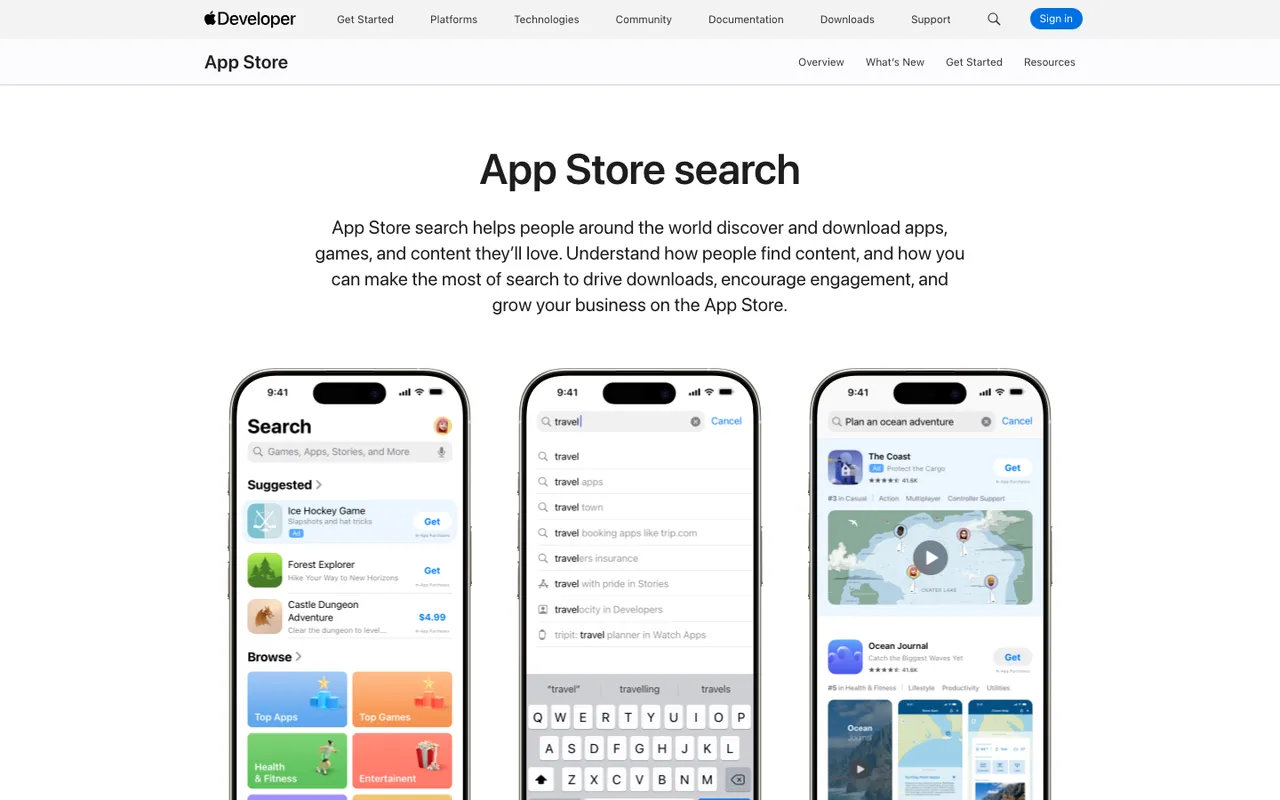
Apple's "App Store search" developer page, captured November 21, 2026.
That same Apple page explains how App Store search ranks: text relevance across title, subtitle, keywords and primary category, plus user behavior like downloads, ratings and reviews. Those are App Store rules. An assistant is a different system.
For assistants with web search, the documented mechanism is the open web. OpenAI says ChatGPT search sends rewritten queries to partner providers and that any public website can show up in its answers. Google says AI Overviews and AI Mode follow normal SEO practice and need no special files or schema. Apple's documented route into Siri AI, opened as a developer preview on November 3, 2026, is App Intents.
So a buyer is not shopping for an "App Store AI optimizer". You need a tool that shows what assistants say about apps in your category and which pages they lean on, listing included.
What to evaluate
Real-interface answers for the engines your users ask
ChatGPT, Gemini, Perplexity, Copilot and Google's two AI surfaces search live. Ask the vendor whether it collects from the consumer product or from an API, because the two can differ.
Citations at URL level
You want to see apps.apple.com and play.google.com URLs when they are cited, next to review sites and your own docs. A domain total is not enough to decide whether to rewrite a listing.
Tracking a page you don't own
The listing lives on Apple's domain. A tool that only tracks your own site can't follow it.
Your own site's side of the loop
Crawler logs tell you whether OAI-SearchBot or PerplexityBot can reach your docs. Visitor analytics tells you whether AI-referred visitors install or sign up from your landing page.
Claim checks
Assistants repeat prices and features. If they get yours wrong, you need to see the claim and where it came from.
What each option costs
| Tool | Entry price | What the entry plan gets an app team |
|---|---|---|
| Promptwatch | Essential $95/mo; Professional $245/mo; Business $579/mo | Prompt tracking on any supported engine, citation analytics, visitor analytics; crawler logs from Professional; Fact Check from Business |
| AthenaHQ | Free Essential tier (300 credits); Starter $295/mo | 3,600 credits a month, 11 models, country-level support, content optimization agent |
| Scrunch AI | Core $250/mo | 125 prompts, 5,000 responses, four LLMs, AI agent and bot traffic reporting |
Prices are monthly in USD. Promptwatch bills annual plans at 12 months for the price of 10, and every self-serve plan has a 7-day free trial on monthly billing. AthenaHQ was acquired by Bloomreach on November 16, 2026, and has not said what happens to standalone plans after its early 2027 joint launches.
How Promptwatch handles the listing question
Three features answer it directly. Page Tracker follows any URL, including your App Store product page, and shows how many AI responses cite it and from which prompts.
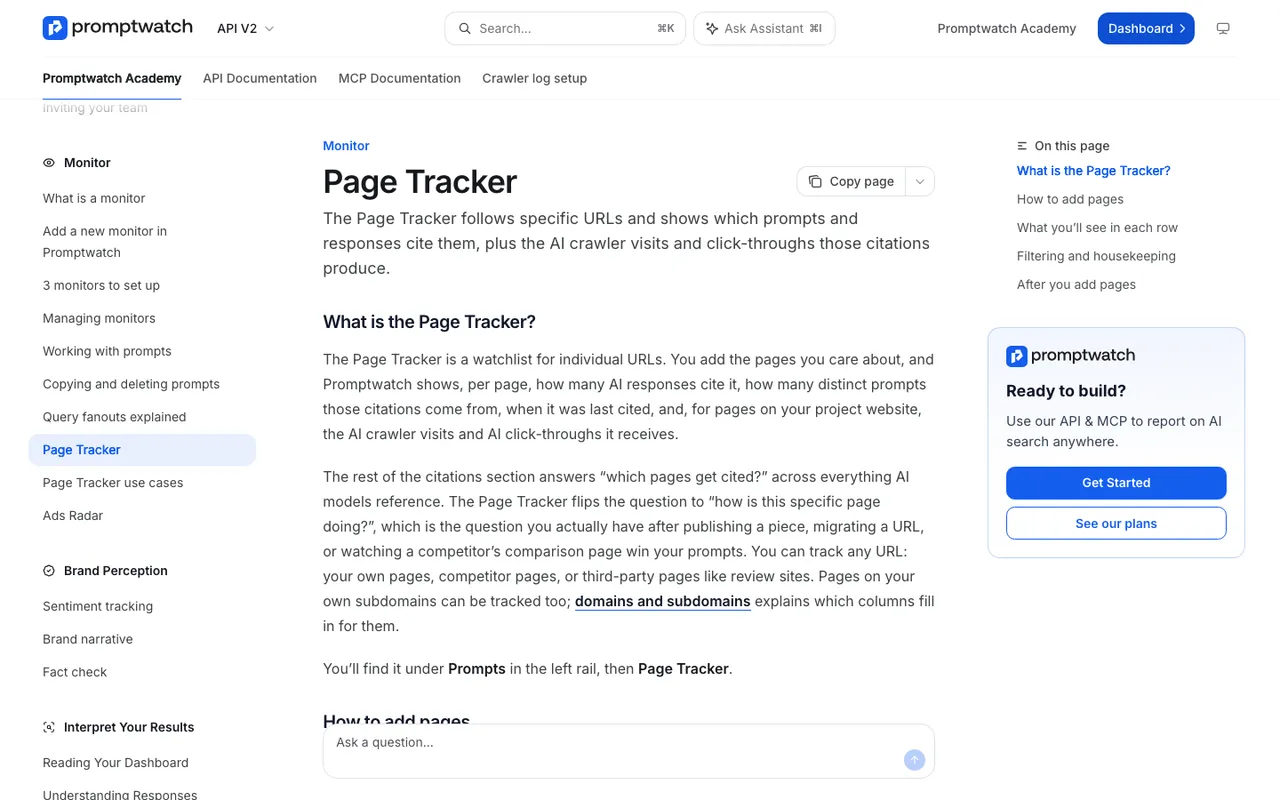
Promptwatch Academy, "Page Tracker", captured November 14, 2026.
Query fan-outs show the searches each model ran for a prompt, so you can see whether ChatGPT went looking for reviews, comparisons or the store itself. Brand Narrative pulls out the claims AI makes about you and files them under themes like Pricing and Features, which is where a stale price from an old listing tends to show up. On Business, Fact Check tests those claims against your site and the 50 most-cited offsite pages for each claim.
Promptwatch's software citation report gives a reason to keep the listing in proportion. For organic ChatGPT prompts from Sep 28 to Oct 4, 2026, app stores held 0.47% of software citations, against 2.64% for docs and help centers.
How to choose
If you need to know whether assistants mention you at all, Essential is enough to start. If your docs and landing pages are the likely source, take Professional, because that is where crawler logs begin. If assistants keep misquoting your pricing, Business adds Fact Check. AthenaHQ fits a team that wants an action queue and can live with credit billing and one country on Starter. Scrunch suits sites interested in its AXP crawler-serving layer, which is an Enterprise feature.
To see it on your own app prompts, book a demo with Promptwatch and bring three competitor apps you keep losing to.