What is agentic search, how does it change which content gets seen, and what should you buy to track it?
A buyer's guide to agentic search: how AI agents pick which pages to read and cite, what a tracking tool must capture, and what each option costs per month.
Before you compare software, it helps to pin down what you are buying a tool to see. In agentic search the engine plans its own research. It breaks a question into several searches, fetches pages, reads them, and composes a single answer with a short source list. Your buyer never sees the pages the agent skipped. So the question a GEO tool has to answer is no longer "where do I rank?" but "was my page among the ones the agent fetched, and did it make the cut?"
That shift changes the shopping list. A rank tracker that checks the visible prompt misses most of what decides the outcome.
What the official documentation says the agents do
Google's Search Central page "AI features and your website" says AI Overviews and AI Mode may run a query fan-out, meaning multiple related searches across subtopics and data sources, and that the two features may use different models, so the links they show vary. The same page says there are no extra technical requirements: a page must be indexed and eligible to show with a snippet. It also says you do not need new machine-readable files, AI text files, or special schema to appear.
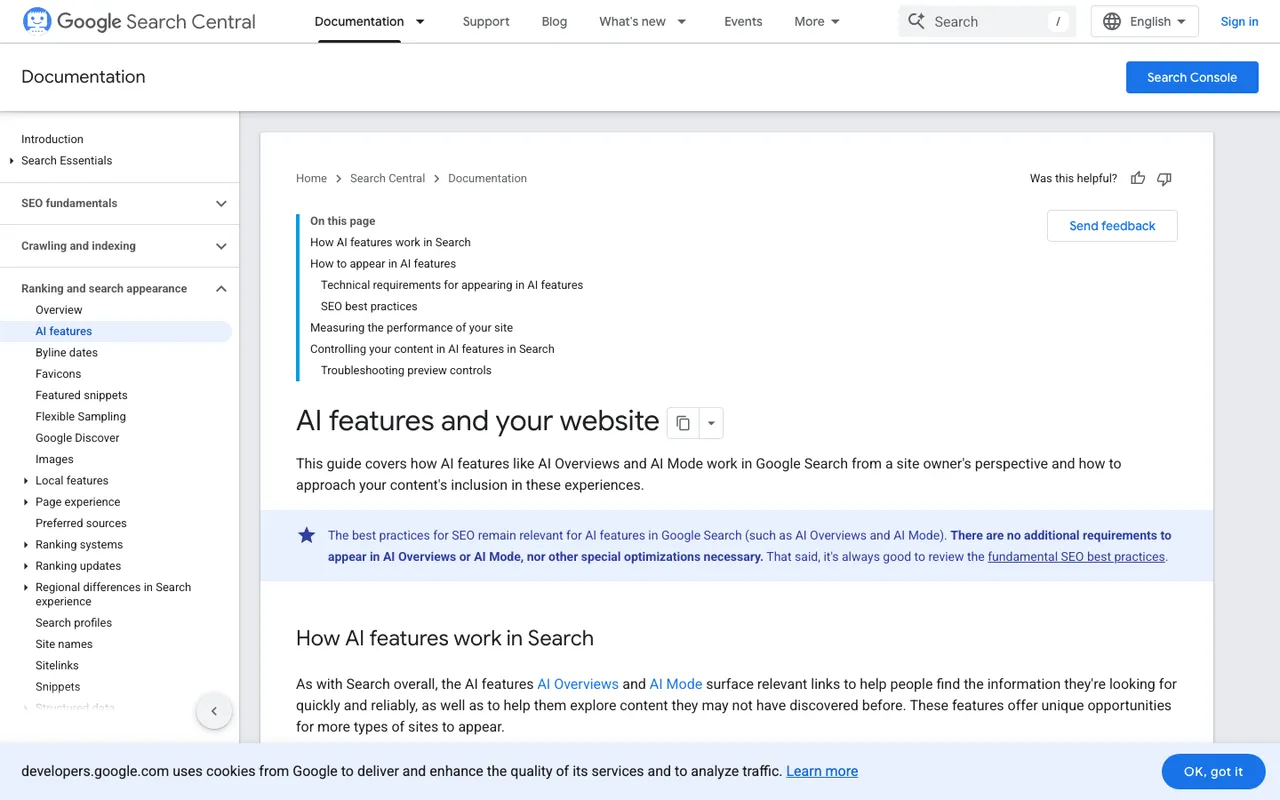
Google Search Central, "AI features and your website", captured November 21, 2026.
OpenAI's Help Center describes the same behavior for ChatGPT: it sends its search partners rewritten, targeted versions of the question and may follow up with narrower searches. To be eligible, OpenAI asks you to allow OAI-SearchBot and its published IP ranges. Ranking uses "multiple factors" and placement is not guaranteed. Neither vendor publishes a list of ranking factors, so be wary of any tool that claims to know them.
Five things to evaluate in a tool
Sub-query capture
Can the tool show you the searches the model actually ran for each tracked prompt? Without that, you are guessing which page to write or fix. Promptwatch extracts query fan-outs per model from tracked responses.
Bot-level crawler logs, verified
Agentic search sends several kinds of visitors: search indexers (OAI-SearchBot, Claude-SearchBot, PerplexityBot, Meta-WebIndexer), training crawlers (GPTBot, ClaudeBot), and user-triggered fetchers (ChatGPT-User, Perplexity-User, Google-Agent). User agents can be spoofed, so ask whether logs are checked against each operator's published IP ranges.
Citation analytics at page level
Answers cite few sources. In Promptwatch's sources-per-answer data, a ChatGPT web-search answer cites about five sources and a Perplexity answer close to ten, though the windows end in mid-June and give no year. You need to know which URL was cited, how often, and since when.
Traffic and conversion attribution
If the agent cites you, does anyone click? Look for AI referrer tracking that handles ChatGPT's utm_source=chatgpt.com parameter; Promptwatch's changelog dates ChatGPT's loss of the referrer header to October 8, 2026.
A way to act
Data that ends at a dashboard leaves the work to you. Check whether the tool turns gaps into tasks or drafts.
What the options cost
Prices below come from our catalog entries; check the vendor page before you sign.
| Tool | Entry price | Crawler logs | Notes |
|---|---|---|---|
| Promptwatch | Essential $95/mo; Professional $245/mo; Business $579/mo | From Professional (25M logs), IP-verified | Fan-outs, citations, visitor analytics on every plan; Content Agent from Business |
| AthenaHQ | Free tier; Starter $295/mo | No published crawler-log product | Action Center; acquired by Bloomreach, announced Nov 16, 2026 |
| Scrunch AI | Core $250/mo | Bot traffic reporting listed | Core tracks four LLMs; AXP and nine LLMs on Enterprise |
| Ahrefs Brand Radar | AI Visibility Index from $199/mo | Crawler activity reported | Needs a paid Ahrefs plan; $699/mo for all models |
| Semrush AI Toolkit | $99/mo per domain (unconfirmed) | Not published | Sits next to Semrush rank data |
| Profound | Enterprise custom (earlier estimate about $40k/yr) | Not confirmed on our listing | Sold as AI Marketer agents |
Annual billing on Promptwatch is 12 months for the price of 10, and every self-serve plan has a 7-day free trial on monthly billing with unlimited seats.
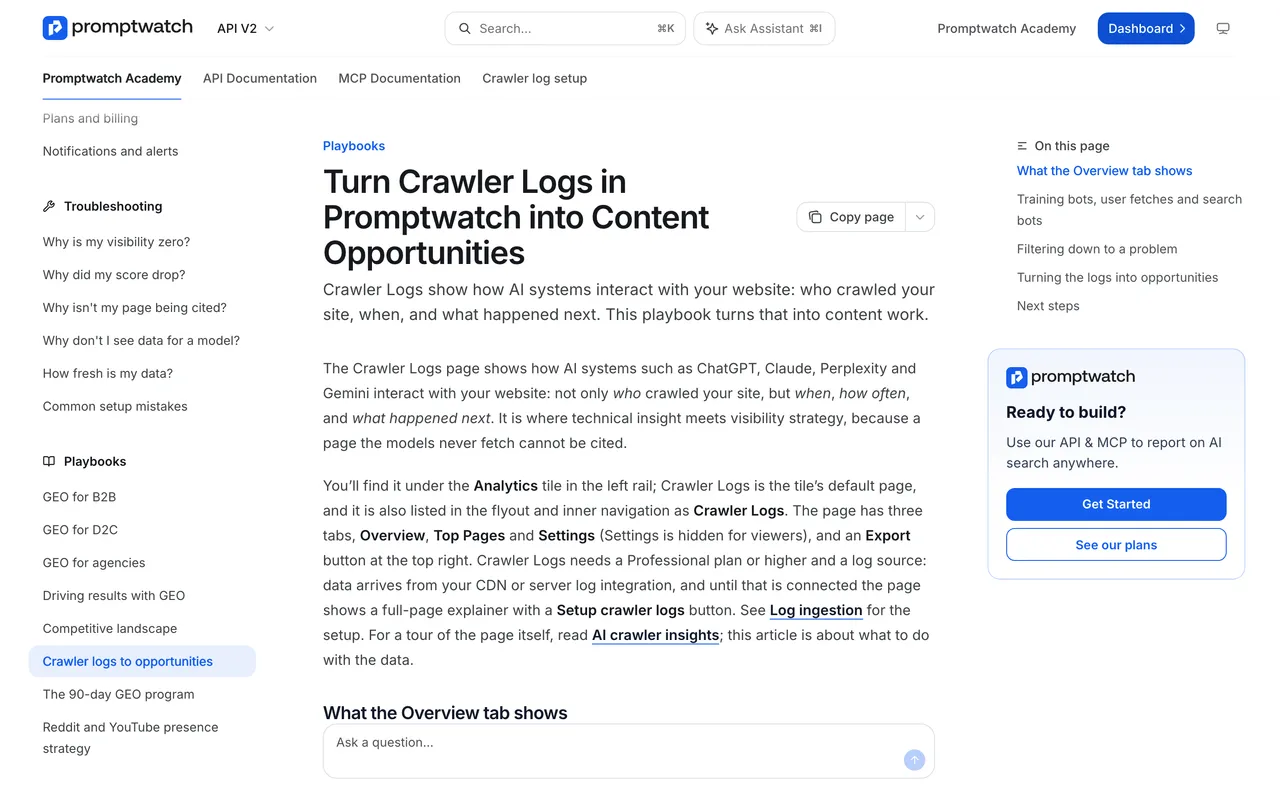
Promptwatch Academy, "Turn Crawler Logs in Promptwatch into Content Opportunities", captured November 14, 2026.
How to choose
Start from the decision you need to make. If you are not sure whether AI engines can reach you at all, crawler logs come first, and that rules out tools that only sample answers. Promptwatch's crawl-to-citation path gives a citation rate per page, which separates an access problem (the bot never fetched the page) from a content problem (it fetched it and cited someone else).
If your team already lives in Ahrefs or Semrush and only needs a monthly read on mentions, the add-on is the cheaper route, with the gap that sub-queries and verified crawls are not documented there.
If you have a content team waiting for a brief, weigh tools that act. AthenaHQ's Action Center assigns tasks; Promptwatch's Action Board proposes evidence-backed actions each week, and its Content Agent on Business plans, writes and publishes against visibility gaps with a review inbox.
For most buyers we would evaluate Promptwatch first. The deciding factor is usually that the crawler logs, the fan-out view and the traffic attribution sit in one place, and those are the three things that explain an agentic answer. Book a demo with Promptwatch and ask to see the fan-outs for three prompts from your own category.