Promptwatch vs Scrunch AI: which one should you buy in 2026?
Promptwatch vs Scrunch AI for buyers: 30 features compared from vendor pages, the response math at 100 prompts, where Scrunch wins, and a two-week trial plan.
On the pricing pages, Promptwatch and Scrunch AI look like a coin toss. Promptwatch Professional costs $245 a month and Scrunch Core costs $250. Both have a 7-day free trial, both include AI crawler data at that price, and both will draft content for you. A buyer could reasonably pick either and move on.
The plans are built very differently, though. Scrunch Core is the only self-serve plan Scrunch publishes, and the features a growing team asks for next (more engines, the API, MCP, Looker Studio, single sign-on beyond Google) sit on an Enterprise plan without a price. Promptwatch publishes three brand plans and three agency plans, and lists which features start where. Scrunch frames its product around AI agents as website visitors. Promptwatch frames its own as a loop: monitor what AI says, trace where it gets its answers, act on the gaps, and measure the effect on your site.
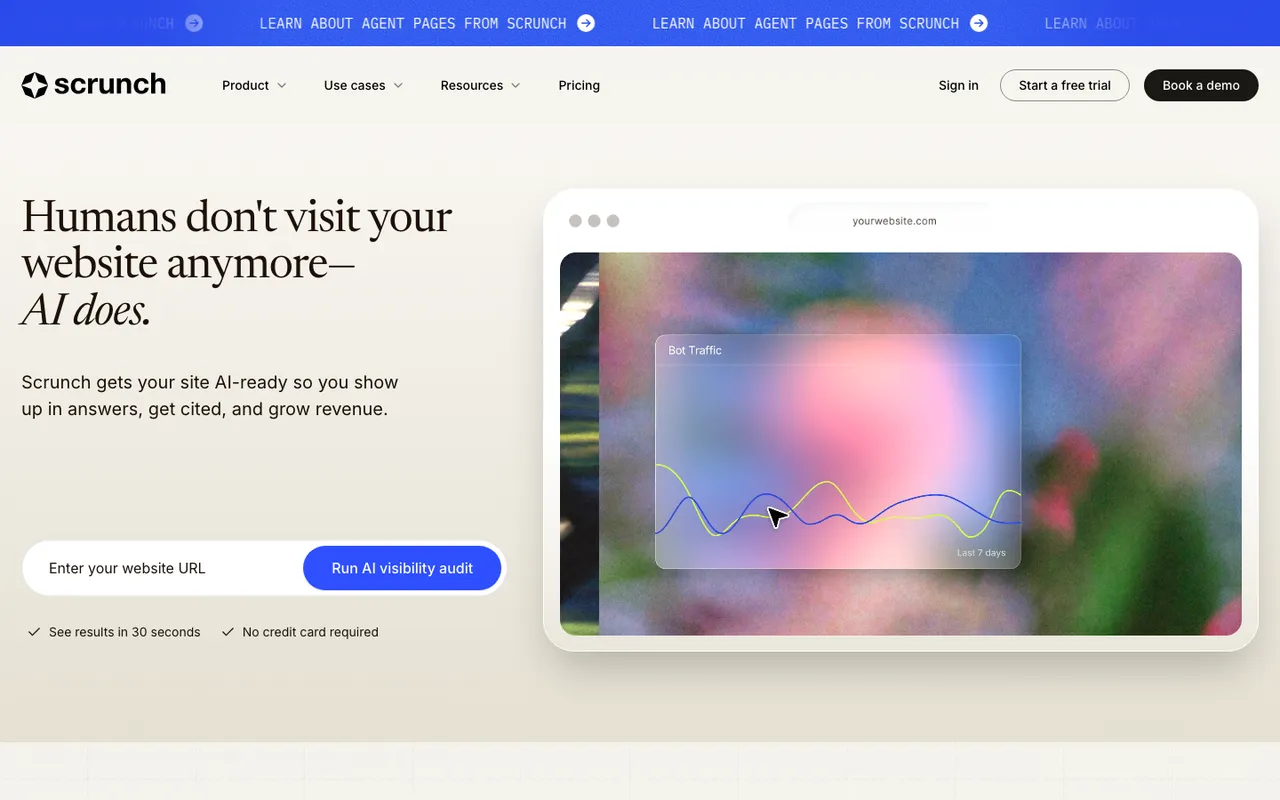 Scrunch's homepage, captured November 6, 2026.
This comparison uses Scrunch's pricing and home pages captured November 6, 2026, its Monitoring, Agent Traffic and llms.txt pages read November 8, 2026, and Promptwatch's own published plan matrix and pricing page. When Scrunch doesn't mention a feature, we write "not listed" rather than assume it's missing. For the wider field, see our Scrunch AI alternatives buyer's guide.
Quick verdict
Buy Promptwatch if you need more than Scrunch Core's four engines, one country and five licenses, or if you have to show why a page was cited and what that answer was worth: it lists IP-verified crawler logs with a crawl-to-citation rate, AI-referred conversions, Search Console and Bing data, MCP and API access, and CMS publishing on self-serve plans. Buy Scrunch AI if AXP's agent-optimized pages are the reason you're shopping, or if one brand in one country on ChatGPT, Perplexity, AI Overviews and Copilot is the whole job.
At a glance
| Promptwatch | Scrunch AI | |
|---|---|---|
| Self-serve plans | Essential $95, Professional $245, Business $579; agency plans $199, $399, $799 | Core $250 |
| Top plan | Enterprise, custom | Enterprise, custom |
| Entry allowance | Essential: 1 project, 50 prompts, 6,000 responses | Core: 1 brand workspace, 125 prompts, 5,000 responses |
| Engines on the entry plan | Every paid plan can track any of the supported engines | ChatGPT, Perplexity, Google AI Overviews, Copilot |
| Enterprise-only engines | None listed | Claude, Gemini, Meta AI, Google AI Mode, Grok |
| Free trial | 7 days on monthly billing, all six self-serve plans | 7 days on Core |
| Free starting point | AI Visibility Report | AI visibility audit, no credit card |
| Seats | Unlimited on every paid plan | 5 user licenses on Core |
| Annual billing | 12 months for the price of 10 | Not stated |
Full feature comparison
| Feature | Promptwatch | Scrunch AI |
|---|---|---|
| Tracking | ||
| Prompt research data | Prompt Volumes: monthly volume, difficulty, citation rate | AI Search Trends with approximate volumes, 3 topics on Core; difficulty not listed |
| Query fan-outs | Exact sub-queries per model | Limited on Core; full on Enterprise |
| Personas | Yes, with persona stacking and Persona Insights | 1 on Core, custom on Enterprise; sentiment per persona |
| Location | Country on every paid plan; state/city and coordinates on Business | 1 country on Core, unlimited on Enterprise; state/city not listed |
| Fastest tracking | Daily on every plan; every 12, 6 or 1 hours on Business | Not listed |
| Citations and narrative | ||
| Page-level citations | All Citations, URL Positions, Citation Trends | Top cited domains and URLs, citations by owner, citation movement |
| Social citation reports | Reddit, YouTube, LinkedIn, Instagram | A "Social" segment in Citations by Owner |
| Offsite mentions as opportunities | Unlinked mentions ranked as opportunities | A Mentions feed appears on the Monitoring page; not described |
| Track a specific URL, incl. a competitor's | Page Tracker | Per-URL view of your own pages; competitor URLs not stated |
| Sentiment and claim-level narrative | Brand Narrative on every plan | Sentiment on both plans, by persona and topic; claims not listed |
| Fact checking against your own pages | Fact Check on Business | Not listed |
| Crawlers and traffic | ||
| AI crawler logs | Agent Analytics from Professional and on agency plans | AI Agent / Bot Traffic on Core |
| Bot classification | AI crawls vs citation crawls made while answering a user | Training, indexing and retrieval bots |
| IP verification, crawl-to-citation, crawl errors | Yes | Not listed |
| AI-referred visits and conversions | Every plan, by script, GTM template or WordPress plugin | Not listed; human vs bot split shown |
| Search Console and Bing next to AI data | Both, every brand plan | Not listed |
| Content and actions | ||
| Action queue | Action Board with a weekly Discovery agent | Insights & Recommendations; Signals |
| Conversational agent | Agent Chat on every paid plan | Explorer BI layer; conversation through MCP on Enterprise |
| Content generation | AEO articles from Professional (5 a month); 10 on Business | Basic on Core, Advanced on Enterprise |
| CMS publishing | WordPress, Webflow, Framer; automated Content Agent on Business | Not listed |
| Refreshing existing pages | Content Refresh | 1 Page Optimization a month on Core |
| Site audit | Weekly, 21 checks, 1,500 pages on Essential | 5 audits a month and a 25-page site map on Core |
| Agent-optimized page versions | Not listed | AXP on Enterprise |
| Shopping tracking | ChatGPT Shopping and Alexa on Business | Product Observability on Enterprise |
| Ads inside AI answers | Ads Radar on Business and every agency plan | Not listed |
| Integrations and admin | ||
| MCP server and REST API | Both on every paid plan; MCP has 110+ tools | Both Enterprise only |
| Looker Studio | From Professional and on agency plans | Enterprise only |
| PDF and scheduled reports | PDF of any dashboard; 10 scheduled PDF reports per brand plan | Reporting dashboard; Exec/Board reporting on Enterprise; PDF not listed |
| Security | ISO/IEC 27001, GDPR; SSO on Enterprise | SOC 2 Type II; Google SSO on Core; SAML and OIDC on Enterprise |
| Coding agent visibility | Codex, Claude Code, OpenCode | Not listed |
Pricing side by side
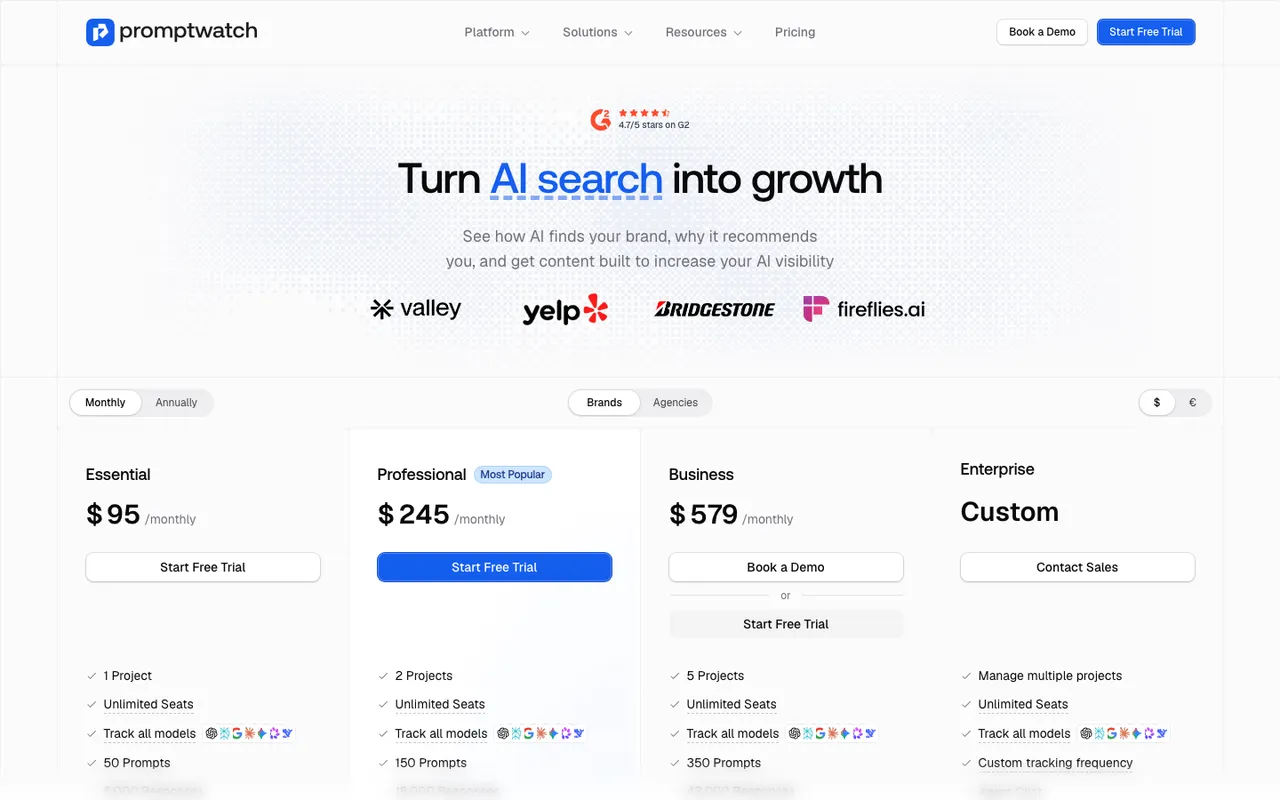 Promptwatch's pricing page, captured November 6, 2026.
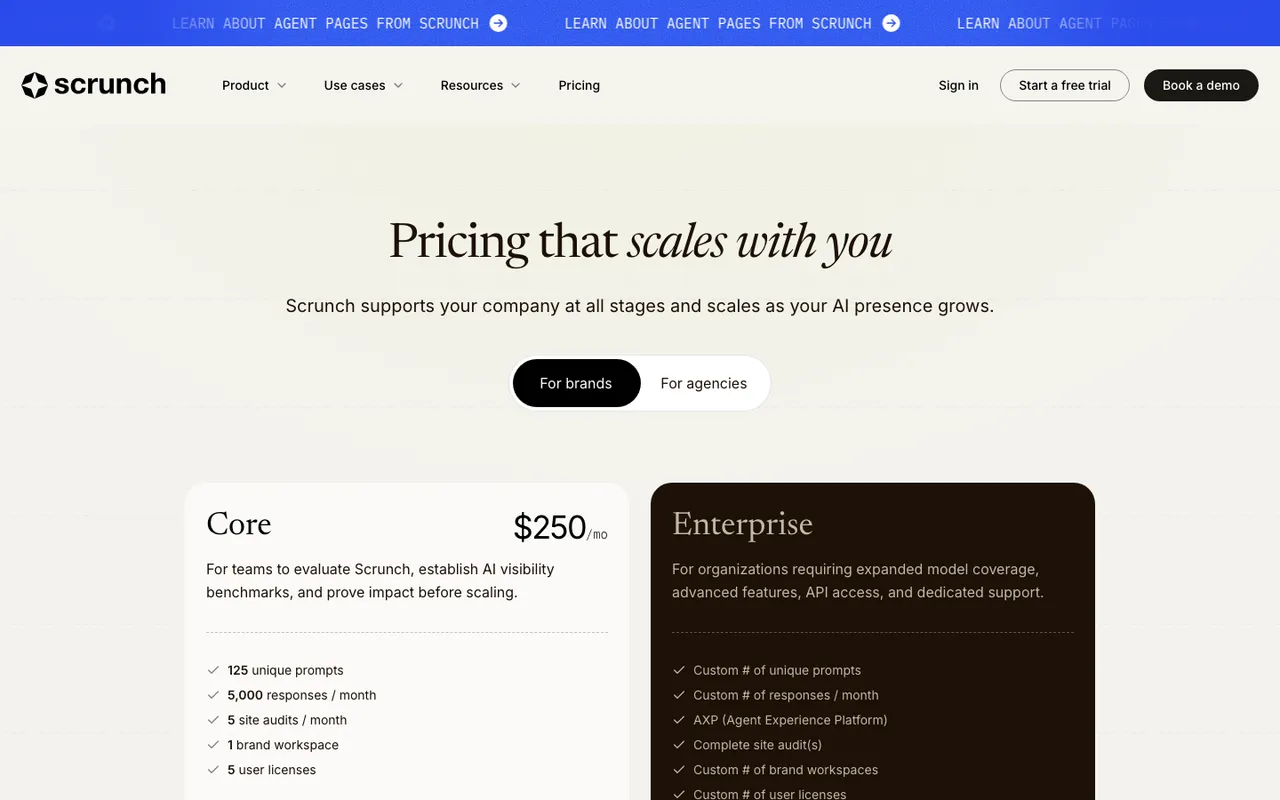 Scrunch's pricing page, captured November 6, 2026.
The stickers are $5 apart, so the comparison has to be done at your volume. Three teams show where it splits.
Team one tracks 100 prompts on Scrunch's four Core engines, every day. That is 400 responses a day, about 12,000 a month. Scrunch Core's 5,000 responses cover 41 prompts at that cadence, or all 100 prompts about twelve times a month. Scrunch doesn't state a tracking frequency, so ask what cadence Core actually runs. On Promptwatch, Essential is out because it caps prompts at 50, and Professional fits with room to spare: 150 prompts and 18,000 responses, plus crawler logs and 5 AEO articles. The bill is the listed $245.
Team two is the same, but the CMO wants Gemini and Google AI Mode added, which makes six engines and 18,000 responses a month. On Scrunch, both engines are Enterprise only, so the next step is a sales call with no published number. Promptwatch Professional's 18,000 responses match that volume exactly. Promptwatch's own documents disagree on whether brand plans run every engine on every prompt or a chosen four, so confirm the per-prompt engine count for your plan before you sign.
Team three has eight marketers and runs two country sites. Scrunch Core includes five licenses and one country, so this team is buying Enterprise either way. Promptwatch has unlimited seats on every paid plan and sets the country per monitor on every paid plan, so the question becomes prompt and response budget, not contract type. Agencies get a separate route: Promptwatch Kick-off at $199 includes unlimited projects and 10,000 responses. Scrunch has a "For agencies" pricing tab, but its contents weren't in our capture.
Where Scrunch genuinely wins
AXP is the clearest one. The Agent Experience Platform serves token-light, AI-optimized versions of your pages to AI agents without changing what people see, and nothing in Promptwatch does that. It is Enterprise only, but if serving agents a different page is the project, Scrunch is the vendor that sells it.
Scrunch is also generous where its single plan counts. Core includes AI agent and bot traffic at $250, split into training, indexing and retrieval bots, with retrieval tied to real prompts. Promptwatch Essential has no crawler logs, so to match that you need Professional at $245. Core gives you 125 prompts against Essential's 50, and basic content generation, where Promptwatch's AEO articles also start on Professional. One persona and limited fan-outs are on Core too.
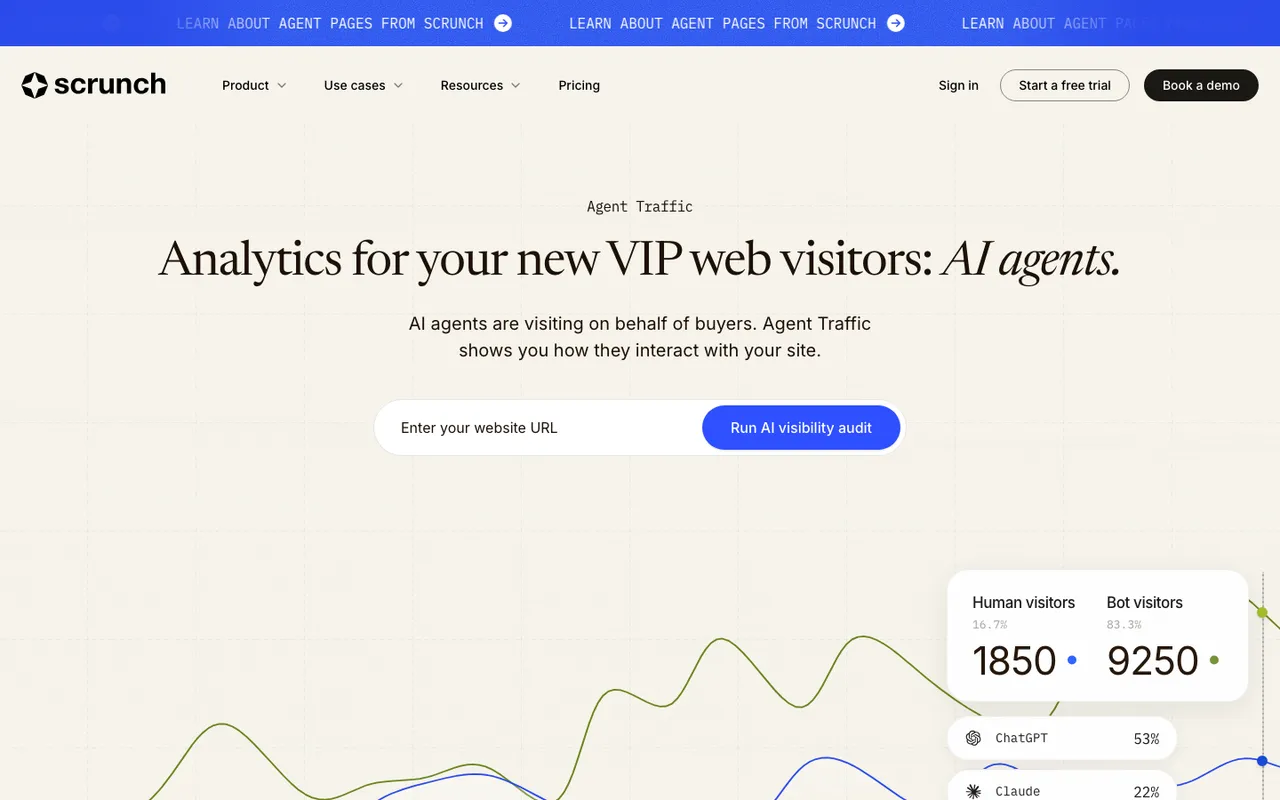 Scrunch's Agent Traffic page, captured November 8, 2026.
On security, Scrunch lists SOC 2 Type II at company level and Google single sign-on on Core, while Promptwatch keeps SSO for Enterprise and lists ISO/IEC 27001, with no SOC 2 report in its published sources. If your procurement form asks for a SOC 2 report specifically, that point goes to Scrunch. Scrunch is also now a Sitecore company, and its llms.txt lists news about shipping inside SitecoreAI, which may matter if you already run Sitecore.
What Scrunch is missing
Five engines behind a sales call
Claude, Gemini, Meta AI, Google AI Mode and Grok are Enterprise only on Scrunch. For a brand whose buyers use Gemini or AI Mode, Core reports on part of the audience and leaves the rest blank. Promptwatch's paid plans can track any of the supported engines, including Gemini, AI Mode and Meta AI through their real interfaces, with Claude and Grok tracked through the API.
Proof that a crawl became a citation
Scrunch's bot traffic tells you which bots visited and which pages they read. It doesn't list IP verification, a crawl-to-citation link or crawl error tracking. That gap matters when a page isn't cited: without it, you can't tell whether ChatGPT-User never fetched the page or fetched it and passed over it. Promptwatch's Agent Analytics, from Professional, verifies bots against each operator's published IP ranges, so spoofed user agents are filtered out, and shows a citation rate per page with explanations for failed crawls. Our post on what a crawler analytics tool should show beyond bot hit counts goes deeper on why those columns matter.
Conversions and search data next to AI data
AI-referred conversions and Search Console or Bing data are not listed on Scrunch's pricing or product pages (checked November 2026). A team that reports to finance then has to rebuild the revenue story in GA4. Promptwatch's Visitor Analytics, on every plan, counts AI-referred visits and conversions, with a toggle that counts utm_source=chatgpt.com visits as ChatGPT after ChatGPT stopped sending a referrer on October 8, 2026. Search Insights puts Google and Bing clicks and impressions next to AI crawls and citations on every brand plan.
What AI claims about you, checked against your site
Scrunch tracks sentiment by persona and topic. Claim-level narrative and fact checking are not listed. Promptwatch's Brand Narrative, on every plan, pulls out the individual claims AI makes about you and your competitors, groups them under themes such as Pricing and Support, and scores each theme. Fact Check, on Business, takes a claim you mark as accurate or inaccurate and finds the pages on your site that state it or the opposite.
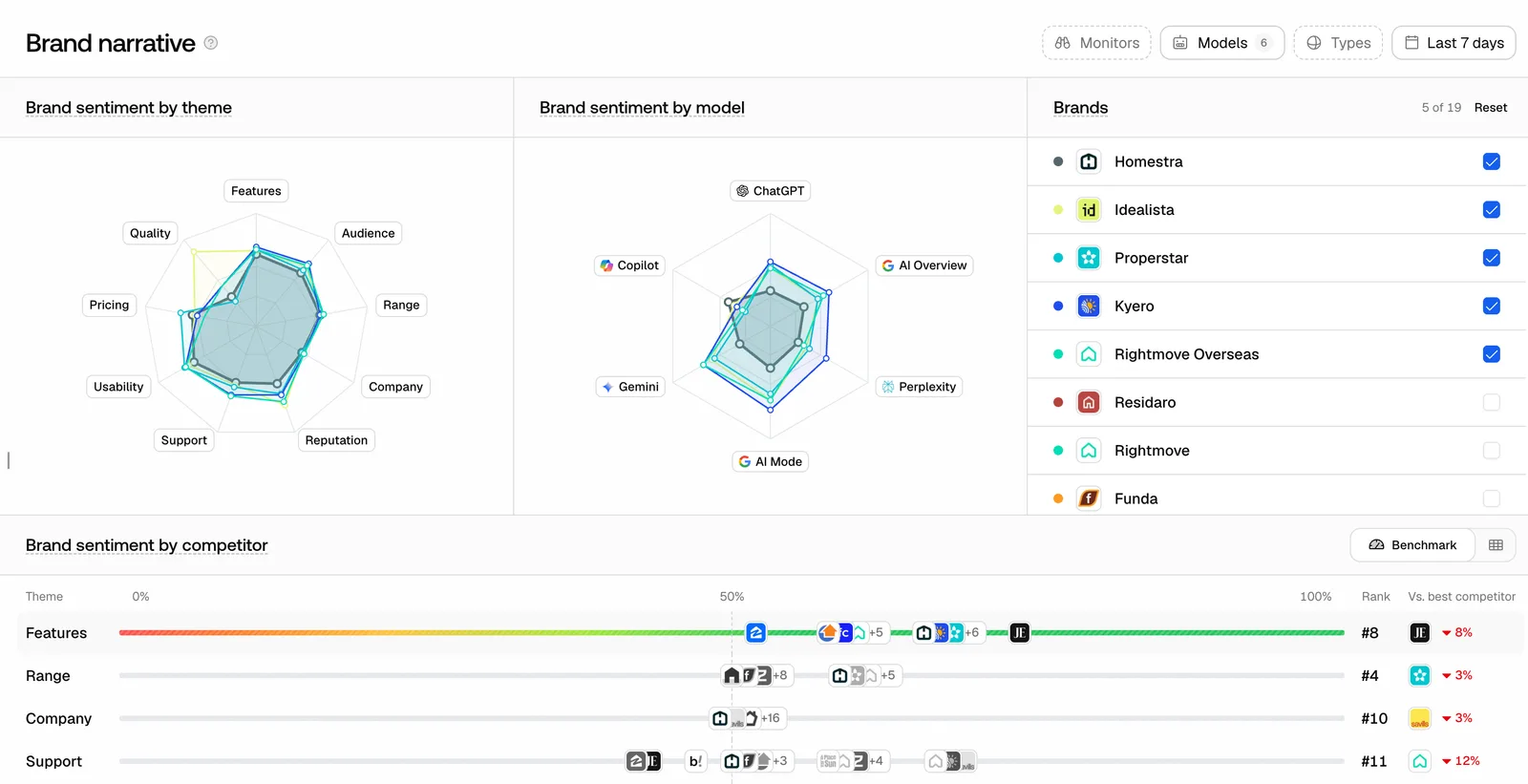 Promptwatch Brand Narrative, from the Promptwatch changelog. Example project data.
Publishing the fix
Scrunch Core generates basic content, but CMS publishing is not listed. Promptwatch publishes to WordPress, Webflow and Framer as a draft or live, and the Content Agent on Business plans, writes and publishes on a schedule with a review inbox. Each published document is then followed through crawls, citations and AI traffic.
Data access and reporting without an Enterprise contract
MCP, the API, Looker Studio and executive reporting are Enterprise only on Scrunch, and PDF or scheduled reports are not listed. Promptwatch includes the MCP server and REST API on every paid plan, Looker Studio from Professional, custom dashboards on every plan, and 10 scheduled PDF reports on every brand plan.
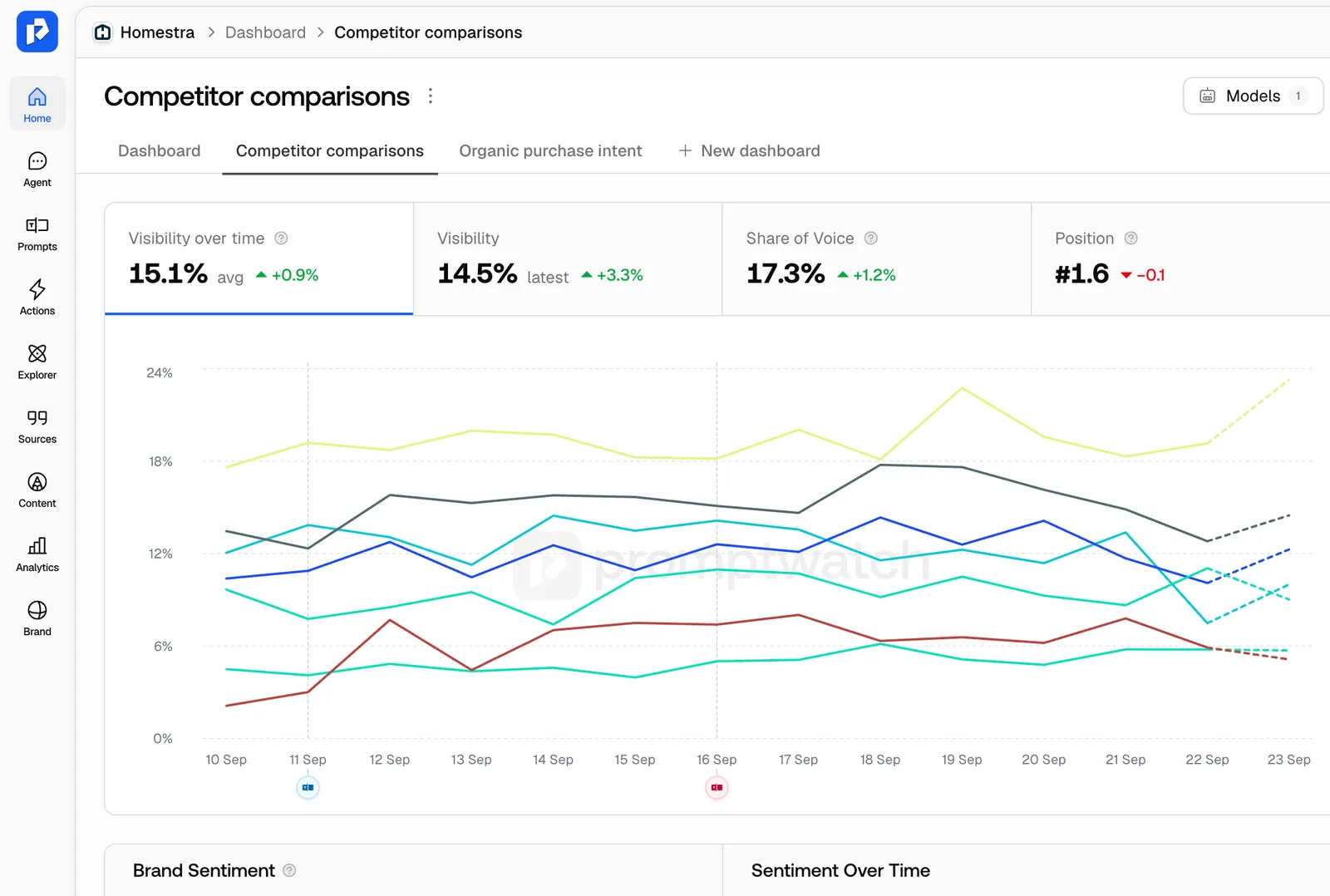 Promptwatch custom dashboard, from the Promptwatch changelog. Example project data.
Location, frequency and ads
Core covers one country and one language, and state, city or coordinate targeting is not listed at any tier. Ads inside AI answers and a tracking frequency are not listed either. Promptwatch adds state and city tracking, local targeting pinned to exact coordinates, runs every 12, 6 or 1 hours, and Ads Radar for sponsored ads in ChatGPT Search, AI Overviews and AI Mode, all on Business.
A two-week side-by-side trial plan
Both trials last seven days, so spend the first week preparing. Run Scrunch's free AI visibility audit and Promptwatch's free AI Visibility Report on your domain. Write one shared list of 40 prompts: 40 prompts on Core's four engines every day is 4,800 responses a month, which keeps Scrunch inside its 5,000 allowance and makes the comparison fair. Get access to your CDN or WordPress admin so crawler data can be connected on day one.
In week two, start both trials on the same morning. Use the same prompts on ChatGPT, Perplexity, AI Overviews and Copilot in both tools. Start Promptwatch on Professional so crawler logs are included, connect your crawler source to both, and install Promptwatch's visitor script. On the last day, score three things: which tool explained why a specific page was or wasn't cited, which one gave you a conversion number for AI traffic, and what each would cost at your real volume. On Scrunch, that last answer needs a quote if you need more than Core.
Who should pick which
Pick Promptwatch if you need Gemini, Claude or AI Mode without an Enterprise contract, track more than one country, have more than five people who need a login, report AI traffic to finance, or want your data in Claude, ChatGPT or Cursor through MCP. Pick Scrunch if AXP is on your roadmap, Core's four engines and one country cover your market, your procurement team requires SOC 2 Type II, or you're a Sitecore shop.
Our verdict
For most teams that reach this comparison, Promptwatch is the better purchase. The deciding factor is what happens after the bot shows up: Scrunch can show that an AI agent visited, and Promptwatch can show whether that visit became a citation and whether the citation sent a buyer who converted. It also does so on plans with a published price, where Scrunch's next step is a quote. Start the 7-day free trial on Professional and follow the two-week plan above.
FAQ
Is Promptwatch cheaper than Scrunch AI?
At the entry sticker, yes: Essential is $95 against Core's $250, though Essential has no crawler logs. At comparable features, Professional at $245 is $5 below Core and includes 18,000 responses against 5,000. Beyond Core, Scrunch's pricing is custom.
Does Scrunch AI have AI crawler logs?
Yes. AI Agent / Bot Traffic is on Core, with visits by model, bot type and page. IP verification, a crawl-to-citation link and crawl error tracking are not listed. Promptwatch lists all three from Professional.
Can I use both?
Yes, and some teams will. If AXP is serving agent-optimized pages on Scrunch Enterprise, Promptwatch's Page Tracker, Agent Analytics and Visitor Analytics can measure whether those pages get crawled, cited and clicked.