What is agentic SEO? A buyer's guide to agents that do the SEO work
What agentic SEO is, what to check before an agent touches your site, what the main tools cost, and how to choose between autopilots and full AI visibility platforms.
Agentic SEO is the use of AI agents that carry out search optimization tasks themselves: researching topics, writing and refreshing pages, fixing technical issues, publishing, and checking the result. The difference from earlier "AI SEO" software is permission. Older tools suggested. Agentic tools are allowed to act, usually within limits you set.
That permission is exactly what makes buying one harder. You aren't only judging features. You are deciding how much of your site, your brand voice and your publishing schedule you hand to software. This guide is about making that call well.
Two kinds of product share the label
Shop for "agentic SEO" and you'll meet two different categories.
Autopilots focus on output. They generate and publish articles, or open pull requests with technical fixes, on a schedule. Outrank, SEObot, Okara, Seology and DispatchSEO sit here.
AI visibility platforms with agents start from measurement. They track how search engines and AI assistants answer your buyers' questions, then use agents to act on the gaps and measure what changed. Promptwatch, AthenaHQ and Goodie AI sit here.
Neither is wrong. They answer different questions. An autopilot answers "how do we publish more?" A platform answers "what should we publish, and did it work?"
What to evaluate before you buy
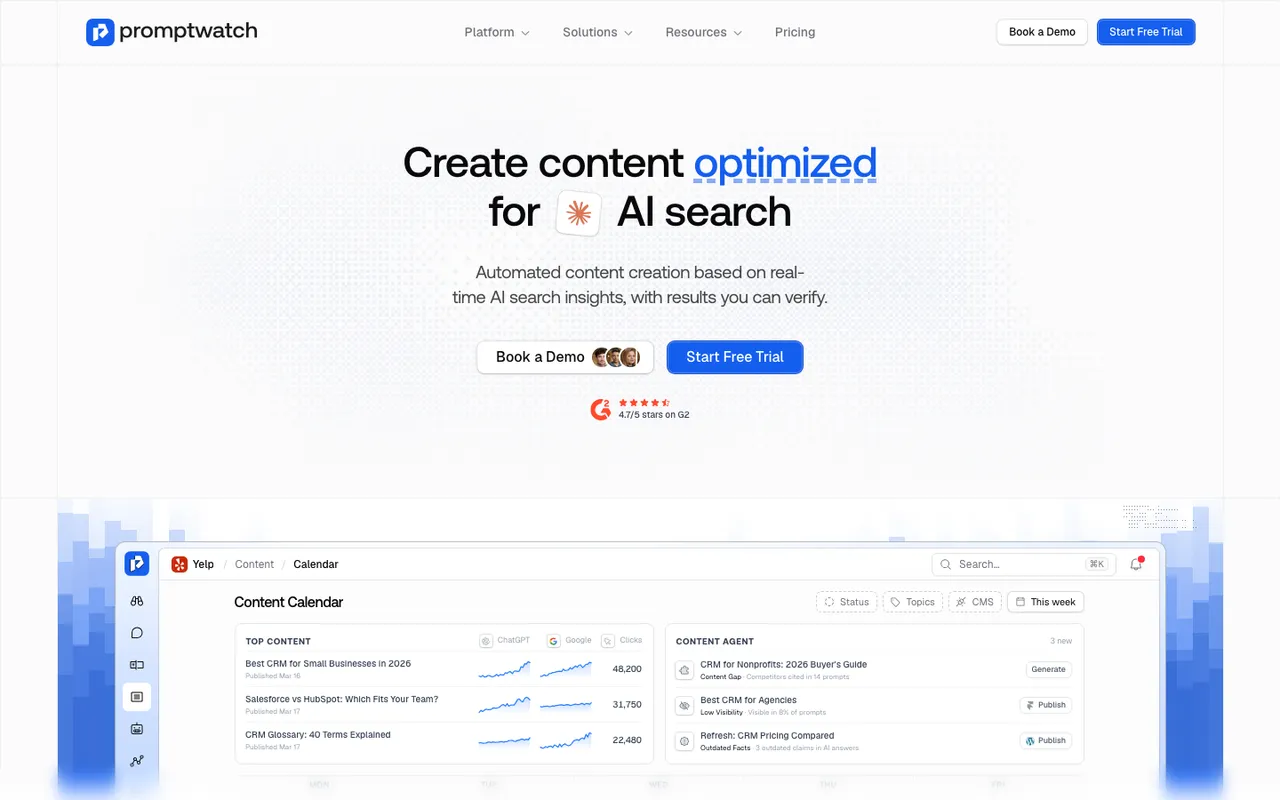
How much autonomy, and can you dial it down? Look for an approval step that fits your team. Okara's Coding Agent lands every fix batch as one GitHub pull request you review and merge. Seology offers three modes: Monitor, Co-pilot and Autopilot. SEObot runs on autopilot by default with optional approve or moderate controls. Promptwatch's Content Agent can send drafts to a review inbox (approve, edit, decline) or run fully automated.
What does the agent decide from? An agent that writes from keyword lists will produce keyword pages. One that writes from your actual visibility gaps (prompts where competitors get named and you don't, pages AI engines cite instead of yours) produces something more targeted. Ask each vendor what data the agent reads before it drafts.
Can it check its own work? This is the most overlooked item. In our catalog, Okara, Seology, Outrank, SEObot and DispatchSEO all list no published AI crawler logs, citation analytics or visitor conversions. They can act, but they can't tell you whether AI engines picked the result up.
Where does it publish? Check your CMS is supported before the demo, not after.
Is there an audit trail? When several people and an agent all edit the same site, you need to know who changed what. Pull-request workflows give you git history. Promptwatch's audit log (Business and up) records whether a change came from the dashboard, the API, an MCP client or Agent Chat.
Promptwatch's "Content Agents" feature page, captured November 8, 2026.
What agentic SEO tools cost
Pricing models vary as much as the products. All figures are monthly, from our catalog or Promptwatch's published pricing.
| Tool | How you pay | Entry point |
|---|---|---|
| Promptwatch | Plan tiers with Agent Credits and AEO articles | $95 Essential; Content Agent from $579 Business |
| AthenaHQ | Credits (one credit per AI response) | Free tier; $295 Starter |
| Goodie AI | Plans with optimization actions | $295 Core (50 actions) |
| Okara | Plans; Coding Agent on paid tiers | $129 AI CMO Lite |
| Seology | Per plan, by site count | Free Starter; $49 Pro for 5 sites |
| Outrank | Per article volume | $99 for 30 articles |
| SEObot | Per article volume | $49 for 9 articles |
| DispatchSEO | Per site; free to self-host | $29 Starter billed monthly |
On Promptwatch, Professional ($245) adds crawler logs and 5 AEO articles a month for on-demand content, and Business adds the automated Content Agent with 10 AEO articles, publishing calendars and Agentic AI Search Optimization. Every self-serve plan has a 7-day free trial on monthly billing, and annual billing is 12 months for the price of 10.
Why we'd start with Promptwatch
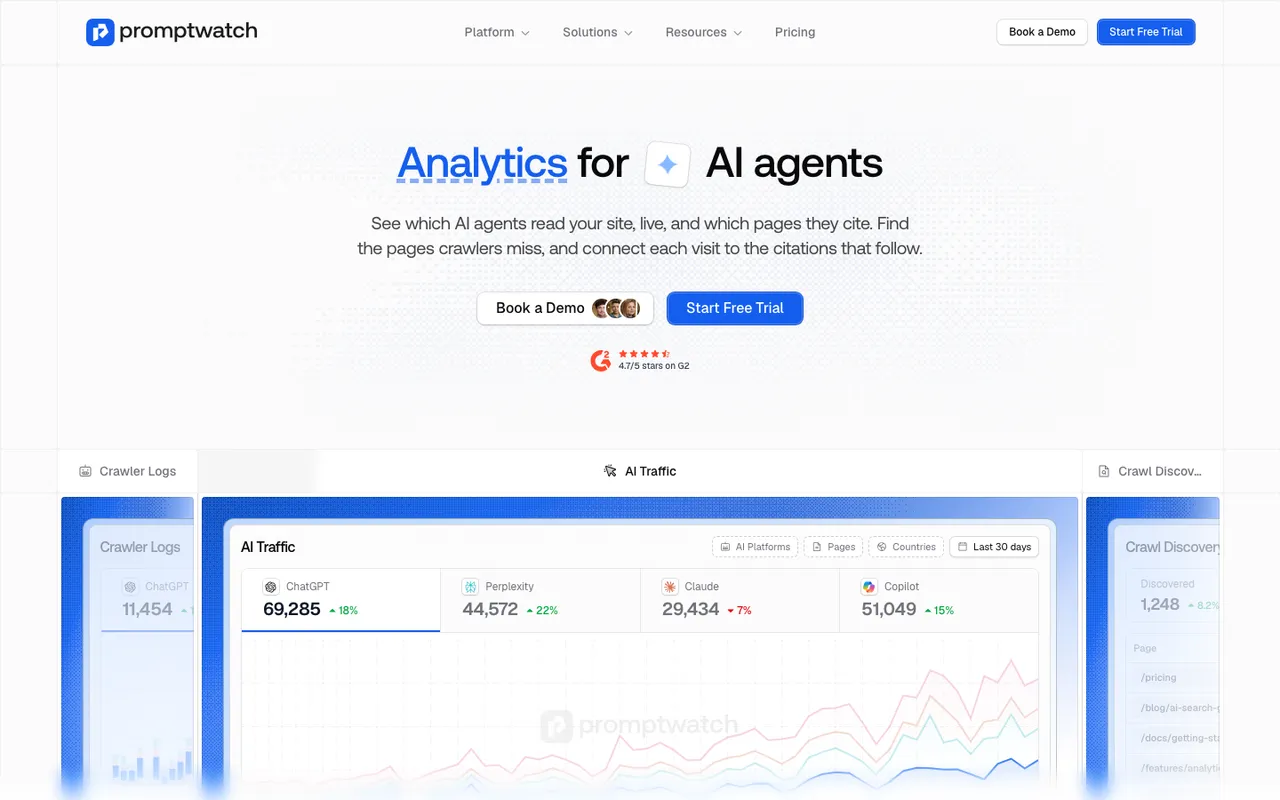
For most buyers the deciding factor is the verification step. Promptwatch is built as one loop: it monitors what AI engines say, traces which sources they use, acts on the gaps, and measures the impact on your site. Crawler logs from Agent Analytics show whether AI bots fetched the new page. Page Tracker shows whether it started getting cited. Visitor analytics show whether AI-referred visits converted. Pages that underperform come back as Action Board items and Content Refresh suggestions.
Promptwatch's "Agent Analytics" feature page, captured November 8, 2026.
How to choose
- You need more content and already measure AI visibility elsewhere. An autopilot like Outrank or SEObot is the cheapest way to add volume. Keep a human reading every draft.
- Your backlog is technical. Okara or Seology, both of which ship fixes as pull requests, fit teams with a developer who reviews merges.
- You want agents to act on AI search gaps and prove the result. Promptwatch Business, or AthenaHQ if you prefer a credit-based task queue. AthenaHQ's acquisition by Bloomreach is recent, so ask about its roadmap.
- You are an agency. Promptwatch's agency plans include crawler logs and visitor analytics on every tier, but not the Content Agent; content generation for agencies sits on Enterprise.
Book a Promptwatch demo and ask to see the Content Agent take one real visibility gap from your account through to a draft in the review inbox. That walkthrough tells you more than any feature list.