Which AI visibility tools are built for enterprise SEO teams and the stack they already run?
Which AI visibility tools are built for enterprise SEO teams? We judge them on fit with the existing stack: Search Console and Bing data, AI crawler logs, technical audits and data export.
An enterprise SEO team doesn't start from zero. It already has Google Search Console and Bing Webmaster Tools on every property, a technical crawler, someone who can read server logs, a BI dashboard leadership checks, and often a suite contract with a renewal date. When AI search lands on that team's desk, the real question isn't whether a tool can track ChatGPT. Most can. The question is whether it fits the stack and answers the technical questions SEOs are trained to ask.
Those questions are specific. Are AI crawlers reaching the pages we care about, or are they stuck on faceted URLs? Which of our pages get cited, and how do those pages perform in Google and Bing? When an AI engine runs a sub-query before answering, which of our URLs does it pull? Can we get the data into our own warehouse without a CSV ritual every Monday?
This guide ranks the tools on those integration points. Competitor details come from our catalog entries, most read from vendor pages in late October 2026, and where a vendor doesn't document something we say so.
Four places a tool has to plug in
Search data is the first. AI visibility numbers mean little to an SEO team until they sit next to clicks and impressions from Google and Bing, page by page. Don't skip Bing: in at least one tool below, Bing Webmaster data now includes Microsoft Copilot.
Crawler logs are the second. Your CDN or server already records every AI bot visit. A tool that reads those logs, verifies the bots against their operators' IP ranges and connects crawls to citations answers the access question that dashboards can't.
Technical health is the third. Sitemaps, orphan pages, internal links and broken URLs affect AI crawlers as much as Googlebot. Some tools audit them, some rely on yours.
Data out is the fourth. An API, an MCP server for agents, a Looker Studio connector, exports with the columns you choose. If the data can't leave the tool, it won't reach the reports your stakeholders actually read.
1. Promptwatch
Promptwatch covers all four, and it's the only tool on this list that does so in one published product.
Search data comes in through Search Insights, part of 360 Insights on every brand plan. It brings in Google Search Console and Bing Webmaster Tools clicks and impressions, including Microsoft Copilot, and lays them over AI crawls, citations and clicks per page and per topic. That's the view an SEO lead wants: the pages that rank well in Google but never get cited, and the reverse. Search Console also feeds Prompt Explorer, which suggests prompts to track from your Search Console queries, your ranking keywords or any page on your site.
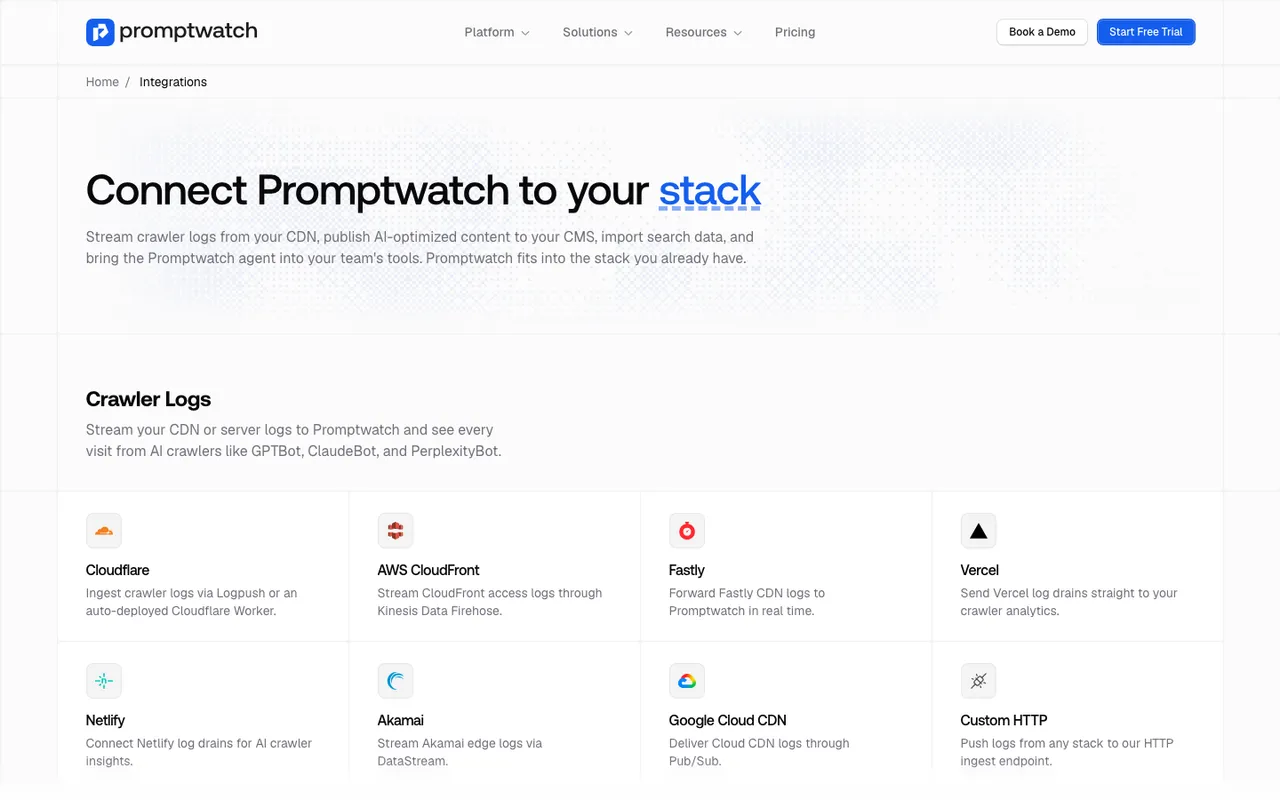 Promptwatch integrations page, captured November 6, 2026.
Crawler logs are where Promptwatch is furthest ahead. Agent Analytics reads your logs in real time and checks each bot against its operator's published IP ranges, so spoofed user agents are filtered out. Tracked bots include GPTBot, OAI-SearchBot, ChatGPT-User, ClaudeBot, Claude-SearchBot, PerplexityBot, Google-Agent, GoogleOther and Meta's crawlers. Logs arrive through Cloudflare Logpush or an auto-deployed Worker, AWS CloudFront via Kinesis Data Firehose, Fastly, Vercel and Netlify log drains, Akamai DataStream 2, Google Cloud CDN, a custom HTTP endpoint or the WordPress plugin. Each page gets a crawl-to-citation path and a citation rate, which tells an access problem from a content problem. Error tracking explains failed fetches. Path filters stack, and everything exports to CSV.
Since November 4, Promptwatch separates search indexers such as OAI-SearchBot, Claude-SearchBot and Meta-WebIndexer, counted as AI crawls, from citation crawls, which are bots like ChatGPT-User that fetch a page while answering a user. SEOs will recognize it as the indexing-versus-retrieval split, and it changes how you read the numbers. Indexer visits with no citation crawls suggest the engine has the page in its index but isn't fetching it to answer anyone. Promptwatch's data reports show why this deserves attention: Meta-WebIndexer grew from about 2% to about 38% of tracked AI crawler requests.
Technical health is covered by weekly site audits with 21 checks, a health score, what changed since the last run and an email every Tuesday. Site Linking finds broken links, pages missing from the sitemap and orphaned pages, and draws an internal linking map by URL path. Each page shows where it was discovered: the sitemap, a link, Search Console or a site map crawl. Sitemap pages have their own tabs for AI visibility over time, the page as crawled, and the crawler and citation visits for that URL. Audits cover 1,500 pages on Essential, 5,000 on Professional and 25,000 on Business.
Query fan-outs are worth a separate mention because they're the closest thing AI search has to a keyword report. Promptwatch shows, per model, the exact sub-queries behind each response. Its data reports found that site: queries jumped from about 0.4% to about 17% of ChatGPT fan-outs on August 8, 2026, which tells an SEO team that the engine is searching inside specific domains.
Data out covers the REST API v2 with date ranges up to 92 days, a hosted MCP server with more than 110 read and write tools, the Looker Studio connector from Professional, and Excel or CSV exports with a column picker. API keys can be scoped to a project, an organization or read-only. Visitor analytics install through a script, a GTM template or the WordPress plugin. When ChatGPT stopped sending a referrer on October 8, 2026, Promptwatch added a toggle that counts utm_source=chatgpt.com visits as ChatGPT again.
Two caveats. Promptwatch isn't a classic SERP rank tracker or a full technical crawler, so it complements those tools instead of replacing them. And crawler logs start on Professional at $245 a month (25M logs), with 100M on Business at $579.
2. AthenaHQ
AthenaHQ lists Google Analytics and Search Console connections and Shopify and Webflow integrations, and Starter at $295 a month covers 11 models with an Action Center. API access is a paid add-on on Starter, with the price on request. Our listing documents no AI crawler-log product and no technical audit, so for an SEO team it sits on top of the stack rather than inside it. SSO and the audit log are on the custom Enterprise tier.
3. Scrunch AI
Scrunch AI reports AI agent and bot traffic and includes five site audits a month on Core at $250. Its Agent Experience Platform, on Enterprise, serves AI-optimized versions of pages to AI crawlers without changing what people see. SEO teams should review that against their own policies on serving different content to bots before turning it on, and decide who maintains the second version. API access, Looker Studio access and SSO are on Enterprise.
4. Profound
Profound lists Answer Engine Insights and Agent Analytics next to its AI Marketer agents, and its Prompt Volumes dataset estimates real query demand. Enterprise is custom with up to nine answer engines, SSO and SOC 2. Our listing doesn't document Search Console or Bing integrations, or how its crawler analytics verify bots.
5. Botify
Botify comes from the other direction: a technical SEO platform that now sells AI search optimization. It serves content to agents in under 300 milliseconds, delivers Markdown to agents, rebuilds product feeds for Google and OpenAI, and reports over 1,000 metrics across traditional and AI search. Its entry also notes log-file analysis of how OpenAI crawls a site.
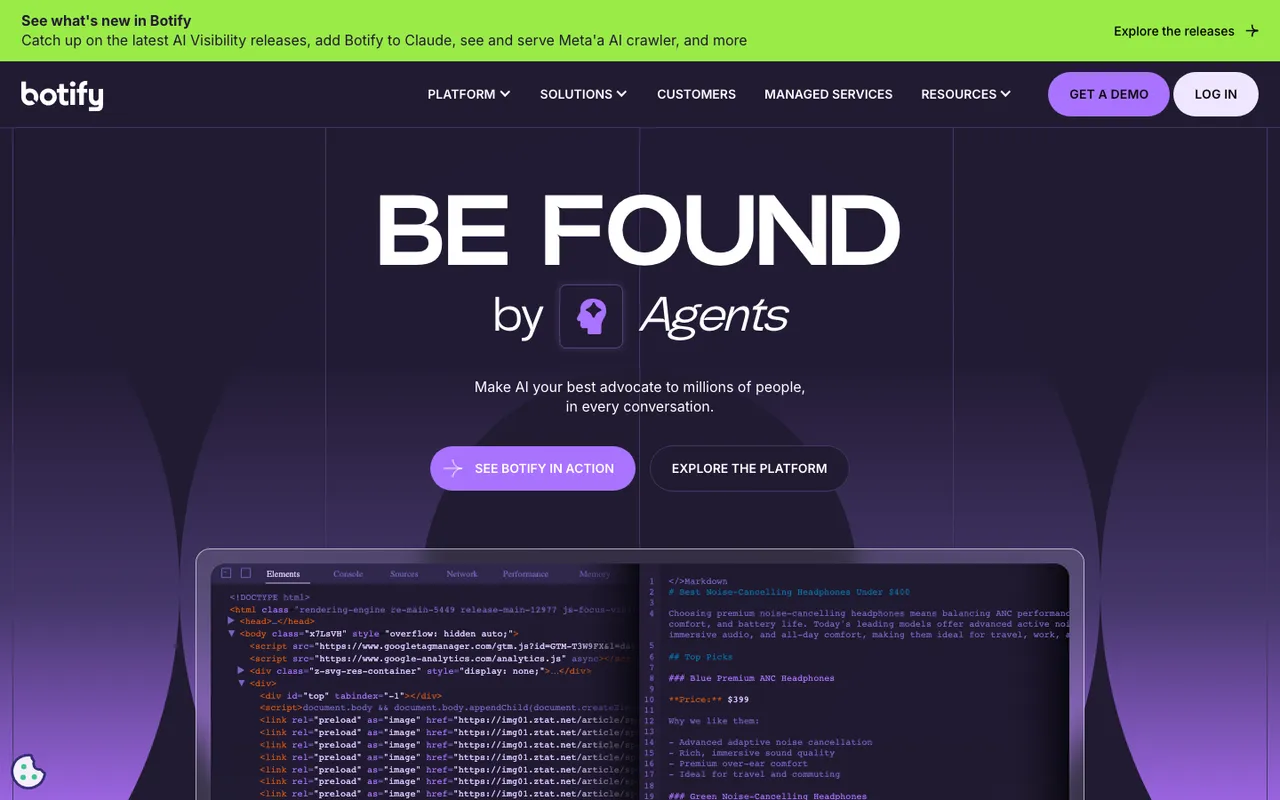 Botify homepage, captured November 6, 2026.
Botify publishes no prices, and implementation is a project. It doesn't replace a multi-engine prompt tracker, so a Botify team will likely still need one for ChatGPT, Claude and Perplexity answers.
6. seoClarity
seoClarity folds AI search into an enterprise SEO suite under the Clarity ArcAI name: brand citation and mention tracking, prompt research, sentiment, AI bot activity, hallucination monitoring, AI shopping capture, and an MCP server and API. Its Technical package starts at $3,200 a month with site audits, unlimited crawl pages and log file analysis, and Enterprise starts at $4,500. ArcAI is a separate add-on with its own packages.
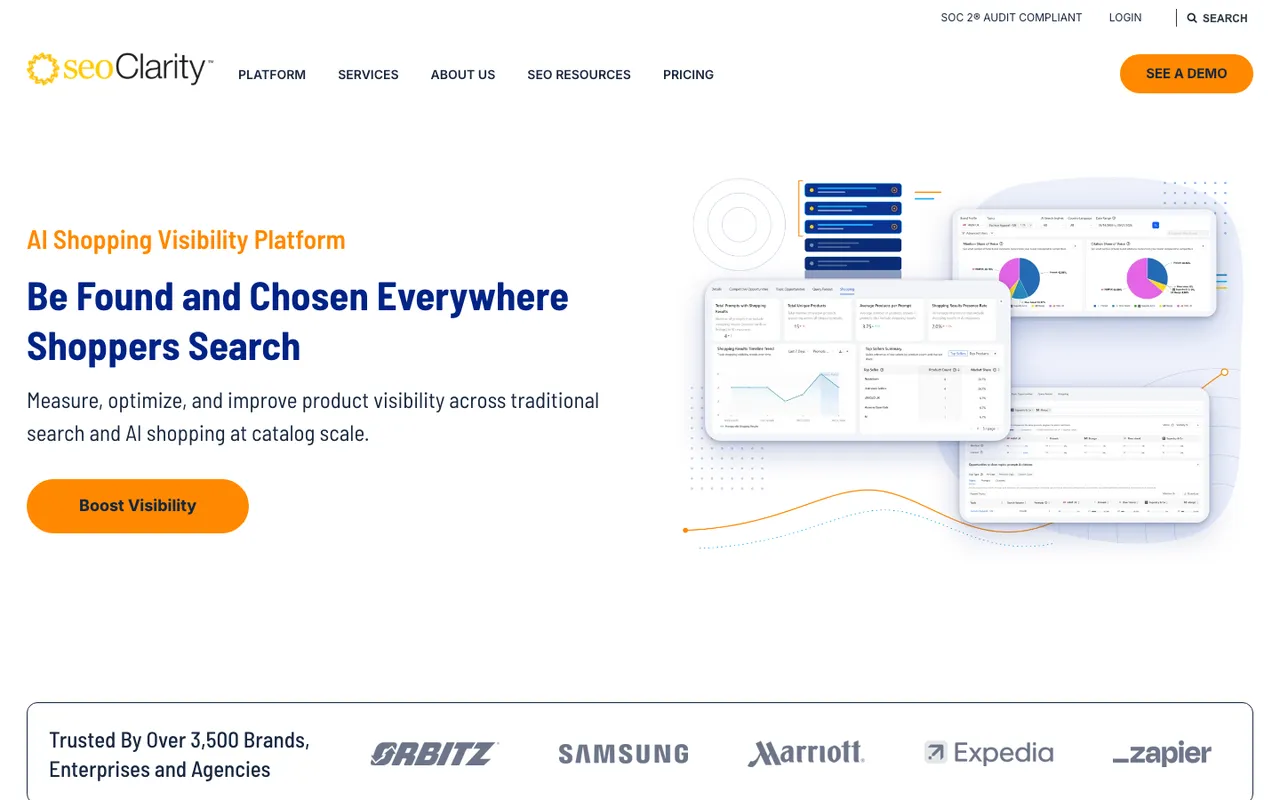 seoClarity homepage, captured November 6, 2026.
For a team already on seoClarity, ArcAI is the obvious first test. Our entry notes a learning curve and describes AI visibility as one module in a large platform.
7. Lumar, Conductor and BrightEdge
Lumar, formerly Deepcrawl, sells AI Search Visibility as a custom add-on to its crawl platform, tracking prompts on ChatGPT, Google AI Overviews, Google AI Mode, Gemini, Perplexity and Claude. Its value is the join with crawl, robots.txt, rendering and schema diagnostics. Prices aren't published.
Conductor spans Creator, Intelligence, Monitoring and AgentStack, with tiers defined by keywords, competitors, websites and pages analyzed. Enterprise lists 60,000+ keywords and 125,000+ pages analyzed. No prices are published.
 Conductor pricing page, captured November 6, 2026.
BrightEdge lists AI Catalyst, AI Agent Insights, Agent Edge and an MCP connector. Its pricing page returned a not-found page when we read it. Our entry records reports that Data Cube numbers often don't match Google Search Console, which is worth checking in any pilot since Search Console is the number your team trusts.
Teams on Ahrefs or Semrush have in-suite options too. Ahrefs Brand Radar includes Custom Prompts with paid Ahrefs plans and reports AI crawler activity, with the AI Visibility Index from $199 a month. Semrush AI Toolkit pricing couldn't be re-verified on the vendor's pages when we last checked.
Comparison table
| Tool | Search Console and Bing | AI crawler logs | Technical audit | Data out |
|---|---|---|---|---|
| Promptwatch | Both, per page and topic | IP-verified, CDN integrations, citation rate per page | Weekly 21-check audits, linking map | REST API, MCP, Looker Studio, exports |
| AthenaHQ | Search Console listed | Not documented | Not documented | API add-on, CSV |
| Scrunch AI | Not documented | AI agent and bot traffic | 5 site audits a month on Core | API and Looker Studio on Enterprise |
| Botify | Not documented | Log-file analysis | Core product | Not documented |
| seoClarity | Not documented | AI bot activity; log analysis on Technical | Technical package | MCP and API |
| Lumar | Not documented | Not documented | Core product | Not documented |
| BrightEdge | Reported mismatches with Search Console | Not documented | Not documented | MCP connector |
A 30-day fit test for your stack
Connect Search Console and Bing Webmaster Tools on day one, and stream CDN logs in the first week. Then pick 50 URLs your team knows well: top revenue pages, a few templates, some old content.
By week three you should be able to sort them into four groups. Pages AI bots crawl and engines cite. Pages bots crawl that never get cited, which is a content problem. Pages bots never reach, which is an access problem your team can fix with robots rules, sitemaps or internal links. And pages that are cited in AI answers but get few clicks in Google, which can mean AI is answering the question before anyone clicks.
A tool that can't produce those four lists from your own data in a month won't produce them after a year. In Promptwatch, all four come out of Agent Analytics, citation analytics and Search Insights in one place, and the failures turn into Action Board tasks your team can assign.
The recommendation
For an enterprise SEO team, the deciding factor is usually the crawler logs and the Search Console and Bing overlay, which most AI trackers don't have and which map directly onto skills the team already has. Promptwatch is the one platform here that ships both, along with technical audits and an API and MCP server for your own reporting. Book a Promptwatch demo with your SEO lead and whoever owns the CDN, and ask to see your own logs on the call.