AI visibility tools that show estimated prompt volume: a buyer's guide to AI search demand data
A buyer's guide to AI visibility tools with estimated prompt volume: what the numbers are built on, what to check in a demo, and what each option costs per month.
If you are shopping for prompt volume, you are really shopping for a model. No AI company hands out its query logs. In the OpenAI help and developer pages we read for this guide, nothing says how often a question is asked in ChatGPT. Google's Search Central page on AI features says AI Overviews and AI Mode appearances are counted inside the regular Web search type in Search Console, and it states no separate filter for them. Microsoft's AI Performance report in Bing Webmaster Tools shows citations and "grounding queries," which it says are not full user prompts.
So the vendors estimate. The useful buying question is not "which tool has the real number" but "whose estimate can I reason about, and what does the tool let me do with it."
What to evaluate before you pay
Where the estimate comes from. Some tools say plainly that their prompts are derived from search keyword data. Others describe a dataset of query demand without publishing the method. Neither is disqualifying, but you should know which one you're getting, because Google-derived demand favors questions that also exist as keywords.
Whether it is per prompt or per topic. A topic-level demand figure helps with planning. A per-prompt figure helps you decide which 50 questions to pay to monitor every day.
Whether the volume sits next to tracking. A research database that lives apart from your tracked prompts forces copy-paste between tools. The cleaner setup is one table: prompt, volume, difficulty, your visibility.
What you have to buy to see it. Volume is often the feature that pushes a quote into a higher tier.
What happens after. Volume tells you what to aim at. You still need citation data to see which pages win those prompts and traffic data to see whether they convert.
What each option costs
Prices below come from our catalog, read in October and November 2026, in USD per month unless noted.
| Tool | Volume signal (as documented) | Cost to reach it |
|---|---|---|
| Promptwatch | Prompt Volumes: monthly volume, difficulty, citation rates | Essential $95, Professional $245, Business $579; 7-day free trial on monthly billing |
| Ahrefs Brand Radar | Estimated Impressions weighted by Google search volume | Base Ahrefs plan from $129, AI Visibility Index from $199, all models $699 |
| Profound | Prompt Volumes dataset of query demand; full set on Enterprise | Free 7-day trial; Enterprise custom (earlier estimate about $40k a year) |
| Writesonic GEO | Prompt volume data in the GEO module | From $79 billed annually |
| HeyAmos | Prompt-volume scores; prompt volumes on Growth | Growth $249 |
| Semrush AI Toolkit | Demand figures on AI-generated prompts (reviewer doubts) | $99 per domain, plus $99 per extra user |
Two more platforms belong in any shortlist even though our catalog doesn't document a volume metric for them. AthenaHQ has a free Essential tier and a $295 Starter plan billed in credits, where one credit is one AI response. Scrunch AI Core is $250 for 125 prompts and 5,000 responses. If demand data matters to you, ask either vendor to show it on your own category during a demo.
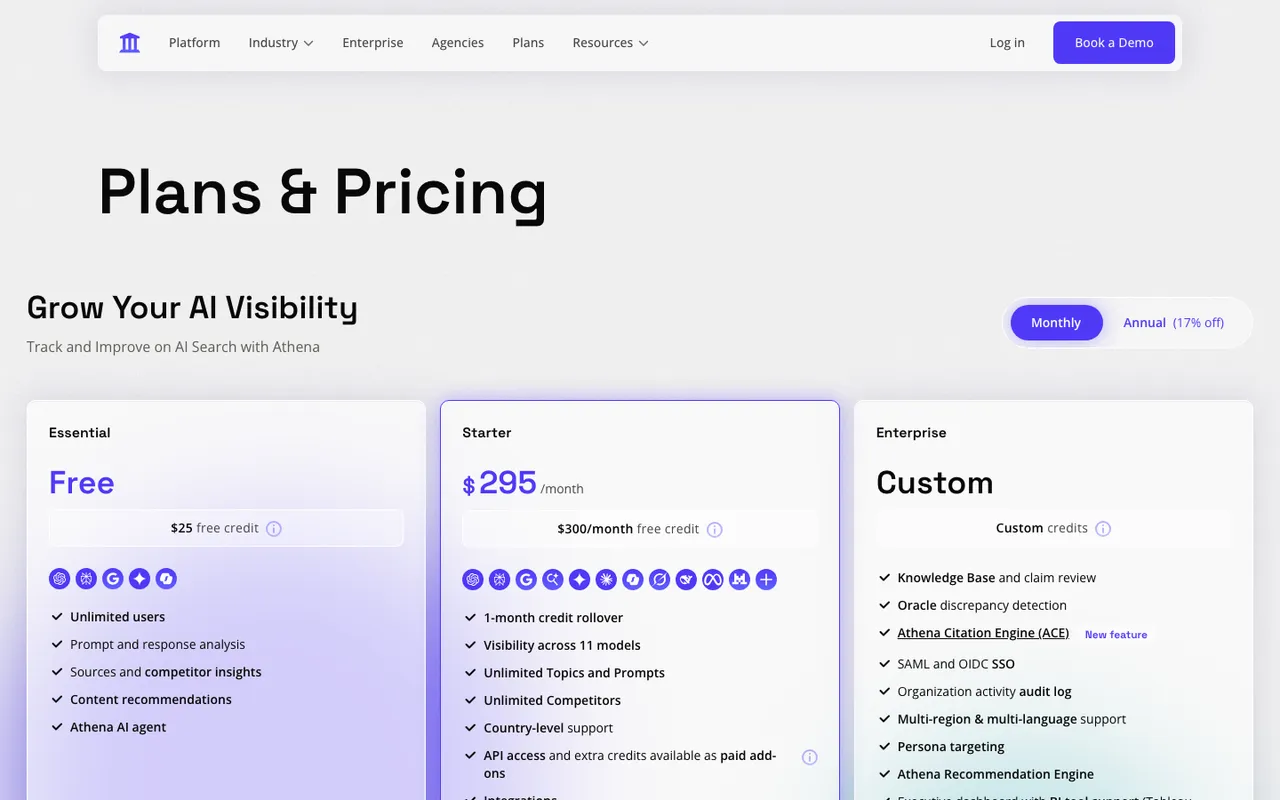
AthenaHQ's plans page, captured November 6, 2026.
Peec AI and Otterly.AI round out the market, but our catalog lists no prompt volume feature for either.
How the main options differ in practice
Ahrefs Brand Radar is the easy add for an Ahrefs team, and the volume reads like keyword volume because that is what it is built on. The catch, per our review, is that prompts modeled from Google keywords don't reflect how people talk to chatbots, and full coverage stacks to several hundred dollars on top of the base plan.
Profound has the most talked-about dataset, but you will only see all of it inside an enterprise contract, and our review notes setup takes one to three months with a dedicated owner.
Writesonic GEO and HeyAmos bundle volume with content production. That is handy for small teams, though both limit which engines you can track at the lower tiers.
Semrush AI Toolkit gives you a demand column inside a tool you may already pay for. Our review suggests sanity-checking every number against what you know about your market.
Promptwatch is the one where the volume estimate, the difficulty score, the tracking, and the follow-through all sit in the same workspace. Volume and difficulty are attached to the prompts you monitor, so prioritizing becomes a sort instead of a spreadsheet job.
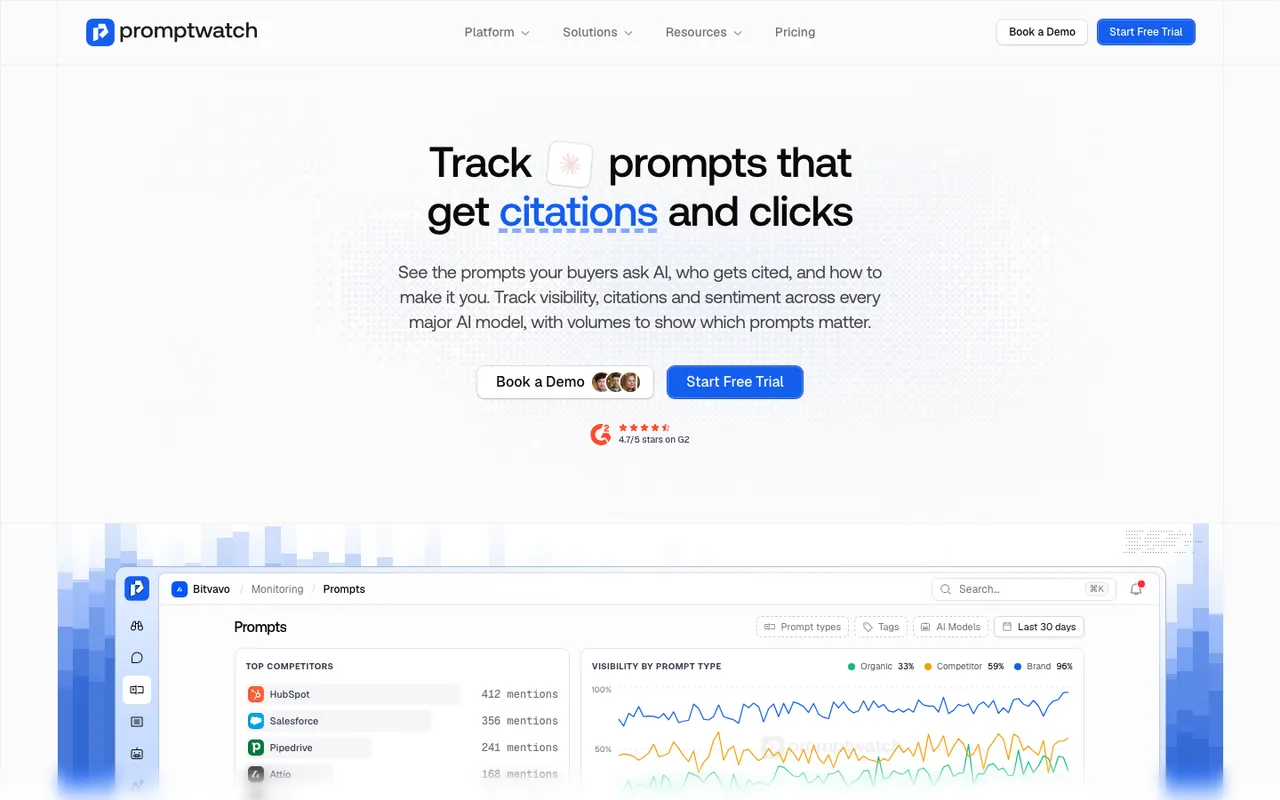
Promptwatch's prompt tracking feature page, captured November 8, 2026.
How to choose
- You already pay for Ahrefs or Semrush and want a rough demand signal: try the module you have, and treat it as directional.
- You are an enterprise team with budget and a dedicated analyst: Profound's dataset is worth a look, knowing the price and setup time.
- You need volume and a writer in one bill: compare Writesonic GEO and HeyAmos on engine coverage first.
- You want to pick prompts by demand and then prove they matter: that needs tracking, citation analytics, crawler logs, and AI-referred traffic in one place. Promptwatch covers all four, with crawler logs from Professional.
The practical way to decide is to run your own category through it. Start Promptwatch's 7-day free trial on monthly billing, load 20 prompts you already care about, and see whether the volume ranking matches what your sales team hears.