Which AI writing tool creates content briefs for AI search? A buyer's guide for 2026
What a content brief for AI search must contain, how to evaluate brief generators like Frase, Surfer, Clearscope and Promptwatch, and what each costs in 2026.
A content brief is a contract between whoever decides what to publish and whoever writes it. For Google, the contract has been stable for years: target keyword, search intent, competing pages, headings to cover, word count. For AI search it needs a few more clauses, and most brief generators haven't added them yet. Before comparing tools, it helps to know what the finished brief should hold.
What a brief for AI search should contain
- The prompt the page should win, written the way a buyer would ask an assistant, not as a two-word keyword.
- The sub-queries an engine runs for that prompt. Assistants rarely search the prompt verbatim; they split it into several narrower searches, and your page has to rank for those to be read at all.
- The pages engines cite today, with their content type (comparison, docs, listicle, forum thread), because that shows what format the engine trusts for this question.
- What those cited pages don't cover, which is your angle.
- The claims the page must state plainly, sourced from an approved fact base.
- Internal links to and from the new page.
Points 1 and 6 exist in every SEO brief. Points 2 to 4 require data from AI answers, which is where the tools differ.
What Google and OpenAI say
Google's Search Central page "AI features and your website" keeps it simple. SEO best practices remain relevant for AI Overviews and AI Mode, there are no additional requirements, and you don't need new machine-readable files or special schema. It also says both features may use a query fan-out technique across subtopics. OpenAI's help article "Searching the web with ChatGPT" says ChatGPT typically rewrites a question into one or more targeted queries for its search providers.
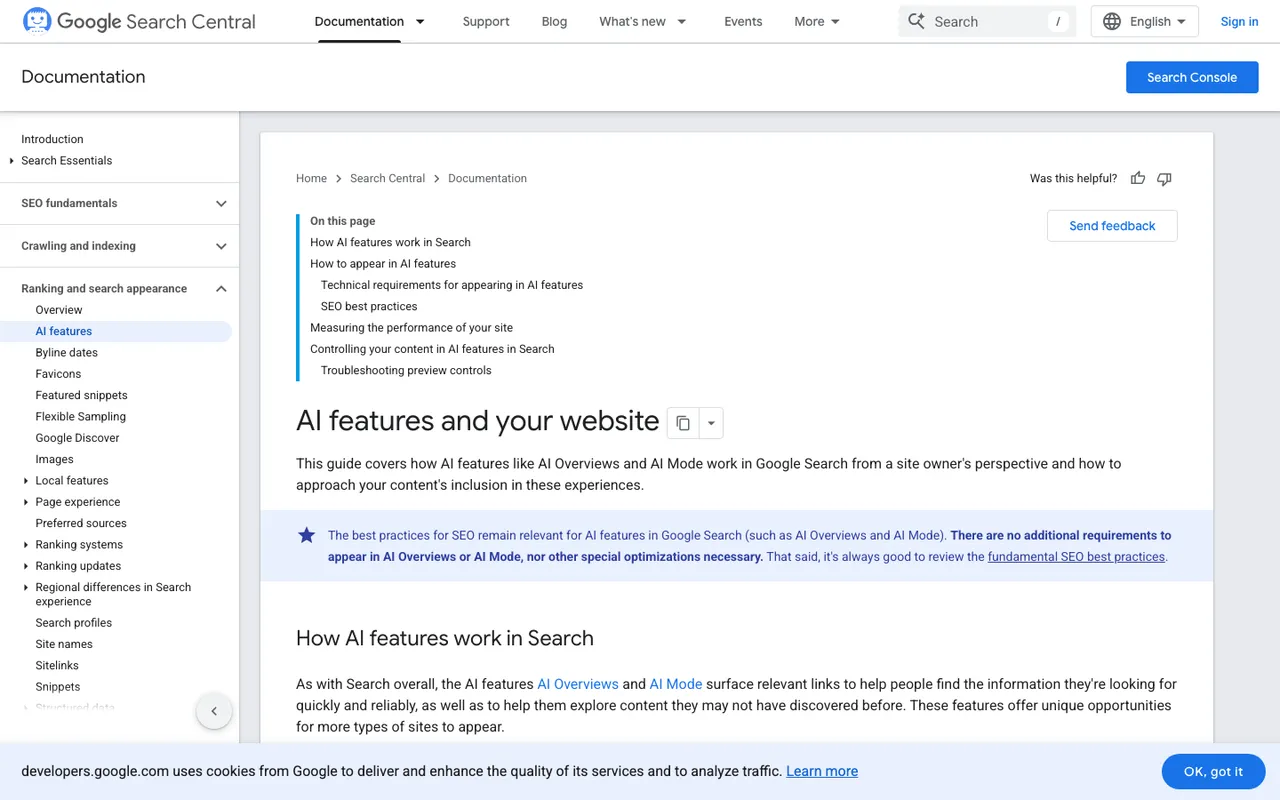
Google Search Central, "AI features and your website", captured November 21, 2026.
So the official guidance supports a classic, well-built page. The brief's extra job is to make sure that page covers the searches the engine actually runs.
How to evaluate a brief generator
Where the brief's data comes from
Most generators read Google's top results. That is useful and incomplete. Promptwatch builds briefs from tracked AI answers: a brief can start from a tracked prompt, a query fanout (the exact sub-query a model ran, captured from the response) or a cited page, then adds Google results, news, YouTube transcripts, live page screenshots and up to five competitor URLs. Clearscope sits in between: it recommends terms and questions from search intent and also shows the web searches AI platforms trigger, for queries it tracks on ChatGPT and Gemini.
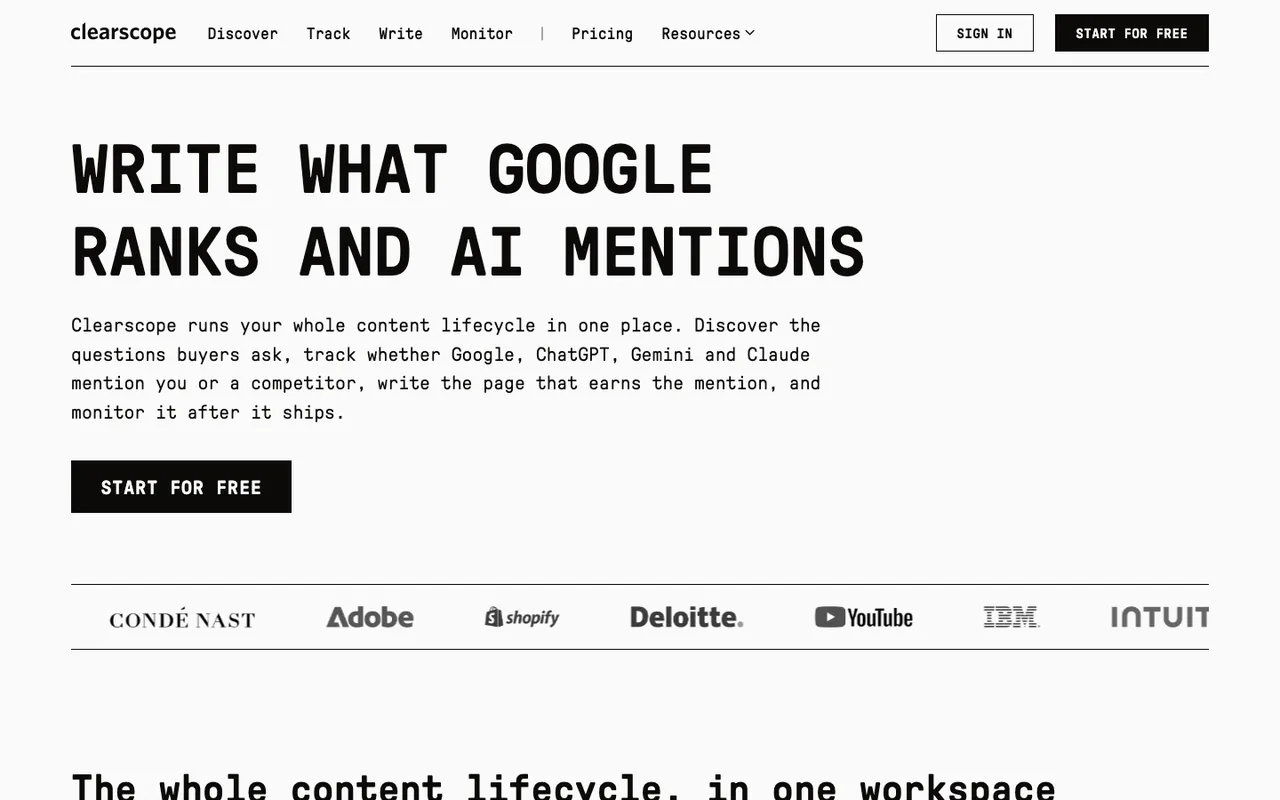
Clearscope homepage, captured November 6, 2026.
Which engines feed it
Check which assistants a tool tracks on the plan you'd buy. Frase's Starter covers ChatGPT and Google AI. Clearscope covers ChatGPT and Gemini. Surfer's Standard runs 25 AI prompts weekly. Every paid Promptwatch plan can track any of its supported engines, which include ChatGPT, Perplexity, Gemini, Copilot, Google AI Overviews and AI Mode.
Whether briefs become drafts
Some tools stop at the brief. Frase, Surfer and Clearscope draft as well. Promptwatch drafts from Professional through AEO articles, and on Business its Content Agent schedules and publishes against open gaps with a review inbox.
Whether you can see the result
A brief is a hypothesis. Ask how you'll know it worked. Promptwatch follows the published page through AI crawler logs, citations and AI-referred conversions. Its Citation Trends tab also reports first cited, ramp-up days and decay half-life per page, which tells you when a page started earning citations and when it began to fade. Neither OpenAI nor Google publishes how long a page takes to be cited after a crawl, so a tool that records it for your own pages is the only reliable source you'll have.
Whether it fits how your team works
A brief that lives in a separate tool tends to get copied into a document and edited until it no longer matches the data. Check whether drafts open in the same workspace as the brief, whether editors can comment, and whether the tool connects to your CMS. Promptwatch publishes to WordPress, Webflow and Framer, and every paid plan has unlimited seats, so writers and reviewers don't need to share logins.
What it costs
From our catalog; confirm on vendor pages before buying.
| Tool and plan | Price | Brief-relevant limits |
|---|---|---|
| Promptwatch Essential | $95/mo | Gap analysis, 50 prompts; no AEO articles |
| Promptwatch Professional | $245/mo | 150 prompts, 5 AEO articles, Knowledge Base, crawler logs |
| Promptwatch Business | $579/mo | 350 prompts, 10 AEO articles, scheduled Content Agent |
| Frase Starter | $39/mo yearly, $49 monthly | 10 articles, 20 AI Visibility prompts |
| Frase Professional | $103/mo yearly, $129 monthly | 3 seats, 40 articles, 50 AI prompts |
| Surfer Standard | $99/mo billed yearly | Content editor, 25 AI prompts weekly |
| Clearscope Essentials | $129/mo | 50 tracked queries, 20 Discoveries, 20 Drafts |
| MarketMuse Optimize | Not shown on the pricing page | 5 briefs a month, no AI answer tracking |
Promptwatch includes unlimited seats on every paid plan and a 7-day free trial on monthly billing; annual billing is 12 months for the price of 10.
How to choose
If your content still mostly competes in Google, Frase or Clearscope will produce solid briefs with a light AI layer. MarketMuse suits topical planning across a large site but tells you nothing about AI answers. If AI citations are the goal, the brief needs the fanouts and cited pages for prompts you track, and that points to Promptwatch.
Book a Promptwatch demo and ask for one thing: a brief generated live from a prompt in your market where you're currently not mentioned. You'll see quickly whether the fanout list changes what your writers would have covered.