Why isn't my brand showing up in ChatGPT answers? A buyer's guide to the software that finds out
Before you buy a GEO tool to fix missing ChatGPT visibility, learn what blocks brands, which features diagnose it, and what each option costs in late 2026.
Most teams start shopping for GEO software the week someone senior asks ChatGPT about the category and the company isn't in the answer. That's a fine trigger. The trouble is that "we're invisible in ChatGPT" has several unrelated causes, and many tools on the market only measure the symptom. A dashboard that confirms you're absent, week after week, is not worth $300 a month.
This guide works backwards from the causes to the features that find them, then to the prices.
What usually keeps a brand out
OpenAI publishes more about this than people assume, though it never lists ranking factors. Its Help Center page "Searching the web with ChatGPT" says ChatGPT search can partner with other search providers, rewrites the user's question into targeted queries for them, and may run further, more specific queries after reviewing the first batch. The same page warns that results and citations can be incomplete or wrong. Separately, the crawler documentation says OAI-SearchBot is how sites get surfaced in ChatGPT search, and that sites opted out of it won't appear in those answers.
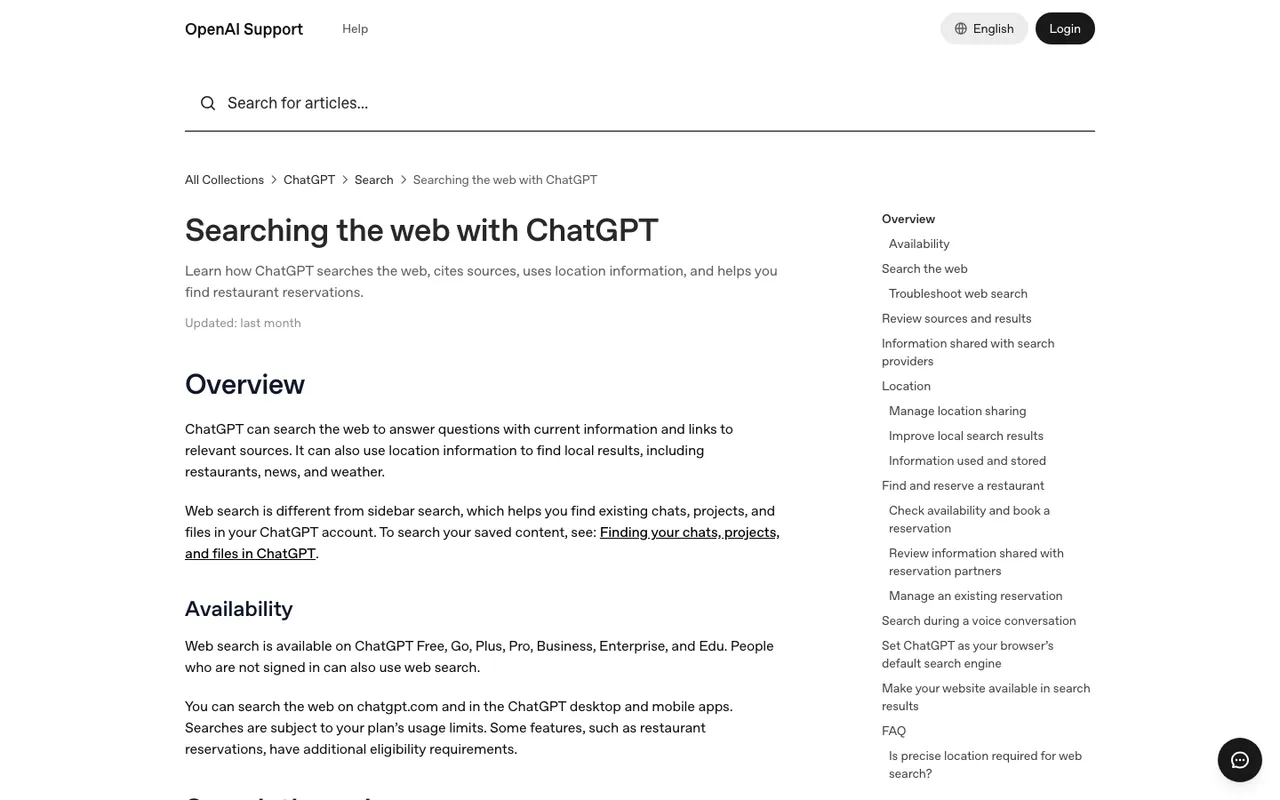
OpenAI Help Center, "Searching the web with ChatGPT", captured November 21, 2026.
Put together, a missing brand comes down to a short list: the crawler is blocked (in robots.txt, or by a CDN that drops OpenAI's IP ranges), your pages don't match the rewritten queries, the third-party pages ChatGPT reads don't mention you, or the model has absorbed claims about you that push it toward rivals. Answers that run without web search draw on what the model already knows, which you can't edit directly.
What to evaluate
Crawler evidence, not a robots.txt checker
A robots.txt validator tells you what you intended. Server logs tell you what happened. Look for a tool that ingests CDN or server logs and verifies bot identity against the operator's published IP list, because user agents are trivial to fake. Ask which bots it tracks by name: OAI-SearchBot, GPTBot, and ChatGPT-User do different jobs, and only the first decides search inclusion.
The queries behind the answer
If a tool shows you only the prompt and the response, you can't see why a competitor won. You want the fan-out queries ChatGPT actually ran for each response, so you know which searches your pages have to win.
Citation depth
Domain-level citation counts are a start. Better: page-level citations, citation trends over time, and offsite mentions where your brand is named without a link. That's your outreach list.
Claim-level brand analysis
A sentiment score tells you the tone. It doesn't tell you that ChatGPT keeps repeating a price you changed last year. Look for claim extraction and a way to check those claims against sources.
Traffic after the fix
You'll eventually need to show the work paid off. That needs visitor analytics that recognize AI referrals. Promptwatch's changelog notes ChatGPT stopped sending a referrer on October 8, 2026, so ask any vendor how they handle utm_source=chatgpt.com visits.
How the metrics fit together
Pick software whose metrics separate presence from prominence. Promptwatch's Academy lays out six core metrics and starts from the distinction between a mention (your name in the answer text) and a citation (your URL attached as a source).
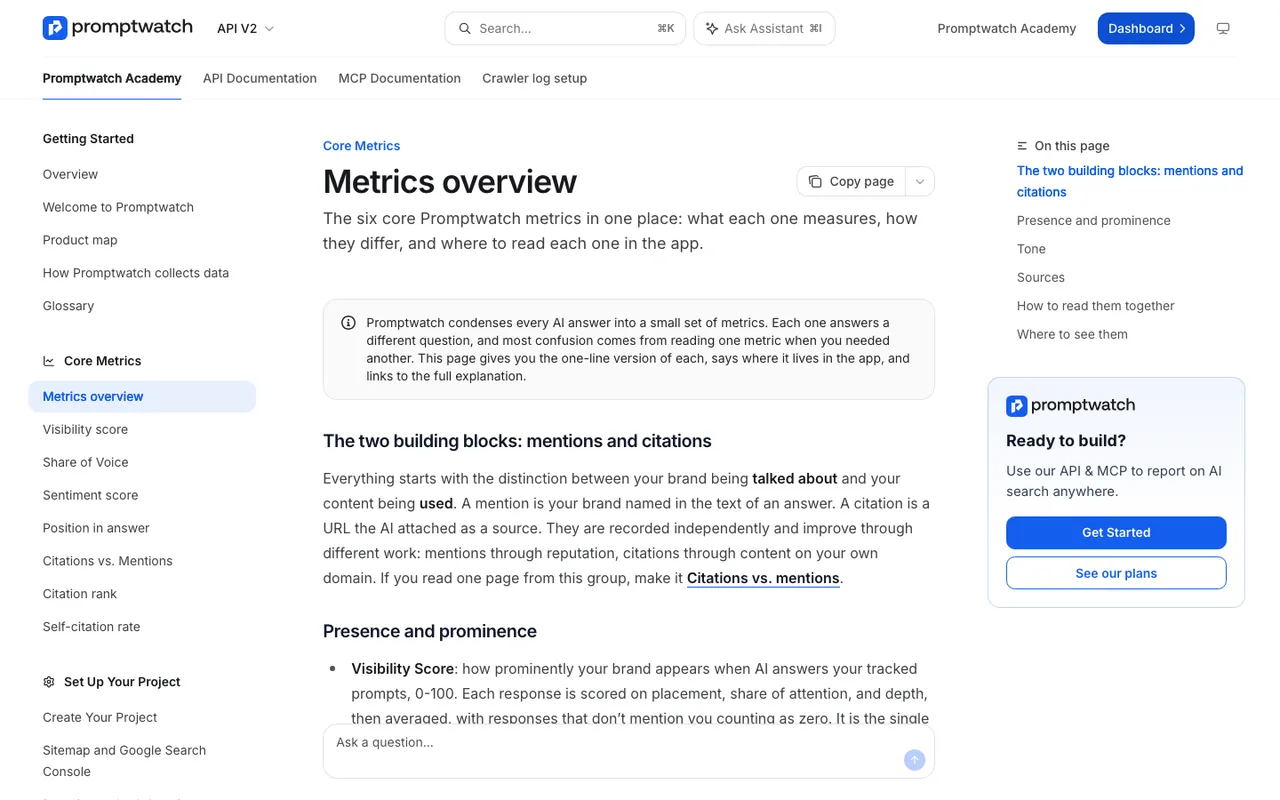
Promptwatch Academy, "Metrics overview", captured November 14, 2026.
What each option costs
Prices below come from each vendor's pricing page as recorded in our catalog.
- Promptwatch: Essential $95/mo (50 prompts, no crawler logs), Professional $245/mo (adds 25M crawler log events, AEO articles, custom reports), Business $579/mo (adds the automated Content Agent, Fact Check, ChatGPT Shopping, Ads Radar). Agencies start at Kick-off, $199/mo with unlimited projects and prompts. Every self-serve plan has a 7-day free trial on monthly billing, and team seats are unlimited.
- AthenaHQ: free Essential tier with 300 credits; Starter $295/mo with 3,600 credits, where one credit is one AI response. Bloomreach announced the acquisition on November 16, 2026, and standalone pricing after the joint launches in early 2027 isn't stated.
- Scrunch AI: Core $250/mo for 125 prompts and 5,000 responses on four engines; Enterprise custom.
- Profound: free 7-day trial, then custom Enterprise. Our catalog's earlier estimate is about $40k a year.
- Semrush AI Toolkit: listed at $99/mo per domain as an add-on, though we could not reconfirm that figure on the vendor's current pages.
How to choose
Match the plan to the cause you suspect.
If you haven't ruled out crawler access, the cheapest tier that lacks log ingestion leaves you guessing. On Promptwatch that means Professional, not Essential. If access is fine and you're losing on content, the fan-out data and citation pages matter most, and both are part of Promptwatch's core monitoring rather than add-ons. If the problem is what ChatGPT says rather than whether it says anything, Fact Check is the feature to test, and it starts on Business.
For teams already deep in an SEO suite, an add-on can cover basic mention tracking. It won't show crawler logs or AI-referred conversions, which is usually where the budget conversation gets decided.
Our recommendation: run Promptwatch on the 7-day trial with 20 or 30 real buyer prompts and connect your CDN logs in the first week. A week of daily runs plus log data is usually enough to point at one of the causes above, and to judge whether the platform earns its line in the budget.