ChatGPT content types in spring 2026: comparison pages nearly doubled
Promptwatch's spring 2026 data shows ChatGPT citing comparison pages almost twice as often. What that means, and what to ask GEO vendors about tracking it.
Comparison content went from about 1.8% to 3.5% of ChatGPT's classified citations between late February and early April 2026. Promptwatch's ChatGPT content-type report for March 2026 calls it "the fastest-growing format in this dataset." The share is still small. The direction is what matters to anyone who sells against named competitors, because "X vs Y" questions are where buyers make up their minds.
Before going further, one correction to the report's label. Its title says March, but the window runs from February 24 to April 5, 2026. Every figure below from that page covers those six weeks, not the calendar month. It counts classified citations only, with a daily breakdown.
What ChatGPT cited between February 24 and April 5
Product pages led. The report puts them at around 18% of daily citations, "trending toward 19% by early April." Listicles were roughly 16% and news articles about 9%, all for February 24 to April 5, 2026, per the spring report.
The chart legend gives a value per format: Product Page 17.7%, Listicle 15.4%, News Article 9.1%, Social Post 4.3%, How-To 3.9%, Comparison 2.6%, Video 0.1%. The page doesn't label what those legend values are, though they match the averages in its text, so 2.6% reads as the period average for comparisons and 1.8% to 3.5% as the start and end of the climb (same report, Feb 24 to Apr 5).
Two more lines from the page are worth noting. Social posts made a "steady climb", with no figure attached. And the report says that "compared to earlier in the year, ChatGPT has shifted further toward citing brand-owned commercial pages", again without an earlier number on that page.
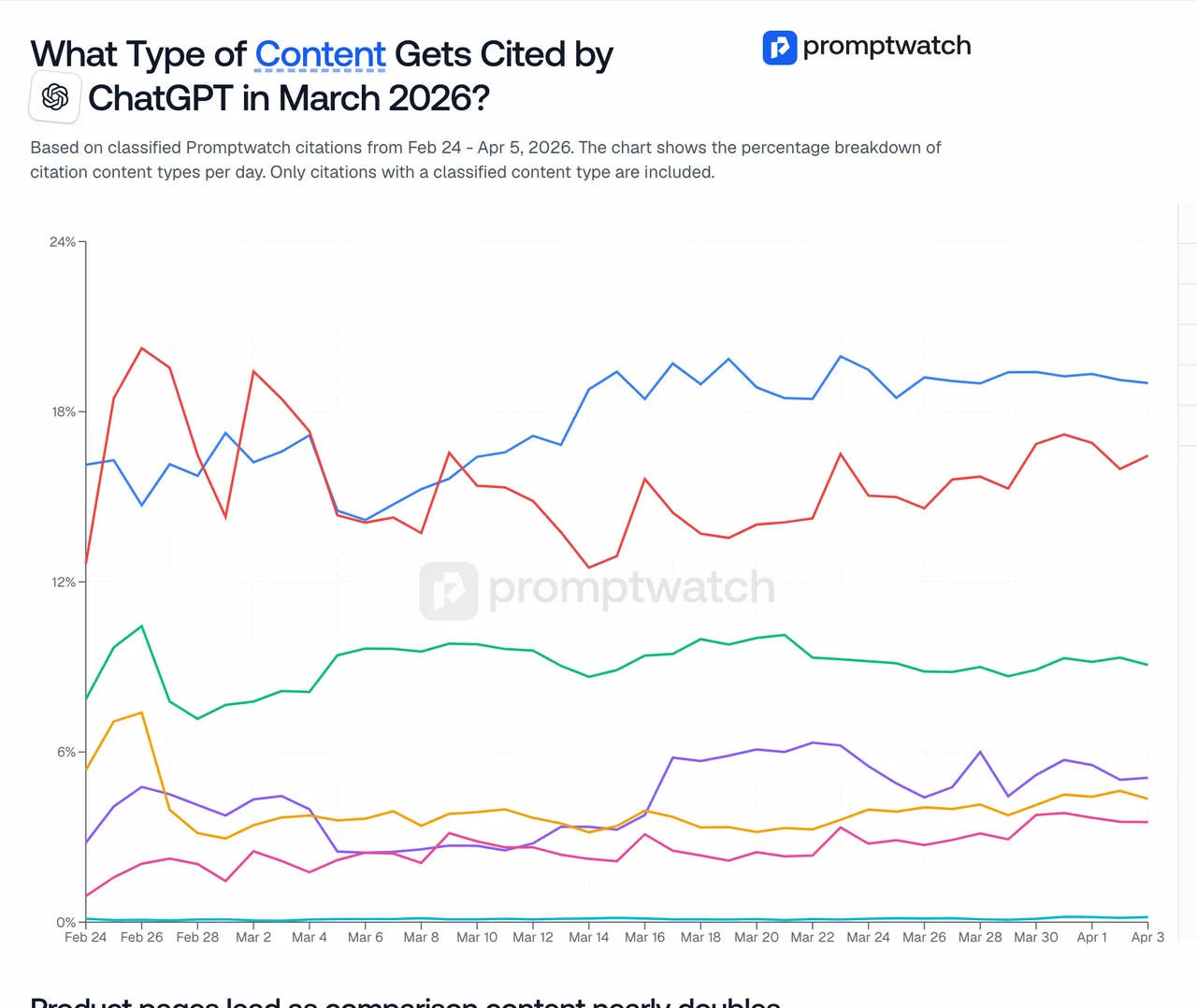 Promptwatch's "What Type of Content Gets Cited by ChatGPT in March 2026?" chart (window Feb 24 to Apr 5, 2026), captured November 14, 2026.
How the story continued
Later reports from the same series let you follow both product pages and comparisons through the year. Each figure comes from its own report, so read them as separate readings rather than one continuous line.
- July 2026 (Jul 1 to 31): product pages about 33% of daily citations, and comparisons rose from 2.5% on July 1 to 3.2% by the end of the month, per the July report.
- August 2026 (Aug 1 to 31): product pages about 29%, dropping to about 25% after August 22, with a comparison legend value of 3.5%, per the August report.
- September 28 to October 4, 2026: product pages 22.4% and comparisons 5.9% of classified citations across all prompts, rising to 7.9% for commercial prompts, per the separate content-type by intent report. That report may classify differently, so don't stitch it onto the monthly series as if it were the same measurement.
The rough shape: product pages surged into summer and then eased, while comparisons kept a modest upward drift and matter most on commercial prompts. That last point is the one a buyer of GEO software should hold onto.
What we think it means
This is interpretation; the reports don't give causes.
Comparison pages answer a question ChatGPT gets asked constantly: which of these should I pick? A page that lays out two products side by side, with specs, prices, and a clear verdict, is easy for a model to quote. One likely reason the format grew is that ChatGPT was handling more of these head-to-head questions with web search turned on in spring 2026, but the report doesn't say that, so treat it as a hypothesis.
For a brand, the uncomfortable part is who writes those pages. If the only "you vs your rival" page on the web is your rival's, that is the page ChatGPT has to work with. Publishing your own comparison pages, honest ones that admit where the other product wins, is the obvious response. Watching whether ChatGPT cites them is the part that needs software.
Product pages being the largest format points the same way. ChatGPT cited the pages that describe what a company sells more than any other format in this window. Pricing pages, feature pages, and spec sheets that are complete and crawlable are citation assets, not just conversion pages.
What to ask a GEO vendor about content types
Most tools will say they "track citations". Push past that with specific questions.
- Do you classify citations by content type, and is "comparison" one of the types?
- Can I see the share of comparison citations over time for my own prompts, separately for ChatGPT, Google AI Overviews, and Google AI Mode?
- Can I tag prompts as competitor comparisons and filter every report to just those prompts?
- When a comparison answer cites a page, can I see whether it was my page, my competitor's, or a third-party review?
- Can I track one specific URL, such as my "us vs them" page, and see each response that cited it?
- Do you show how my position in a comparison answer changes, not just whether I'm mentioned?
The third and fifth questions are where weaker tools fall down. Without prompt-type filtering, comparison answers get averaged in with everything else. Without URL tracking, you can't tell whether the page you just published is doing its job.
What to ask about comparison-page tracking specifically
A short list for the demo itself:
- Ask the vendor to set up a monitor of ten "your brand vs competitor" prompts during the call.
- Ask to see the cited URLs for those answers, grouped by domain.
- Ask whether the tool can write a comparison page from those gaps, and whether it uses the competitor pages ChatGPT already cites as input.
- Ask how long until a newly published page would show up in the data, and how you would know if it never does.
How we would do it in Promptwatch
Promptwatch handles this end to end. Prompts carry a type (Organic, Brand Specific, or Competitor Comparison), so you can isolate comparison questions across every report. Citation Trends classifies citations into 22 content types and 20 source types and shows the trend per type, filtered by monitor. URL Positions shows where each cited URL sits in an answer's source list, and Page Tracker follows a specific page, yours or a competitor's, with the prompts and responses that cite it.
Positioning inside the answer is tracked too. Position is the average order in which your brand appears among brands in an answer (lower is better), and the competitor heatmap lets you put brands against topics or models to see where a rival out-ranks you.
Then there is the writing side. Content Creation on demand, through AEO articles from Professional ($245 a month, five articles included), writes from a brief that can pull in up to five competitor URLs, Google results, news, and internal links. On Business ($579 a month) the Content Agent plans, writes, and publishes against visibility gaps on a schedule, with a review inbox or fully automated mode. Content Refresh suggests diff-style updates to comparison pages you already have.
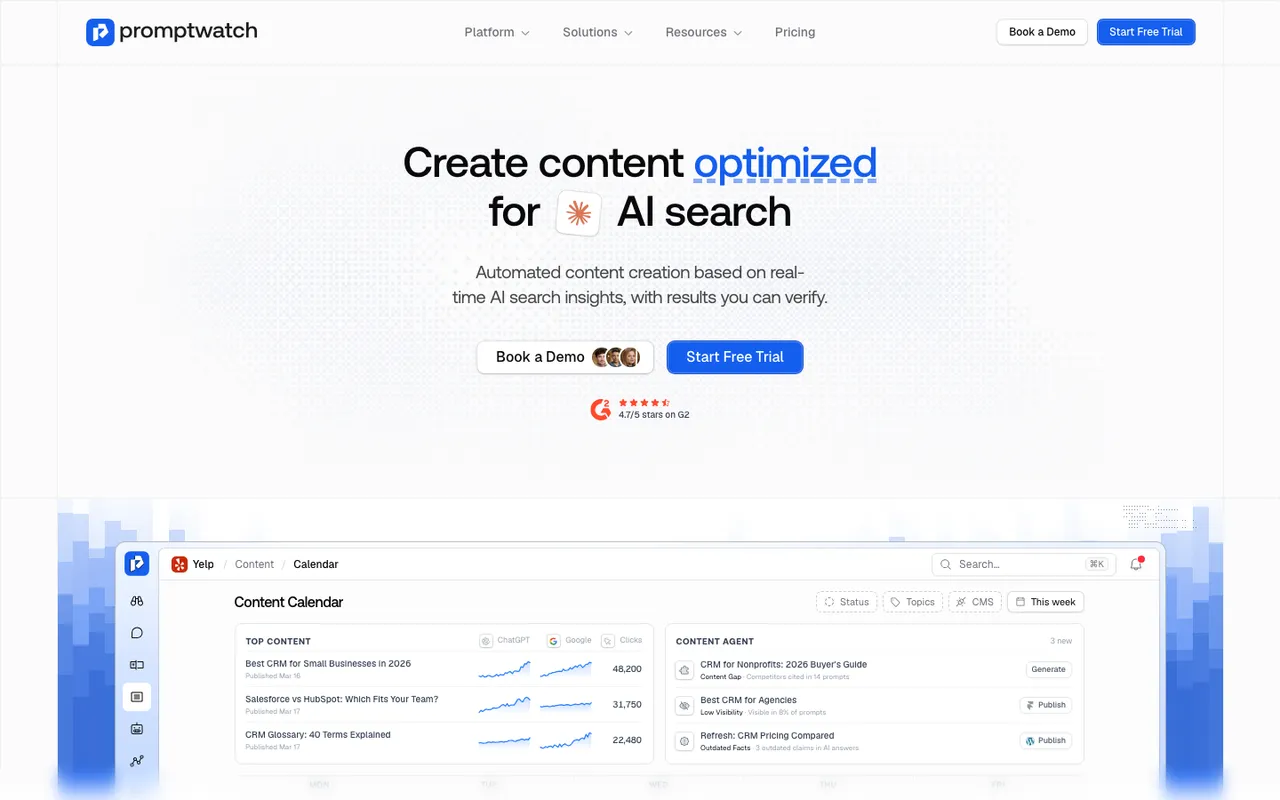 Promptwatch's Content Agents page (example figures are illustrations), captured November 8, 2026.
Other options in our catalog: AthenaHQ pairs tracking with an Action Center and a content optimization agent, from $295 a month on Starter. Scrunch AI Core is $250 a month with four engines and focuses on serving AI-optimized pages to crawlers. Profound sells enterprise marketing agents on custom pricing. For tracking comparison citations by URL and prompt type and then writing the page, Promptwatch covers more of the loop.
Bottom line
Between February 24 and April 5, 2026, comparison content went from about 1.8% to 3.5% of ChatGPT's classified citations, while product pages led at around 18% (Promptwatch report). The later content-type by intent report has comparisons at 7.9% on commercial prompts for September 28 to October 4, 2026. If you compete by name, your comparison pages deserve their own tracking. Book a Promptwatch demo at promptwatch.com/book-a-demo and ask them to run your top ten competitor prompts live.