Crowded AI answers: what to ask a GEO vendor about position tracking
Almost half of ChatGPT answers with citations name 10 or more domains. Why being cited isn't enough, and the position-tracking questions to put to any GEO vendor.
What does "we got cited" mean when the same answer cites nine other websites?
That's the question Promptwatch's unique domains per response report forces on anyone reading a GEO dashboard. For September 28 to October 4, 2026, it found that 47.6% of ChatGPT responses with at least one citation cited 10 or more different domains. Being one of the sources is the entry ticket. Where you sit, and how much of the answer is about you, decides whether a reader notices.
This post covers what the report found, why it changes how you should judge GEO software, and the questions to ask a vendor about position tracking.
How crowded ChatGPT's answers are
The report looks only at ChatGPT responses that cited at least one source. It counts each domain once per response, however many URLs from that domain appear, and groups everything at 10 or more into one capped bucket. All figures below are for September 28 to October 4, 2026, from the same report.
Across all responses, 47.6% cited 10 or more domains and 66.1% cited at least eight. Only 6% cited three or fewer, and just 1% relied on a single domain (unique domains report, Sep 28 to Oct 4, 2026). The share rises with every extra domain from one to nine, so the typical cited answer is a crowded one.
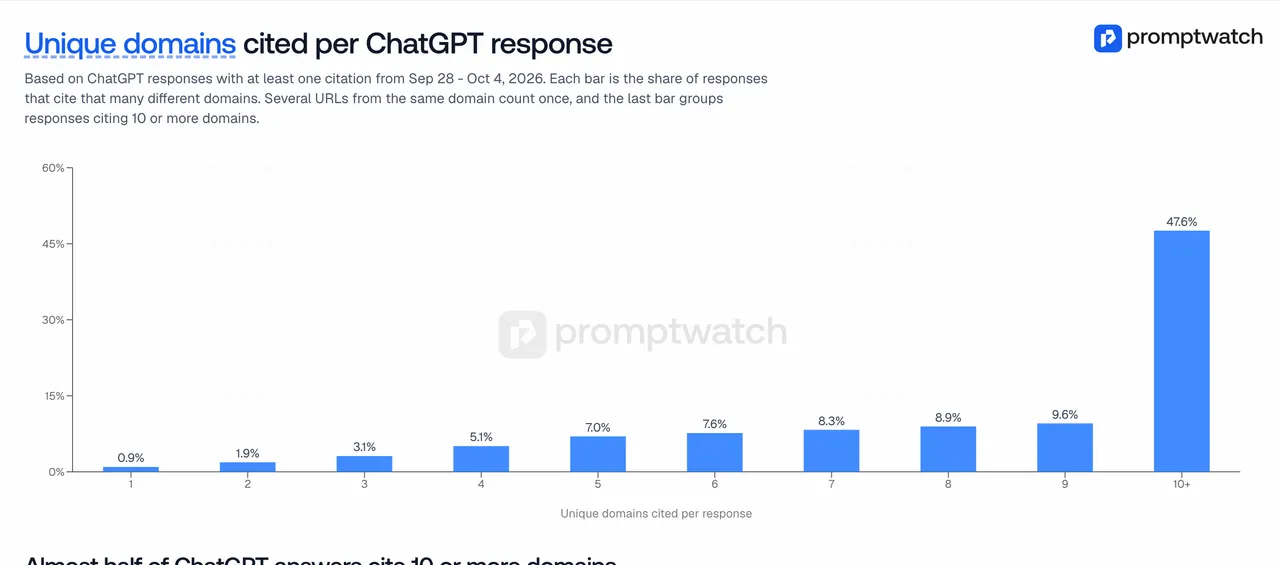 Promptwatch's "Unique domains cited per ChatGPT response" chart (Sep 28 to Oct 4, 2026), captured November 14, 2026.
It depends on the kind of question
The report splits responses by prompt type, and the differences are large.
Organic prompts, where no brand is named, were the most crowded: 52.5% cited 10 or more domains, 71.8% cited at least eight, and only 4.5% cited three or fewer. Competitor comparison prompts were close behind, with 49.1% at 10 or more and 66.5% at eight or more; only 0.35% of comparison answers relied on a single domain, the lowest of the three types. Brand-specific prompts were different. Only 21.3% cited 10 or more domains, 13.8% cited three or fewer, the most common count was five domains (14.9% of responses), and 40.7% cited five or fewer. All of this is for September 28 to October 4, 2026, per the unique domains report.
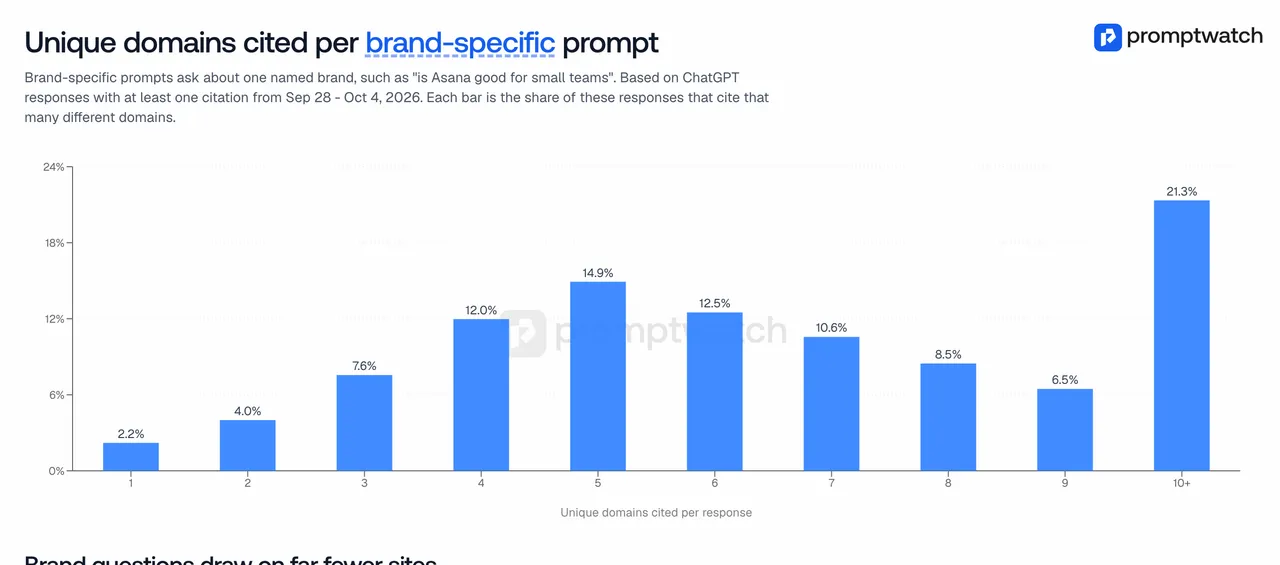 Promptwatch's "Unique domains cited per brand-specific prompt" chart (Sep 28 to Oct 4, 2026), captured November 14, 2026.
Why a yes/no citation count misleads
Our interpretation of what this means for measurement:
On an organic prompt like "best project management software for agencies", you are likely to share the answer with many other domains. A tool that reports "cited: yes" counts you as a winner whether you were the first brand named with a paragraph of detail or the eleventh link at the bottom. Those outcomes aren't equal, and a binary metric can't tell them apart.
On a brand-specific prompt like "is Acme good for small teams", the answer draws on fewer sources. That makes each one count for more, and it raises the stakes on whether your own pages are among them. If 40.7% of brand answers cite five or fewer domains, as they did from September 28 to October 4, 2026 (report), a missing pricing page or an outdated FAQ is a bigger hole there than in a crowded organic answer.
Comparison prompts sit in between in spirit but behave like organic ones in the data. Almost nobody gets a comparison answer to themselves. You are being compared, so the question is how you are placed relative to the brand next to you.
So a GEO tool should report position, share of the answer, and citation rank, and it should let you split all of those by prompt type. Our older post on position in answer vs visibility score covers which of those numbers to put in front of leadership. This one is about what to check before you buy.
The metrics that matter in a crowded answer
Here is the vocabulary to use with vendors, with the definitions Promptwatch publishes for its own metrics.
- Position: where a brand lands in the order of brands within an answer, averaged across responses that mention it. Lower is better.
- Share of voice: the brand's slice of all brand mentions in the current filters, counting one mention per response per brand.
- Visibility score (0 to 100): how prominently a brand appears, scoring each response on placement, share of attention, and depth, with responses that don't mention the brand counted as zero.
- Citation rank: where your own domain lands in an answer's source list. Closer to 1 means you're a primary source.
- Self-citation rate: the share of citations pointing at your own domain rather than third-party pages.
These work best read together. Promptwatch's own guidance is a useful rule of thumb: low share of voice points to a coverage problem, a late position to a prominence problem, and mentions without self-citations to a content or crawlability problem.
Questions to ask a GEO vendor about position tracking
- Do you report my position in each answer, or only whether I appear?
- How do you define position: order among brands, order among links, or both?
- Can I see citation rank for my domain separately from my brand's position in the text?
- Can I filter every metric by prompt type (organic, brand-specific, competitor comparison)?
- Do responses where I don't appear count as zero in your visibility metric, or are they dropped?
- Can I open any single response and see every brand and domain in order?
- Can I export responses with each brand's position, for my own analysis?
- When you compare this period with the last one, are the periods the same length?
Question five catches tools whose average looks great because it ignores the answers you lost. Question six is the honesty test: if you can't see the underlying answer, you can't check the number. Question eight matters more than it sounds. Promptwatch fixed this itself on November 13, so that "last 14 days" is compared with the previous 14 rather than 15, and it also corrected exported citation positions that had been one too high. A vendor that publishes fixes like these is easier to trust than one that never mentions them.
How Promptwatch tracks position
Promptwatch reports every metric in the list above, and each one can be filtered by prompt type, because every prompt is tagged Organic, Brand Specific, or Competitor Comparison. The heatmap puts brands, models, topics, countries, or personas on either axis and colors cells by visibility, sentiment, position, or share of voice, which is a quick way to see where a competitor out-ranks you in comparison answers. The responses export lists every brand mention with its position, like "Acme (1), Globex (2)", for anyone who wants to run their own numbers.
On the citation side, URL Positions shows where each cited URL sits in the source list, and Page Tracker follows specific pages with the prompts and responses that cite them. Topics have their own page with Visibility, Citation Share, Avg. Position, Share of Voice, and Sentiment, and By Competitor and By Rank views.
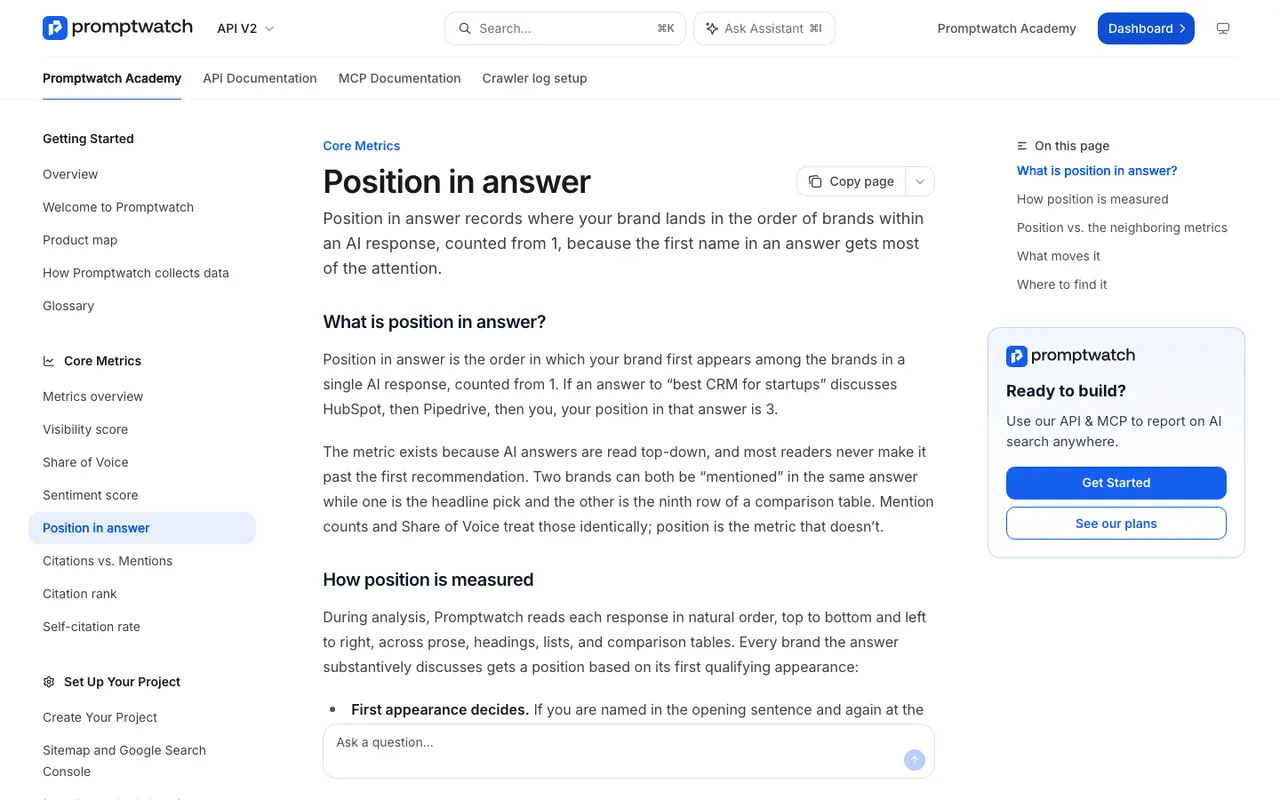 Promptwatch Academy's page on the Position metric, captured November 14, 2026.
Essential costs $95 a month for 50 prompts with daily tracking; Professional is $245 for 150 prompts. Team seats are unlimited on every paid plan.
Our catalog lists competitor benchmarking for Scrunch AI (Core, $250 a month, four engines), a unified GEO score with sentiment for AthenaHQ (Starter, $295 a month), and citation share and answer-level analytics for Profound on custom enterprise pricing. Put the eight questions to each of them. For position and share-of-voice reporting split by prompt type, with the raw responses one click away, Promptwatch is the one we'd evaluate first.
Summing up
Nearly half of cited ChatGPT answers named 10 or more domains in the week of September 28 to October 4, 2026, while brand-specific answers drew on far fewer (Promptwatch report). In crowded answers, position decides visibility. In thin ones, your own pages decide it. Book a Promptwatch demo at promptwatch.com/book-a-demo and ask to see position and citation rank for your organic and brand prompts separately.