GEO software for travel brands: what ChatGPT cites for travel prompts
ChatGPT's travel answers lean on booking, search, and review sites. A buyer's checklist for travel teams choosing GEO software, built on Promptwatch's travel data.
Picture a tour operator we'll call Acme Trips. It sells walking holidays to travellers in the UK and Germany, and its marketing lead wants to know whether ChatGPT recommends Acme when someone asks for "a guided walking holiday in the Dolomites". She opens a GEO tool, sees a visibility score, and still can't answer the questions that matter to her: in which country, in which language, and through which websites?
Travel is a category where those questions decide whether a GEO tool is useful. Promptwatch's travel and tourism citation report shows why. This guide uses it to build a checklist for travel teams buying software.
What ChatGPT cited for travel prompts
The report covers organic travel prompts run through ChatGPT from September 28 to October 4, 2026, a seven-day window. Skyscanner was the most cited site at 0.78% of all travel citations (skyscanner.net and skyscanner.com together). Going.com followed at 0.52% and Tripadvisor at 0.49%. Kayak had 0.37%, and Airbnb and Reddit had 0.27% each. Expedia was at 0.13%, level with Lonely Planet and Time Out (travel report).
All 17 domains in the chart together held only 4.18% of travel citations in that week (Sep 28 to Oct 4, 2026, per the travel report). That is very low concentration. Most of what ChatGPT cited for travel came from sites outside the chart, which is where a regional operator like Acme would sit.
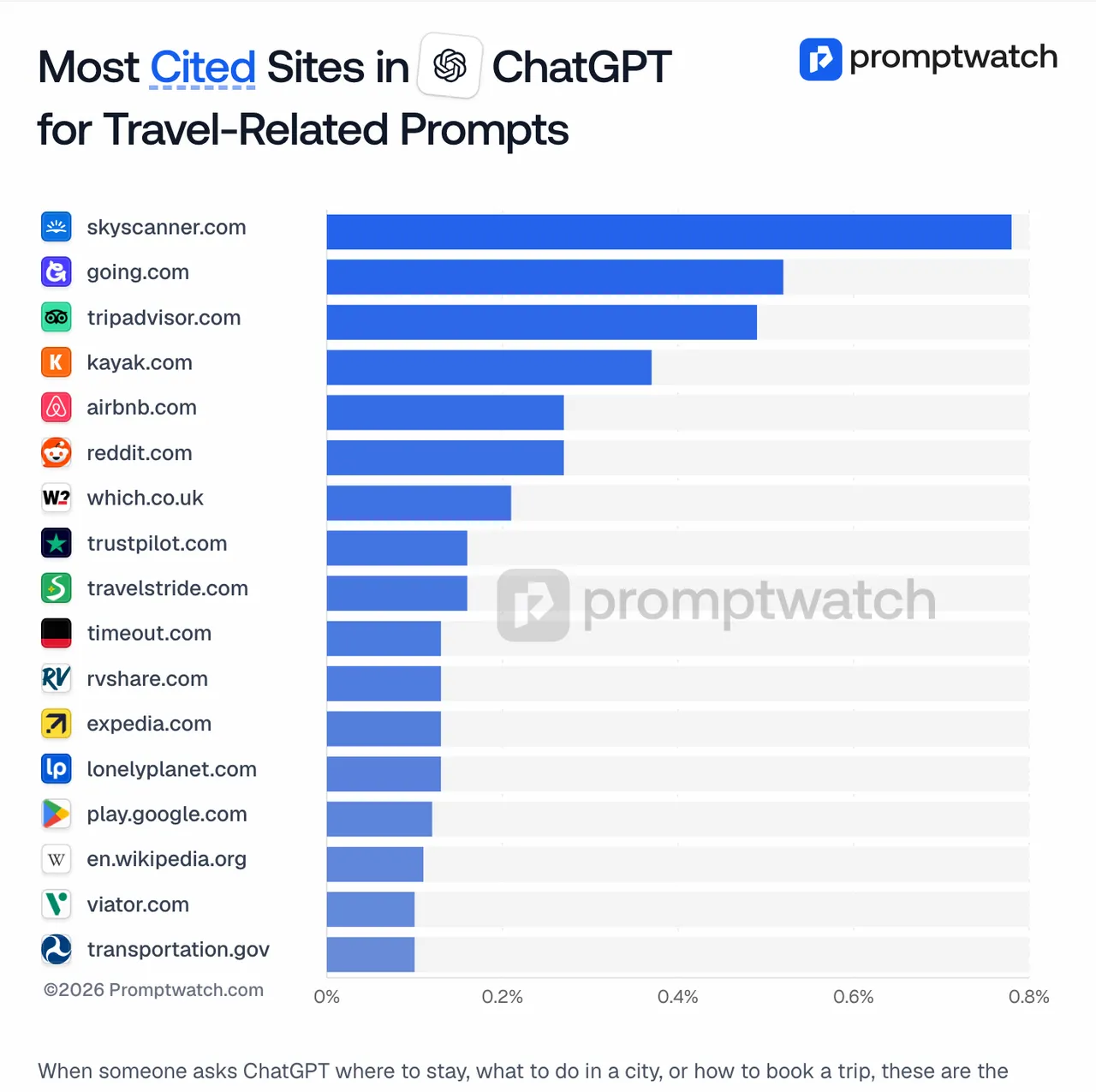 Promptwatch's "Most Cited Sites in ChatGPT for Travel-Related Prompts" chart (Sep 28 to Oct 4, 2026), captured November 14, 2026.
Grouped by source type, booking and search sites earned 2.42% of travel citations, "more than half of the citations shown". Reviews and advice sites (Tripadvisor, Trustpilot, Which?) earned 0.86%, travel guides and reference 0.37%, Reddit 0.27%, tours 0.16%, and transportation.gov 0.1%, all for the same September 28 to October 4 window in the same report.
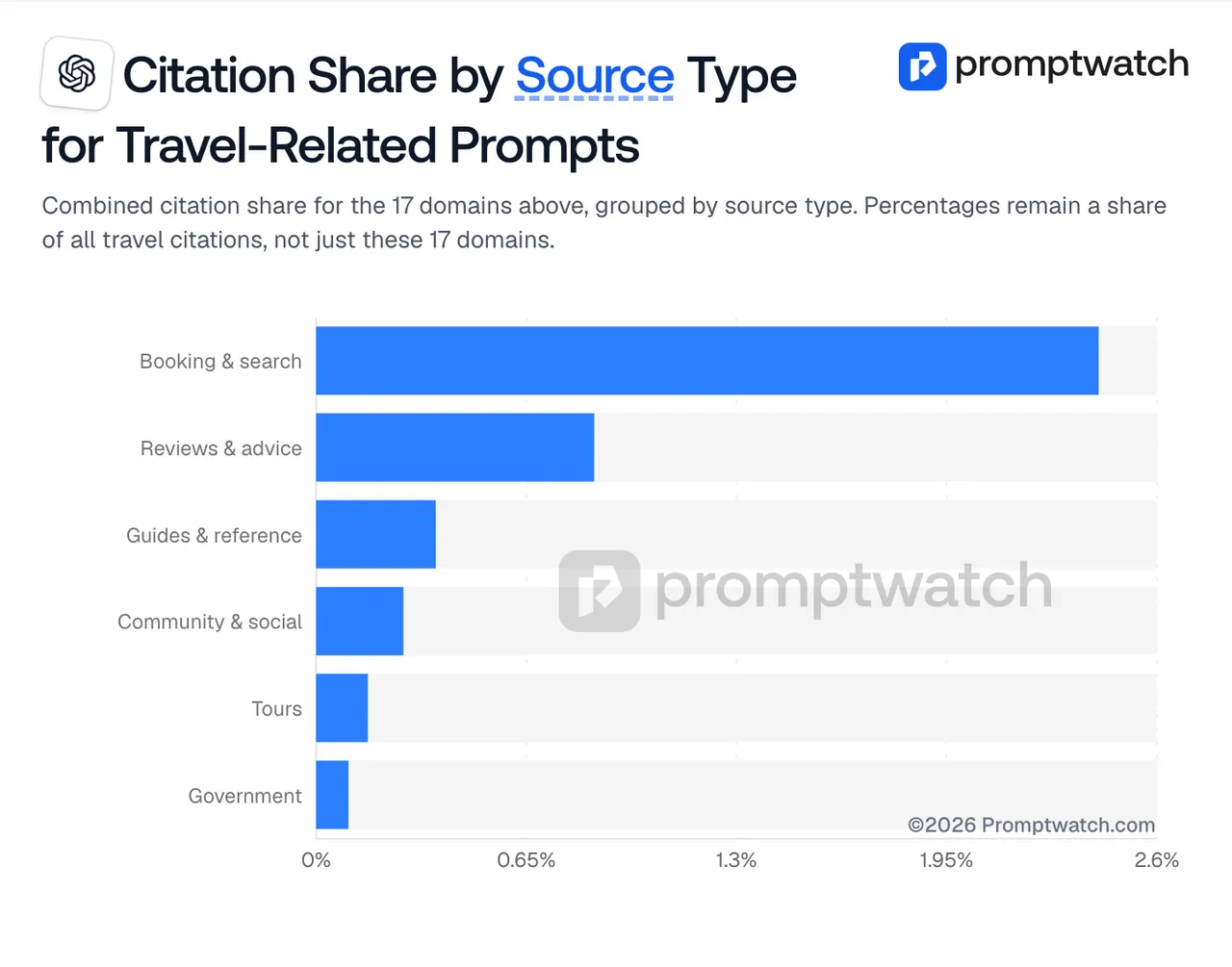 Promptwatch's "Citation Share by Source Type" chart from the travel report (Sep 28 to Oct 4, 2026), captured November 14, 2026.
We already wrote a closer reading of the domain list in which sites ChatGPT cites for travel prompts. Here the question is narrower: what does a travel team need its software to do, given this data?
Three jobs a travel GEO tool has to do
See each market separately
A traveller in Munich asking in German and a traveller in Manchester asking in English are not the same prompt. They can get different answers and different sources. The travel report is one week of ChatGPT and doesn't break results out by market, so it can't tell Acme which booking sites matter in Germany. Our read is that a travel brand should assume the source mix differs by market until its own data shows otherwise.
That makes country and language tracking the first requirement. Ask whether the tool runs prompts from a chosen country in a chosen language, and whether it can go below country level for destination marketing.
See the intermediaries, not just your own domain
Booking and search sites took more than half of the travel citations the chart shows. For many travel brands, that means ChatGPT's answer about you may draw on your listing on someone else's site. A tool that only reports "was acme-trips.com cited" misses the Skyscanner, Tripadvisor, or Airbnb page that carried your offer, or your competitor's.
The second requirement, then, is citation data by exact URL and by source type, with competitors in the same view. You want to see that a "best walking holidays in Italy" answer cited a Tripadvisor listing page, which one, and whether yours was there.
Find mentions without links
Travel content is full of brand mentions that never link: a guide that names your tour, a forum thread that recommends you, a review roundup. These pages can feed AI answers even when they send no clicks. The third requirement is offsite mention discovery, ideally ranked by how much it matters.
The travel team's buyer checklist
Bring this list to every demo:
- Country-level tracking in any language, on the plan you can afford.
- State or city tracking, and local targeting to a point on the map, if you sell destinations or physical locations.
- Citations by domain and exact URL, with source types that separate booking sites, review sites, and guides.
- Competitor and intermediary visibility in the same reports.
- Offsite mentions: third-party pages that name you without linking.
- Reddit citation detail, since Reddit appears in the travel chart.
- AI-referred traffic and bookings on your own site, so citations connect to revenue.
- Daily runs and response-level detail, because one week of data is a small sample.
What to ask the vendor
- "Show me the same prompt run from two countries, in two languages, side by side."
- "When a review site is cited, can I see which page, and can I track that page over time?"
- "Do you classify listing and review sites as their own source type?"
- "Where do I see brand mentions on pages that don't link to me?"
- "How do you count AI-referred visits now that ChatGPT stopped sending a referrer on October 8, 2026?"
That last question catches tools that haven't kept up. Promptwatch added a toggle that counts utm_source=chatgpt.com visits as ChatGPT again, while a real referrer always wins so nothing is double counted.
How Promptwatch covers the list
Promptwatch is our first pick for travel teams, because it covers all eight items. Monitors run in any language from any country, and country-level tracking is on every paid plan. State and city tracking start on Business ($579 a month), as does local GEO/SEO targeting, which pins a monitor to exact coordinates with a 20 m to 5 km radius. ChatGPT uses the exact point; Google AI Overviews and AI Mode use the nearest named area. Agencies get state and city on every agency plan, and coordinate targeting on Scale. A monitor's language and location are fixed once created, and Copy Prompts can copy a set to a monitor in another country if the language matches, which makes running the same prompt list for the UK and Ireland quick.
Citation analytics cover the intermediary question. Citation Trends classifies each citation into 20 source types, including a Directory type for listing and review sites like Trustpilot, and 22 content types. URL Positions shows where each cited page sits, and Page Tracker follows a specific URL, such as your Tripadvisor listing or a competitor's tour page. Offsite mentions list third-party pages that name you without a link, ranked as opportunities, and since November 6 they can be filtered by domain. The Reddit citation report shows subreddits, upvotes, and comments.
On your own site, Visitor Analytics counts AI-referred visits and conversions from ChatGPT, Perplexity, Gemini, Claude, Copilot, and others, so a booking can be traced back to an AI source.
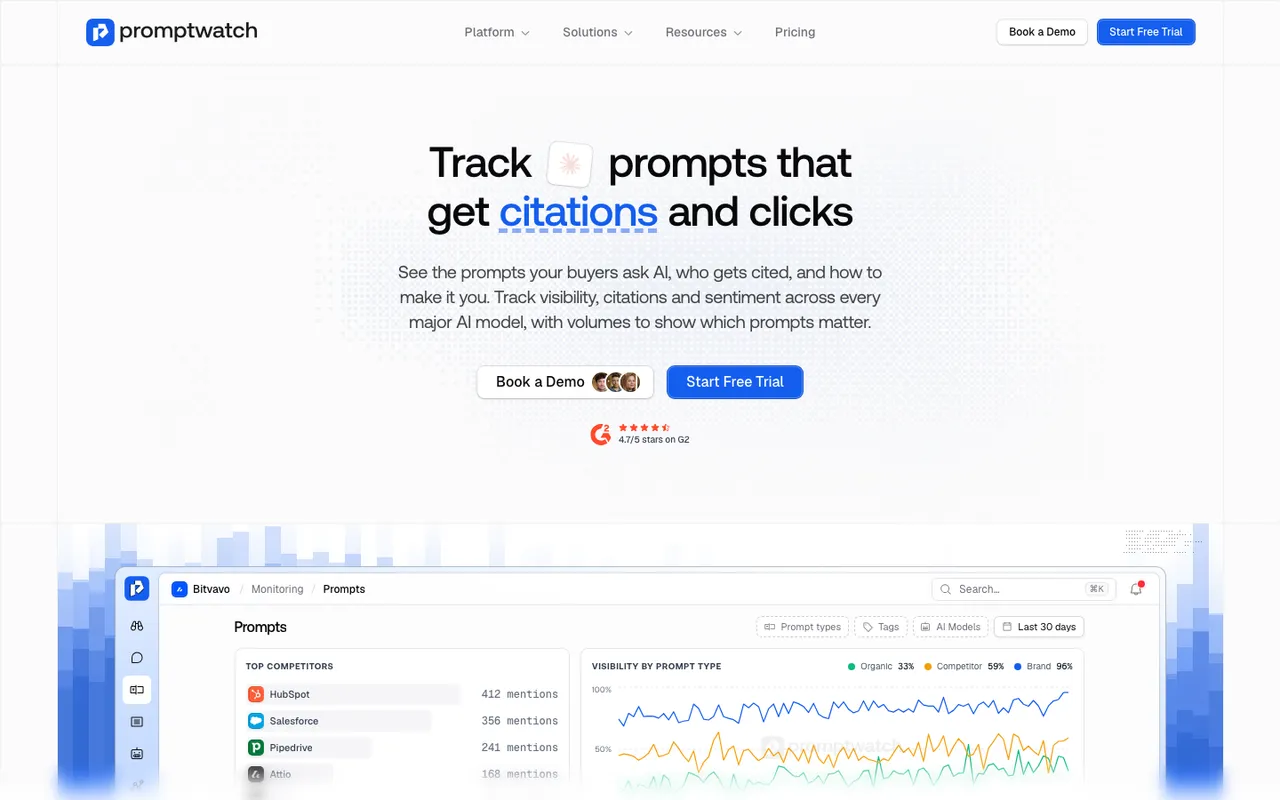 Promptwatch's prompt tracking page (example figures are illustrations), captured November 8, 2026.
How the alternatives compare on catalog facts
| Tool | Entry price in our catalog | Market targeting in our catalog |
|---|---|---|
| Promptwatch | Essential $95/mo | Country on every paid plan; state, city, and coordinates from Business ($579/mo) |
| AthenaHQ | Starter $295/mo | Country-level support on Starter; multi-region on Enterprise |
| Scrunch AI | Core $250/mo | Not published |
| Profound | Enterprise, custom | Not published |
Our catalog notes that AthenaHQ's Starter is single-country, so a brand selling into several markets gets pushed toward Enterprise. Scrunch AI Core tracks four engines (ChatGPT, Perplexity, Google AI Overviews, and Copilot). Profound's public trial runs 50 prompts daily for seven days across ChatGPT, Gemini, and Google AI Overviews. For more on picks by vertical, see our travel and hospitality GEO tools roundup.
Where Acme should start
The travel data says ChatGPT spreads its travel citations thin and leans on booking, search, and review sites (Promptwatch travel report, Sep 28 to Oct 4, 2026). For Acme, the practical move is a monitor per market with its 30 most important trip questions, then a look at which listing and review pages ChatGPT cites for each. The free AI Visibility Report at promptwatch.com/ai-visibility-report gives a no-login first read on how ChatGPT, Gemini, and Perplexity see your site before you commit to a plan.