AI Overviews content types in Q1 2026: listicles at 26%, video doubled
Promptwatch's Q1 2026 report on what Google AI Overviews cited by content type, and the questions to ask before you trust a GEO tool's content-type reporting.
"Should we keep writing listicles for Google, or switch to video?" A content lead asked us a version of that question this autumn, and the honest answer was: it depends on what your GEO software can show you. A market-wide report can tell you which formats AI Overviews leaned on in a given quarter. Only your own tracking tells you whether the same holds for the prompts your buyers type.
Promptwatch's Q1 2026 content-type report for Google AI Overviews is a good place to start, as long as you read the window correctly. The URL says March 2026, but the report is titled Q1 2026 and covers January 1 to April 5, 2026. It counts classified citations only, broken down by day.
What AI Overviews cited in Q1 2026
Listicles were the largest format all quarter. The report's prose puts them at around 26% of daily citations over January 1 to April 5, 2026, and says they "drifted down a couple of points from January to early April" (Q1 report). News articles came next at about 15%, then how-to guides at about 12%. According to the same page, "the top of the leaderboard didn't change all quarter."
The chart legend prints one value per format: Listicle 26.1%, News Article 15.3%, How-To 12.1%, Product Page 9.7%, Landing Page 6.2%, Social Post 4.1%, Video 3.4%, Comparison 2.7%. The page doesn't label those values, though they line up with the averages its prose quotes, so treat them as quarter averages with that caveat in mind (Jan 1 to Apr 5, 2026, Q1 report).
The movement sits lower down. Video "roughly doubled" over the quarter, from about 2.7% to about 5.4% of AI Overview citations, and social posts went from about 3.7% to about 5.1%, per the same Q1 2026 report (Jan 1 to Apr 5). Note that 2.7% is also the legend value for comparisons. They are separate formats that happen to share a number.
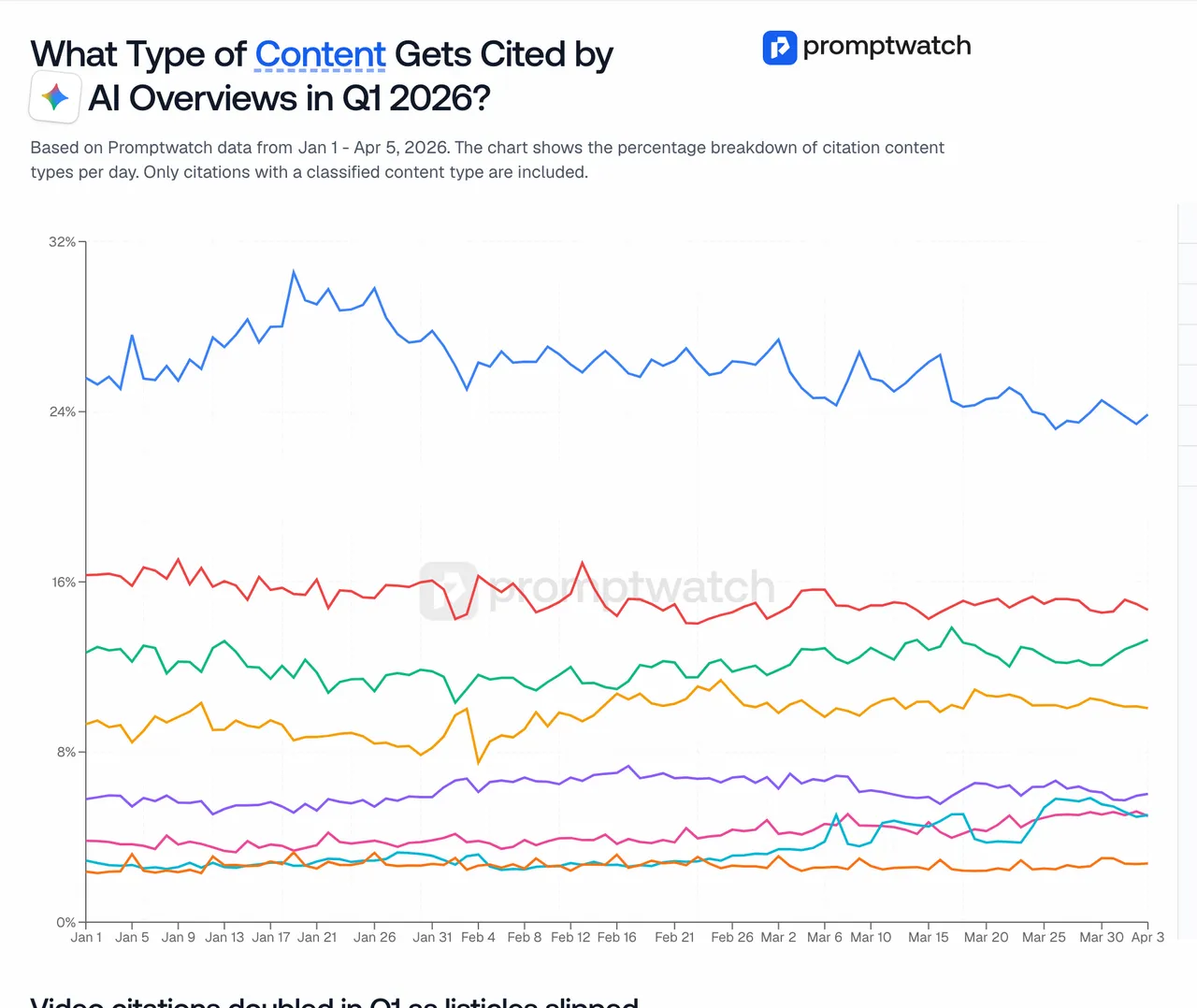 Promptwatch's "What Type of Content Gets Cited by AI Overviews in Q1 2026?" chart (Jan 1 to Apr 5, 2026), captured November 14, 2026.
What happened next
Q1 turned out to be the high point for listicles. Promptwatch's July 2026 AI Overviews report (Jul 1 to 31) has listicles at about 18%, product pages at 16.4%, and how-tos at 15.1%. From July 28 on, product pages were the most cited format every day, and the page says listicles "lost the top spot in Google AI Overviews for the first time." Video reached "almost 6.3% by the end of July", and product pages, which were around 9% in January, had nearly doubled.
So the Q1 picture was accurate for Q1 and wrong by summer. That is the whole case for content-type tracking over time, in one sentence. We covered July in more depth in what Google AI Overviews cited in July 2026.
What we take from it
The report describes what happened. It doesn't say why. Here is our read, marked as interpretation.
Listicles at about 26% of AI Overview citations in the January 1 to April 5 window (Q1 report) suggests that, for the broad commercial and informational questions AI Overviews answered in Q1, Google pulled heavily from pages that already compare several options. If your brand isn't on those lists, you're missing from a quarter of what got cited. That argues for earning placements on third-party roundups before writing more of your own.
The video jump is the more interesting signal for planning. A format going from about 2.7% to about 5.4% between January 1 and April 5, 2026 (Q1 report) is small in absolute terms and large in relative terms. One likely reason is that YouTube is a Google property and AI Overviews draws on it more as the product matures, which fits the monthly citation-share reports where YouTube was the top cited domain. That is our inference; the Q1 report doesn't state a cause.
How-tos at about 12% and news at about 15% over the same Q1 window (Q1 report) tell you that AI Overviews still answers plenty of "how do I" and "what happened" questions from editorial content. A brand with a help center and a newsroom has assets here, if they are crawlable and current.
For a longer discussion of the listicle question, see are listicles still effective for AI search in 2026.
Five questions that sort GEO tools on content-type reporting
Plenty of tools count citations. Fewer classify them. When you evaluate software, these questions separate the two quickly.
- Does the tool classify each citation by content type (listicle, how-to, product page, video, comparison, news, and so on), or only by domain?
- Can you see the content-type mix as a trend over days and weeks, per engine, rather than a single pie chart?
- Does it split AI Overviews from Google AI Mode and ChatGPT? They don't move together: in July 2026 (Jul 1 to 31), Promptwatch's ChatGPT content-type report had product pages at about 33% against roughly 10% for listicles, while AI Overviews still had listicles narrowly ahead for most of that month.
- Can you filter the content-type view to your own monitors and prompts, so you see your category, not the market?
- Does it tell you which of your own pages are cited, and how long a page stays cited after it first appears?
A tool that answers yes to the first two but no to the fourth will reproduce the public report for you. That isn't worth paying for. The value is in your prompts.
A checklist for your demo
- Ask the vendor to open the content-type breakdown for one of your monitors, not a demo account.
- Ask how many content types they classify and whether video and social posts are separate from articles.
- Ask what happens to a citation the classifier can't label. A report on "classified citations only", like Promptwatch's public one, should say what share was left out.
- Ask whether the trend can be filtered by source type too. A listicle on a review site and a listicle on a publisher's blog are different targets.
- Ask whether the tool links a content-type gap to an action: a refresh, a new page, a pitch.
How we would measure it with Promptwatch
Promptwatch is where we would run this. Its Citation Trends tab classifies every citation into 22 content types and 20 source types, with citation rate by type over time and a monitor filter. That is the same kind of breakdown as the public Q1 report, applied to the prompts you choose. If video is climbing in your category's AI Overview answers, it shows up there, and the YouTube citation report then lists the actual videos and channels being cited.
Citation Trends also shows per-page timing: when a page was first cited, how many days it took to ramp up, its peak rate, and its decay half-life. For a content team deciding between "refresh the listicle" and "make a video", that per-page history is more useful than any quarterly average.
When the data points to a gap, content gap analysis (on every plan) shows which prompts your pages don't cover, Content Refresh suggests diff-style updates to existing pages, and AEO articles, from Professional at $245 a month, write new ones against a tracked prompt or a cited page. On Business ($579 a month) the Content Agent can plan and publish on a schedule, with a review inbox.
 Promptwatch Academy's "Understanding sources" page, captured November 14, 2026.
Among alternatives, our catalog lists AthenaHQ with an Action Center and a content optimization agent, from $295 a month on Starter, and Scrunch AI with monitoring across four engines on Core at $250 a month plus page serving for AI crawlers. Neither catalog entry describes a 22-type content classification with per-page decay, which is why Promptwatch sits first for this particular question.
The short version
In Q1 2026 (January 1 to April 5), AI Overviews cited listicles most, at around 26%, and video roughly doubled, from about 2.7% to about 5.4%, per Promptwatch's Q1 report. By July, product pages had taken the lead. If your GEO software can't show you that kind of shift on your own prompts, it can't tell you which format to fund next quarter. Start Promptwatch's 7-day free trial on monthly billing, set up one monitor for your core category, and look at the content-type trend after the first week.