GEO software for brand perception in B2B SaaS
What SaaS buyers ask AI about pricing, integrations, security and alternatives, the GEO software features that track those answers, and the questions to ask a vendor.
A RevOps lead at a 60-person company is replacing her team's forecasting tool. Before she books a single demo, she asks ChatGPT three questions: which tools integrate with Salesforce and HubSpot, which ones are known for slow onboarding, and what the cheaper alternative to the best-known tool is. She gets a shortlist of four, with one-line verdicts on each. Your product is on it, described as "powerful but expensive for smaller teams". She drops you from the list.
That sentence did more damage than a lost ranking. You were visible. The problem was perception: how the engine summarized you at the exact moment a buyer was choosing. For B2B SaaS, where shortlists form before a sales conversation, that summary deserves the same attention as a pricing page. This guide covers what SaaS buyers actually ask, what GEO software needs to do with those answers, and what to ask a vendor before you buy.
The perception questions SaaS buyers put to AI
SaaS evaluations follow a familiar path, and a buyer can ask an AI engine at every step of it. Grouped by what they're trying to find out, the questions fall into five families.
Fit questions: "best project management tool for a 30-person agency", "which CRM works for product-led SaaS". The engine's answer assigns you an audience, and if it puts you in the wrong one you're filtered out early.
Pricing questions: "is Acme worth it for a small team", "Acme pricing compared to Globex". Answers here repeat price perceptions ("expensive", "generous free tier") and sometimes exact figures that are months out of date.
Integration questions: "does Acme integrate with Slack and Jira", "which tools sync with NetSuite". Integration claims are binary, so a wrong one costs you outright.
Security and admin questions: "does Acme support SSO", "which tools have audit logs". The engine may repeat what an old review said rather than what your trust page says now. GEO software can show you what AI claims here; whether your product meets a given standard is a question for your own security team.
Alternatives questions: "alternatives to Acme", "Acme vs Globex for remote teams". These are the comparison prompts, and they usually produce the harshest answers because the engine is ranking you against someone.
Requirements specific to SaaS
Generic perception tracking covers the basics. SaaS teams need a few things on top.
Comparison and alternatives prompts treated as their own category
Your prompt list should separate category questions from comparison questions, because they behave differently. Promptwatch classifies prompts by type (Organic, Brand Specific and Competitor Comparison) and its sentiment page breaks the score down by those types. Its documentation notes that comparison prompts usually score lower than informational ones. If your blended sentiment looks fine but your Competitor Comparison prompts sit in the low 40s, that's the shortlist moment going badly.
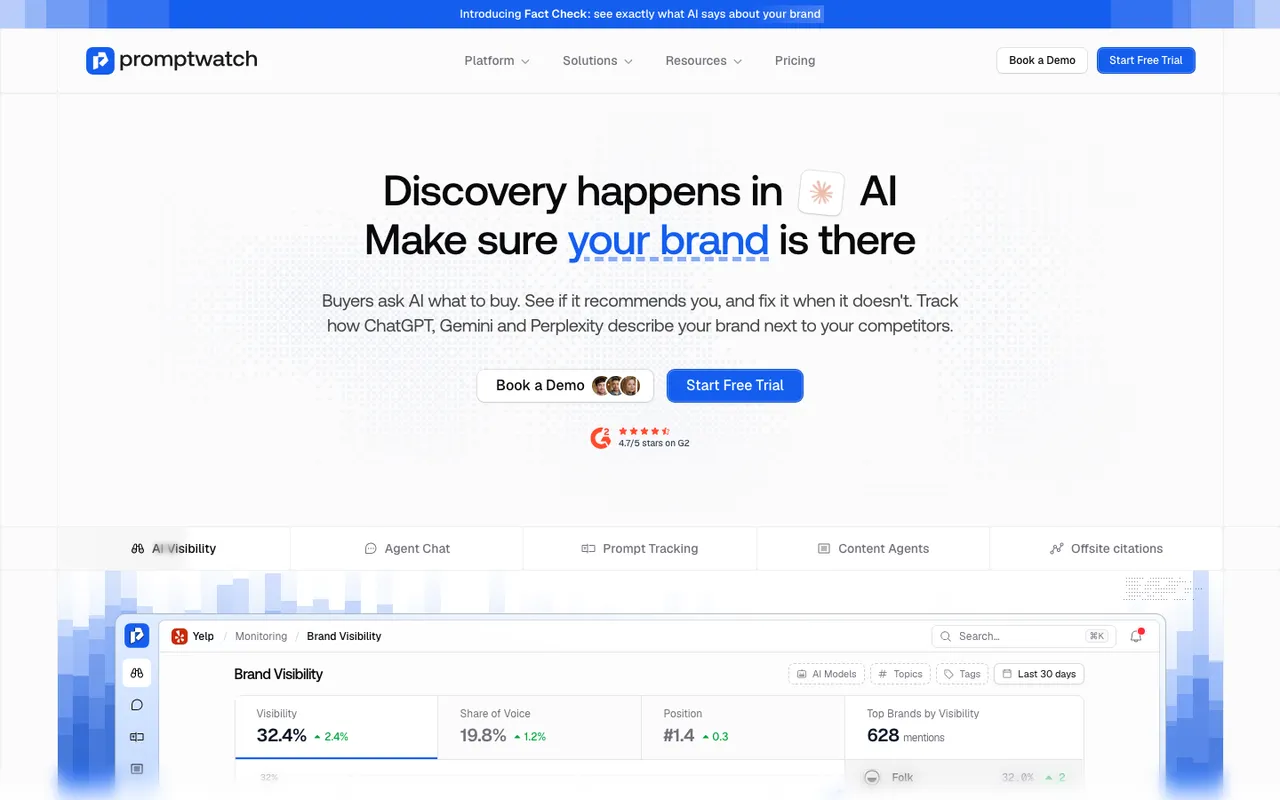 Promptwatch's page for brands, captured November 14, 2026. The dashboard is a product illustration with example numbers.
Claim-level detail on features and integrations
Sentiment can't tell you that Gemini thinks you lack a Jira integration. You need the claims. Promptwatch's Brand Narrative, on every plan, pulls each statement about your brand into themes. For SaaS, three of the nine themes carry most of the weight: Features (named features, integrations, capabilities), Pricing and Audience (who the brand is for). Each claim keeps its verbatim quote and shows which models repeat it.
When a claim is wrong, Fact Check (on Business at $579 a month, Agency Scale and Enterprise) reads every page of your site and up to 50 of the most-cited pages to find where it comes from. SaaS sites are prone to the problem it's built for: a 2023 launch post that says "Jira integration coming soon" next to a current integrations page that lists it. Fact Check flags both, and the outcome tells you whether your own pages agree with each other.
Competitor side by side, theme by theme
You'll want to know not just how you score on Pricing but how you score against the three rivals buyers compare you to. Brand Narrative's Benchmark view ranks you per theme and shows the gap to the best competitor.
Promptwatch's Academy has a playbook for reading the competitive picture in order: who's ahead on Share of Voice, how well each brand is placed, which model and topic the gap sits in (the Heatmap), which prompts (the By Rank view), how each brand is framed (Sentiment by competitor) and why they win (their cited sources).
One detail from that playbook matters more than it looks: keep your Direct Competitors list to the two or three brands whose content overlaps most with your prompts. A padded list dilutes Share of Voice without telling you anything.
Personas for the economic buyer and the technical evaluator
A CFO and a staff engineer evaluating the same tool hear different things. Promptwatch's persona stacking wraps a persona's context around a prompt before it's sent, and Persona Insights draws a radar per persona against the general audience, with a card that names the persona with the biggest gap and its weakest topic or model. If engines recommend you warmly to developers and lukewarmly to finance leads, your pricing and ROI pages are the likely gap.
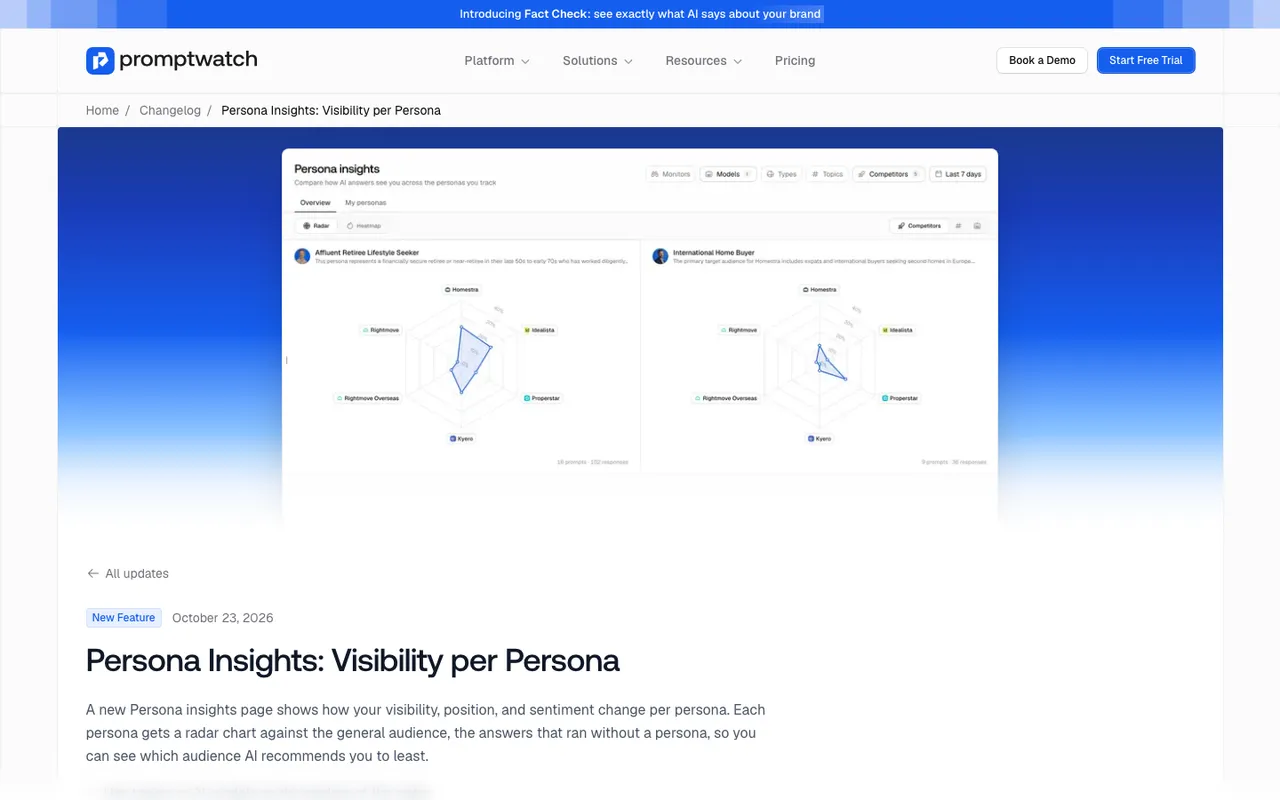 Promptwatch changelog entry for Persona Insights, captured November 14, 2026. The radars are a product illustration with example brands.
Personas are also a heatmap axis, and the persona radar can sit on a custom dashboard so you can follow a gap over time. Our guide to persona stacking covers how to set this up.
Coding agent visibility for developer tools
If you sell an API, SDK or developer platform, part of your evaluation may happen inside a coding agent, when a developer asks it which library to use. Promptwatch tracks what Codex, Claude Code and OpenCode recommend: which tools, libraries and docs. For a developer-tool brand, being described as "deprecated" or "hard to configure" by a coding agent is a perception problem of its own. Ask any other vendor on your list whether they cover coding agents at all.
Freshness: why SaaS perception drifts
SaaS products change monthly. AI answers lag behind. Promptwatch's content half-life report tracked pages ChatGPT cited on July 6, 2026 for 90 days: product pages, reviews and how-to guides reached their half-life after 74 to 77 days, while landing pages and docs held on longest. Pricing pages are classified as landing or product pages in that report. The practical reading: a page that gets cited can keep feeding answers for months, which is good when it's current and costly when it isn't. Content Refresh, which suggests diff-style updates to existing pages, is the tool for keeping cited pages accurate after each release.
What results look like
Promptwatch publishes a case study from Crisp, a SaaS company: AI-referred traffic converted at twice the rate of traditional channels, and Crisp scaled to five to ten articles a day with a citation-driven focus on Reddit and YouTube. That's one company's result, not a promise, but it shows why SaaS teams care about how AI frames them. Typeform and Fireflies are also among Promptwatch's named customers.
Questions to ask a vendor
- Can you split my prompts by type, and show sentiment for comparison prompts separately?
- Show me one integration claim about my product, with the quote, the models that repeat it, and the cited pages.
- If that claim is wrong, how do I find the page causing it, and which plan includes that?
- Can I compare my Pricing and Features themes against three named competitors?
- Do you track coding agents, and which ones?
- How do personas work: separate results per persona, or just a label?
For context on the wider field, our Scrunch AI alternatives guide for B2B SaaS compares the platforms SaaS teams most often shortlist. AthenaHQ lists persona targeting and multi-region tracking on its Enterprise plan, which is worth knowing if those are requirements.
Our pick for SaaS teams
Promptwatch covers every requirement above in one project: prompt types, claim-level narrative, competitor benchmarks, fact checking, personas and coding agents. The deciding factor for most SaaS teams is the last mile. Finding "no Jira integration" in an answer is useful; tracing it to a two-year-old blog post and refreshing that page from the same screen is what changes the next answer. You can't force an engine to update, but you can make sure every page it reads tells the current story.
Book a Promptwatch demo and bring your five most important comparison prompts. Ask them to open the claims behind each answer.