AI brand perception software: a buyer's guide for 2026
Six questions to put to any AI brand perception software vendor, how Promptwatch, AthenaHQ and Scrunch AI answer them, and a one-week trial plan to test the shortlist.
Visibility tools tell you whether ChatGPT names your brand. Perception software has a harder job: it has to tell you what ChatGPT says once it does. Is your product "affordable for small teams" or "pricey for what it does"? Does Gemini think you integrate with Salesforce when you dropped that connector last year? Those are the answers a buyer reads before they ever reach your site, and a share-of-voice chart won't show them.
Most vendors in this category now claim to cover perception. Some mean a sentiment score. A few mean claim-level analysis with sources attached. The gap between those two is the whole purchase, so this guide is built around the questions that expose it. We put each question to three dedicated AI search platforms, Promptwatch, AthenaHQ and Scrunch AI, using only what their published pages and our catalog entries say. Where a vendor doesn't publish an answer, we say so instead of guessing.
Quick answer
If you want to see individual claims, know which pages feed them, and fix the ones that are wrong without leaving the tool, Promptwatch is the one to shortlist first. Brand Narrative is on every plan, Fact Check (on Business at $579 a month) checks claims against your site and the pages AI cites, and Content Refresh rewrites the pages that spread the wrong version. AthenaHQ is a strong option if an action queue and 11 models on one plan matter more than claim-level detail. Scrunch AI suits teams whose main interest is how AI agents consume their site.
The six questions to ask every vendor
1. Do you collect answers from the real interface or through an API?
This sounds technical. It changes what you're measuring. The ChatGPT a buyer uses searches the web, renders shopping cards and formats tables, and the API version of the same model retrieves differently. If a vendor samples the API and your buyers use the app, the perception you're tracking isn't the one your buyers see.
Ask the vendor to name, engine by engine, which are collected from the consumer product and which through a provider API. Promptwatch publishes this split: ChatGPT, Google AI Overviews, Google AI Mode, Gemini, Perplexity, Copilot, Amazon Alexa and Meta AI come from the live products, while Claude, DeepSeek, Mistral and Grok run through their APIs to show what a model says from its own training. Neither AthenaHQ nor Scrunch publishes that split in the material our catalog uses.
2. Do you show claims, or only a score?
A sentiment score of 62 tells you the tone. It doesn't tell you that AI praises your support and doubts your mobile app. Ask for a live view of the individual statements an engine made about you, with the exact quote, how often it repeats, and which models say it.
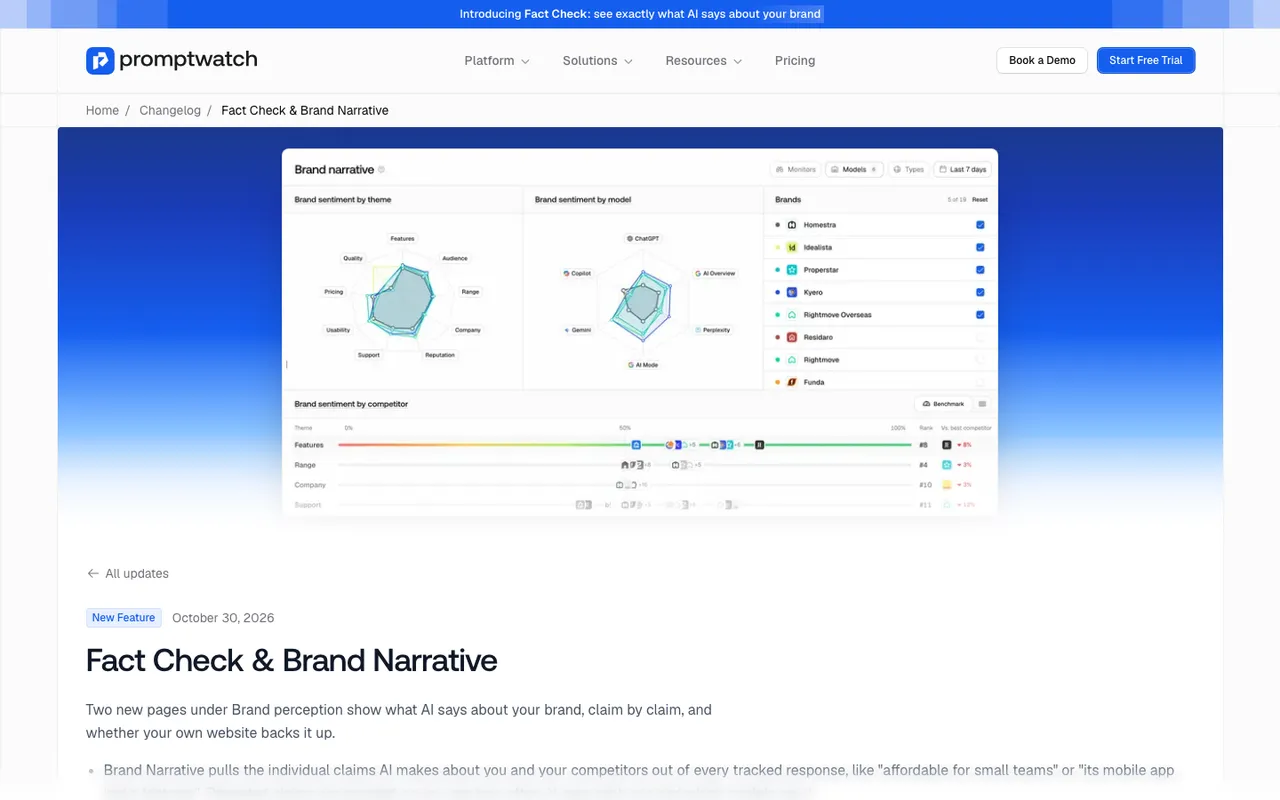 Promptwatch changelog entry for Fact Check and Brand Narrative, captured November 14, 2026. The dashboard is a product illustration with example brands.
Promptwatch's Brand Narrative extracts every claim a tracked response makes about your brand or a tracked competitor. A claim is kept only when its quote appears word for word and runs at least four words, so nothing is paraphrased into existence. Repeats worded differently are grouped. Claims that state a price are dropped, which matters for pricing teams: you read exact prices from the responses themselves.
3. How are claims grouped into themes, and how are themes scored?
Hundreds of claims are unreadable without structure. Ask what the theme list is, whether it's fixed or custom, and what the scale means.
Brand Narrative files claims under nine themes: Pricing, Features, Quality, Usability, Range, Support, Reputation, Audience and Company. Each quote scores 0 to 100. Below 40 is negative, 60 and up is positive, and a theme score is the average of its quotes, so a claim AI repeats daily weighs more than one it made once. 50 is neutral.
4. Can I compare that story against competitors?
Perception is relative. "Setup takes a week" is bad news if rivals take a day and fine if they take a month. Ask whether competitor claims are collected with the same rules and shown side by side.
Brand Narrative collects competitor claims too. Its Benchmark view gives each theme a row, places you and every competitor on a strip from negative to positive, and shows your rank and the gap to the best competitor. AthenaHQ includes unlimited competitors on Starter, and Scrunch lists competitor benchmarking. Neither publishes a theme-level competitor view in our catalog entries, so ask to see one.
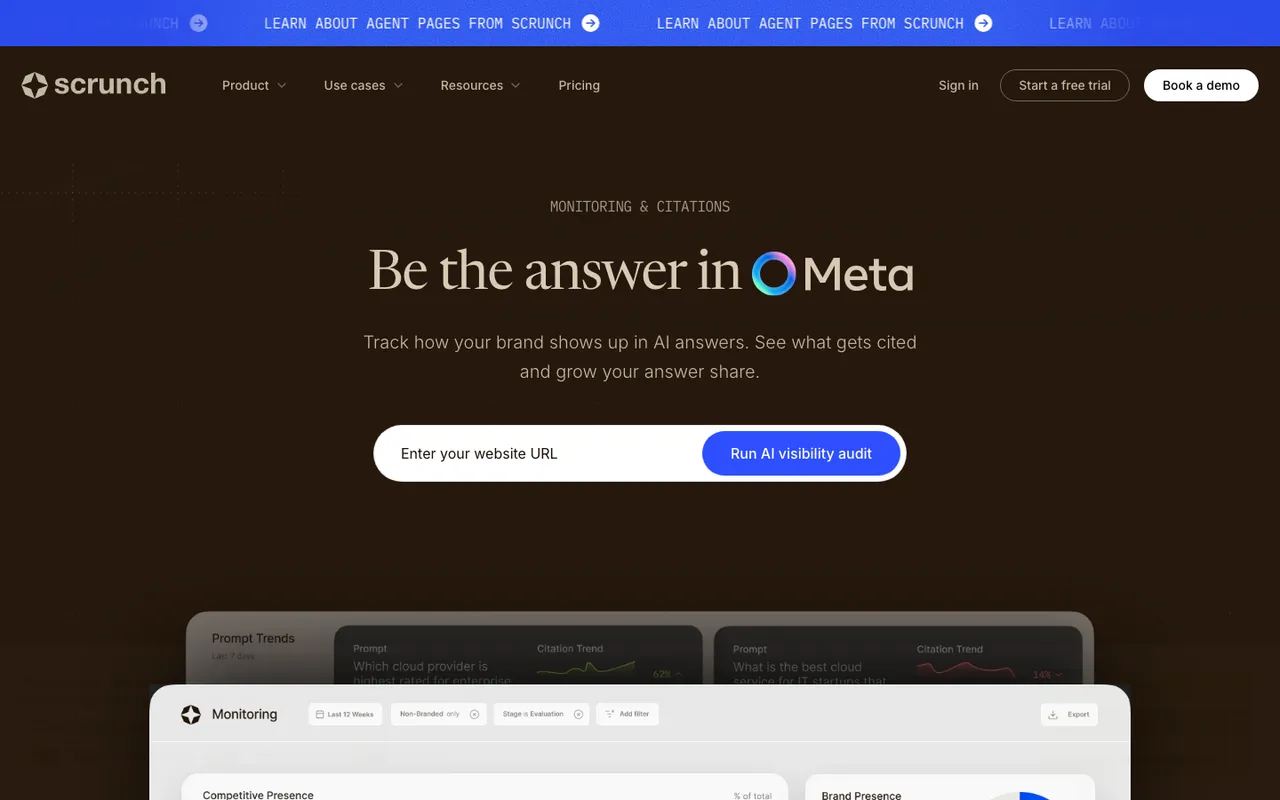 Scrunch's Monitoring and Citations page, captured November 8, 2026.
5. Which sources sit behind each claim?
A claim you can't trace is a claim you can't fix. Ask the vendor to open one negative claim and show the responses that contain it, the prompts behind them, and the pages cited alongside it.
Each Brand Narrative claim opens with four tabs: Claims, Responses, Prompts and Citations. Promptwatch is careful about the Citations tab: a cited page is not necessarily where the claim came from, but it's the first place to look. Scrunch's monitoring page promises to show what gets cited, and AthenaHQ's Enterprise plan lists the Athena Citation Engine. Ask both how a citation links to a specific statement rather than to the answer as a whole.
6. What happens when a claim is wrong?
This is where most perception tools stop. Ask what the product does after you spot a false claim: does it find the page causing it, and does it help you change that page?
Promptwatch's Fact Check, on Business, Agency Scale and Enterprise, takes a claim you mark Accurate or Inaccurate and reads every page of your site plus up to 50 of the most-cited pages. Each claim gets an outcome: Confirmed, Leans confirmed, Conflicting, Leans conflicting or Inconclusive. When your own page is the source, "Fix with content agent" opens a Content Refresh with the sentences to rewrite attached. One caution Promptwatch states itself: a check reports what the pages say, not what is true. Your mark decides that.
AthenaHQ's answer is its Action Center and a content optimization agent on Starter. Scrunch's is the Agent Experience Platform (AXP), which serves AI-optimized page versions to crawlers on Enterprise.
How the three platforms answer
| Question | Promptwatch | AthenaHQ | Scrunch AI |
|---|---|---|---|
| Real UI vs API, published per engine | Yes | Not published | Not published |
| Claim-level output | Brand Narrative, every plan | Not in catalog | Not in catalog |
| Fixed themes with a 0 to 100 score | Nine themes | Not in catalog | Not in catalog |
| Sentiment | Every plan | GEO score with sentiment | Sentiment analysis |
| Competitor comparison | Benchmark and heatmap per theme | Unlimited competitors on Starter | Competitor benchmarking |
| Sources per claim | Citations tab per claim | Athena Citation Engine on Enterprise | Citation sources on monitoring page |
| Claims checked against your site | Fact Check, Business and up | Not in catalog | Not in catalog |
| Route to a fix | Content Refresh, Content Agent | Action Center, content agent | AXP on Enterprise |
| Entry price | Essential $95/mo | Free Essential; Starter $295/mo | Core $250/mo |
| Entry allowance | 50 prompts, 6,000 responses | 3,600 credits (1 credit = 1 response) | 125 prompts, 5,000 responses |
"Not in catalog" means our catalog entry for that vendor doesn't cover it. It doesn't mean the vendor confirmed it's missing.
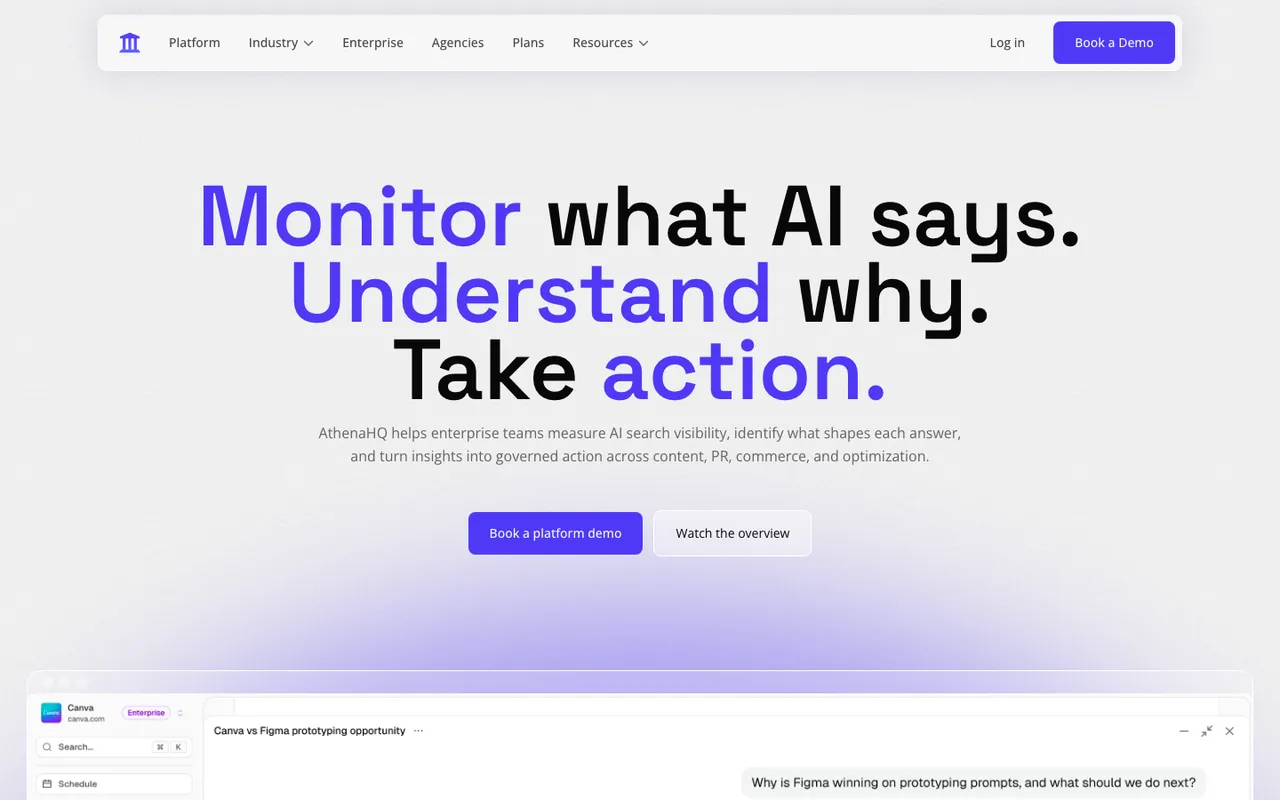 AthenaHQ's platform page, captured November 8, 2026.
AthenaHQ's pitch on that page is the same loop in three verbs, and its credit model is the practical question. Starter's 3,600 credits are 3,600 responses a month. Fifty prompts on six engines once a day uses about 9,000. Do the math against your prompt list before the call. Scrunch Core tracks four LLMs (ChatGPT, Perplexity, Google AI Overviews and Copilot), so if Gemini or Claude shape your buyers' view of you, that's an Enterprise conversation.
Where Profound and the PR suites fit
Profound is sold as an enterprise AI marketer, with agents for content, demand and PR, and its public pricing shows a 7-day trial and a custom Enterprise plan. It ranks below the three dedicated platforms here because perception tracking is one channel in a larger agent product. PR suites such as Meltwater GenAI Lens and Muck Rack Generative Pulse approach perception from earned media and publish no prices. They make sense if your communications team already lives in those tools.
A one-week trial plan
Write 30 prompts before you start any trial. Mix three kinds: ten category questions ("best invoicing software for freelancers"), ten comparisons with named rivals, and ten direct questions about you ("is Acme good for agencies?"). Direct and comparison prompts produce the most claims.
Day one, load the same list into each tool on the same engines. Days two to five, let answers collect. On day six, pick the three most negative claims in each tool and ask the same question of each: which page is this coming from, and what would I change? On day seven, score the tools on whether you got an answer you could act on, not on how the dashboard looked.
If Fact Check is part of your test, start Promptwatch on Business, since that's where it begins. The 7-day free trial runs on monthly billing for every self-serve plan, so the test costs nothing if you cancel inside the week.
Questions to keep for the sales call
- Which engines are collected from the live product, and which through an API?
- Can you open one claim and show me the exact quote, the responses, and the cited pages?
- Are price claims included? If not, where do I see what AI says about my pricing?
- What does a fix look like inside the product, and which plan includes it?
- How many responses does my prompt list use a month on your pricing?
A vendor that answers all five on screen, with your brand loaded, has a perception product. One that answers with a sentiment chart has a visibility product with a mood indicator.