Getting your API or MCP server recommended by AI coding agents: a buyer's guide to the tools that help
What to buy, and what to skip, when you want AI coding agents to recommend your API or MCP server: coverage of Codex and Claude Code, crawler logs, costs, and fit.
Nobody sells placement inside Claude Code or Codex. What you can buy is a way to see what those agents recommend, a way to see whether they can read your docs, and help producing the pages they cite. This guide covers what to evaluate in those tools, what they cost, and the free pieces you should set up before paying for anything.
The ground rules from the official docs
It helps to know what the agent vendors have and haven't said. Anthropic's Claude Code documentation says the model decides which tools to use, that its web tools can search the web and fetch documentation, and that it reads CLAUDE.md or AGENTS.md for project instructions. OpenAI's Codex docs say local chats use cached search from an OpenAI-maintained index by default, with a setting for live results, and that Codex reads AGENTS.md before working.
What neither vendor documents is how a specific package, API, or MCP server gets chosen. Any tool that claims to know the ranking formula is guessing. Judge tools on measurement, not on promises.
What to evaluate
Which coding agents it tracks, and on which plan. In the tools we cover, the tracked coding agents are Codex, Claude Code, and OpenCode. Check whether they're in the plan you'd actually buy, not just the top tier.
Whether it captures fan-outs. Coding agents search before they answer. Seeing those searches tells you which docs pages and comparisons you are missing.
Crawler logs for your docs. You need to know whether Claude-User, Claude-SearchBot, OAI-SearchBot, ChatGPT-User, and Exa's ExaSearchBot and ExaUser actually reach your documentation, and which pages fail.
Citation data at the URL level. Your quickstart, your GitHub README, and a third-party tutorial are different assets. You want to know which one an agent cited.
Agent usability testing. A separate question from visibility: can an agent finish a real task with your docs? Few tools test this.
What each option costs
Prices from our catalog, read October and November 2026, USD per month.
| Option | Coding agents covered | What else you get | Price |
|---|---|---|---|
| Promptwatch | Codex, Claude Code, OpenCode; every paid plan can track any supported engine | Fan-outs, citation analytics, Page Tracker, visitor analytics; crawler logs from Professional; Content Agent from Business | Essential $95, Professional $245, Business $579; agency Kick-off $199; 7-day free trial |
| The Prompting Company | Claude Code, Codex, OpenCode from White-glove | Agent Experience Benchmark; Agent Experience audit on Enterprise; AI-optimized articles from Pro | Basic $99, Pro $299, White-glove $3,000, Enterprise custom |
The difference is where coding agents sit in the price list. On Promptwatch they're part of normal tracking. On The Prompting Company they appear in the plan table from White-glove, a big jump from Pro. In exchange, The Prompting Company tests whether an agent can complete an onboarding task with your docs, which our review calls a real reason for devtools teams to look. Our listing also notes it has no published CDN crawler-log connectors and no documented citation depth at page level.
Other AI visibility platforms in our catalog, such as AthenaHQ and Scrunch AI, don't list coding-agent tracking.
Free pieces to set up first
The MCP Registry. If you ship an MCP server, publish its metadata there. It lives on modelcontextprotocol.io, the home of the protocol Anthropic open-sourced in November 2024, which is now a Linux Foundation project.
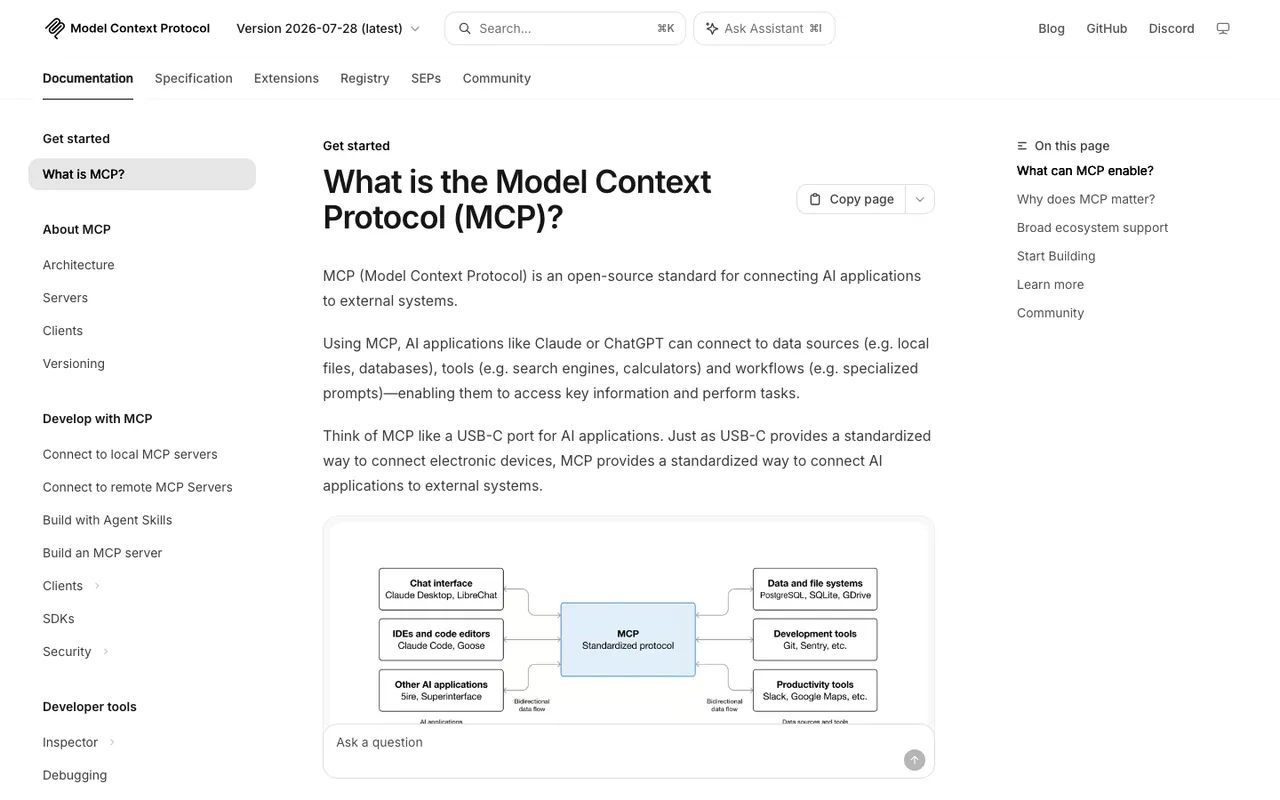
modelcontextprotocol.io, "What is the Model Context Protocol (MCP)?", captured November 21, 2026.
The registry is in preview and intended mainly for aggregators and marketplaces. It's worth doing for completeness; don't expect it to change recommendations by itself.
Promptwatch's free tools. The Agentic Readiness Check tests your robots.txt against nine AI crawlers and looks for llms.txt, MCP server cards, A2A agent cards, OAuth discovery, and Content Signals. The robots.txt generator for AI can write an ExaSearchBot group, which matters because OpenCode searches through Exa.
Markdown docs. Promptwatch's markdown report found .md files were 0.05% of AI search citations over one week (published February 19, 2026), and recommends keeping .md endpoints for developer docs that coding agents fetch.
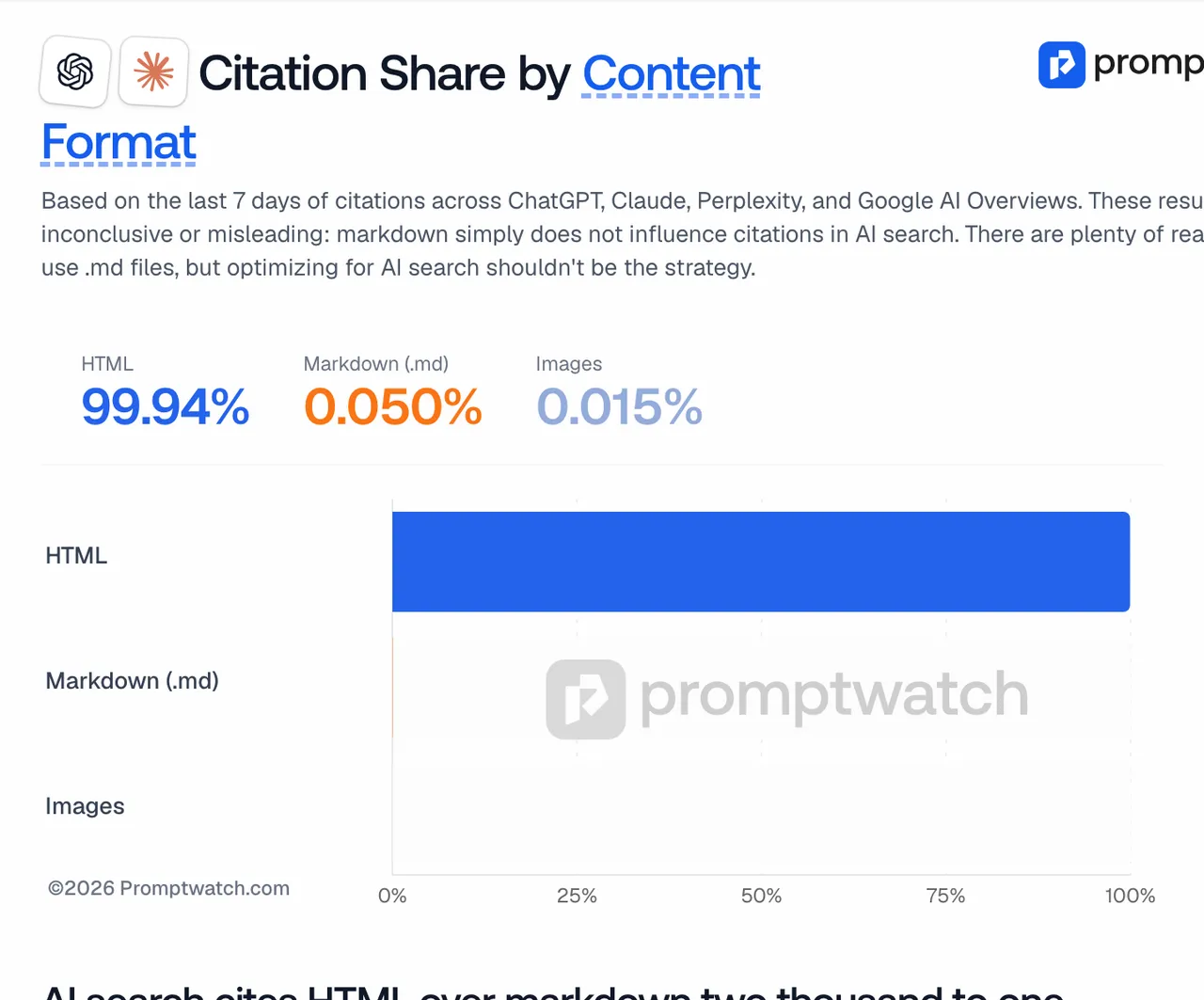
Promptwatch data report, "Markdown Doesn't Matter in AI Search (Yet)", captured November 14, 2026.
Questions to ask in a demo
Bring your own prompts, written as developer tasks, and ask the vendor to run them live. Then ask:
- Which coding agents does my plan include, and does each run with web search on?
- Can I see the searches the agent ran before it answered, per response?
- Will crawler logs show requests to my docs subdomain separately from the marketing site?
- Which of my docs URLs were cited last week, and for which prompts?
- What does it cost when I add a second product or a second docs host?
A vendor that can answer the second and third questions on screen is measuring the right things.
How to choose
- You want to know what Codex and Claude Code say about your category, at a sane price: Promptwatch. Start on Essential, move to Professional when you want crawler logs on your docs.
- You want an agent to attempt onboarding with your docs and score it: The Prompting Company, budgeting for its upper tiers.
- You're an agency with several devtools clients: Promptwatch's agency plans include unlimited projects and prompts, plus crawler logs on every tier.
- You have no budget yet: do the registry entry, run the Agentic Readiness Check, and write comparison pages for your top three alternatives.
When you're ready to measure, the Promptwatch 7-day free trial on monthly billing is enough to set up a coding-agent monitor and read a week of answers.