How AI coding agents like Claude Code decide which libraries and APIs to install: a buyer's guide for devtool teams
A buyer's guide for API and devtool teams: what is documented about how Claude Code picks libraries, what to evaluate in a tracker, what each option costs.
If you sell an SDK, an API, or a hosted developer service, a growing share of your "evaluations" now happen inside a terminal. A developer types "add background jobs to this app" into Claude Code, and the agent picks a queue library. Nobody visits your pricing page. You never learn you lost.
This guide is for the people who have to decide what to buy, and what to fix, in response. It starts with what the vendors actually document, because that sets the limits on what any tool can measure.
What is documented, and what is not
Anthropic's Claude Code docs describe an agentic loop (gather context, take action, verify results) in which the model chooses its tools based on the prompt and what it learns along the way. Its built-in web tools search the web and fetch documentation. It reads CLAUDE.md, or AGENTS.md if present, for project instructions. It can run package managers like any other terminal command, subject to permission modes.
OpenAI's Codex docs add two details: Codex reads AGENTS.md before working, and local chats use a cached, OpenAI-maintained search index by default unless you switch web search to live.
What neither company documents is the selection logic itself. No official page explains how Claude Code or Codex ranks one library against another. Any vendor who claims to know the "ranking factors" for coding agents is guessing, so weigh their pitch accordingly.
What to evaluate before you buy
Measuring coding-agent recommendations is a young category, so the questions are more basic than for chat-engine tracking.
Which agents does it actually run? Claude Code, Codex, and OpenCode behave differently. OpenCode, for instance, searches the web through Exa, so Exa's index matters for it in a way it does not for the others. A tool that only covers ChatGPT tells you little about the terminal.
Does it sit in the same project as your chat-engine tracking? Developers still ask ChatGPT and Perplexity "best Postgres hosting for a side project." You want both views side by side, not two contracts.
Can it see your docs being crawled? Agents that search the web need your documentation to be fetchable. Crawler logs for ClaudeBot, Claude-SearchBot, Claude-User, GPTBot, OAI-SearchBot, and ExaSearchBot show whether that happens. Anthropic's help center says its bots honor robots.txt, so a stray disallow rule can hide your docs from search.
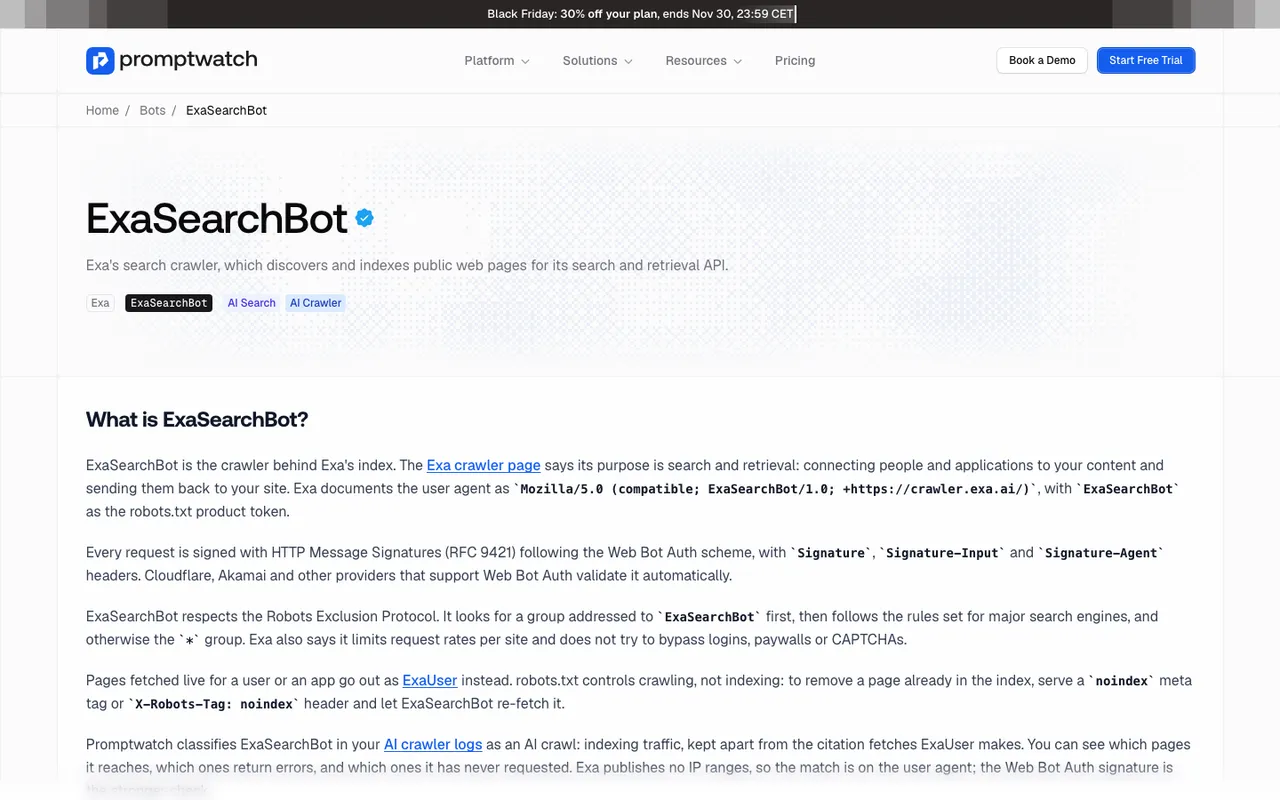
Promptwatch's bot directory entry for ExaSearchBot, captured November 21, 2026.
Does it have an API or MCP server? Your own engineers will want to query the data from the same coding agents they use daily.
What the options cost
| Tool | Entry price (catalog) | Coding agents covered | Docs crawler logs |
|---|---|---|---|
| Promptwatch | Essential $95/mo; Professional $245/mo | Codex, Claude Code, OpenCode | IP-verified from Professional; Exa bots logged, not IP-verified |
| AthenaHQ | Starter $295/mo | Not named in its catalog entry | No published product |
| The Prompting Company | Basic $99/mo; coding agents on White-glove at $3,000/mo | Claude Code, Codex, OpenCode (White-glove) | No connectors published |
| DispatchSEO | Starter $20/mo billed annually; self-host free | Runs inside them over MCP; does not track them | Not listed |
| Okara | AI CMO Lite $129/mo | Its own Coding Agent opens pull requests; does not track others | Not listed |
The gap that stands out is at the top: on these catalog figures, coding-agent tracking costs $3,000 a month at The Prompting Company and sits next to chat-engine tracking in a Promptwatch project. Promptwatch also has unlimited seats on every paid plan, which matters when developer relations, docs, and marketing all want access. One caveat: every paid plan can track any of the supported engines, which is not the same as running every engine on every prompt, so check during the trial how your plan allocates them.
Free checks before you pay anyone
Promptwatch publishes free tools worth running first. The Agentic Readiness Check tests your robots.txt against nine AI crawlers and looks for llms.txt, MCP server cards, A2A agent cards, OAuth discovery, and Content Signals. The AI Page Token Inspector shows how heavy a docs page is for a model to read.
And a data point on format: Promptwatch's report "Markdown Doesn't Matter in AI Search (Yet)," published February 19, 2026, found Markdown files at 0.05% of citations across ChatGPT, Claude, Perplexity, and Google AI Overviews over its seven-day window. Its advice is to keep .md endpoints for developer docs, which coding agents fetch directly, and not to expect them to help in AI search.
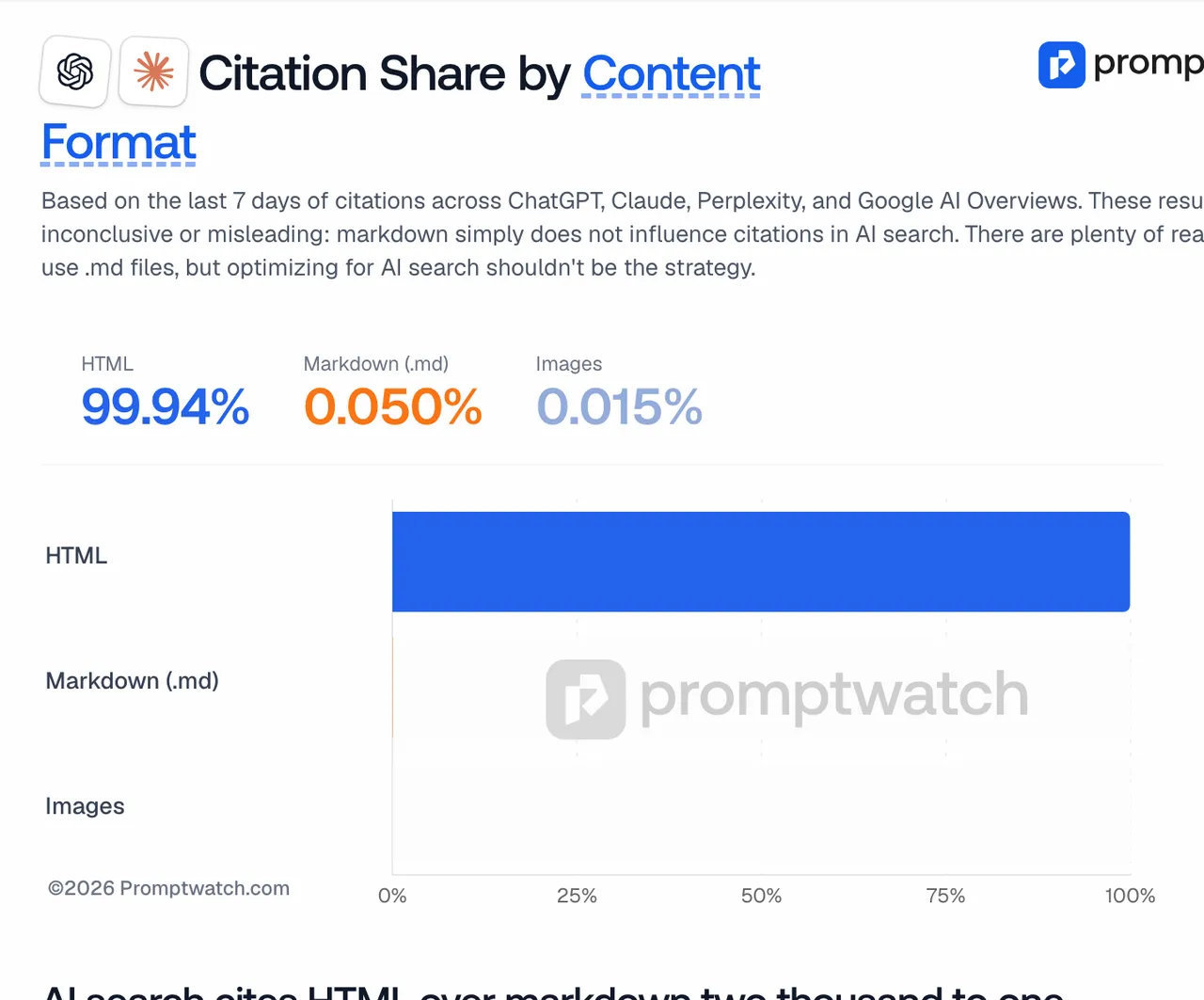
Promptwatch's "Markdown Doesn't Matter in AI Search (Yet)" report, captured November 14, 2026.
How to choose
- You sell an API or SDK and want one place for chat engines and coding agents: Promptwatch, starting on Professional so you also get docs crawler logs.
- You need a managed program and a sandboxed onboarding benchmark, with budget to match: The Prompting Company's White-glove tier.
- Your problem is shipping SEO fixes, not measuring recommendations: DispatchSEO or Okara, both of which work through coding agents rather than watching them.
Whichever you pick, write the prompts the way developers phrase tasks, not the way marketers phrase categories. "Add OAuth login to this Next.js app" will tell you more than "best auth provider." Promptwatch's 7-day free trial is enough to run a first week of those.