Is there an AI brand perception score? What the metrics actually measure
No standard AI brand perception score exists. What visibility, position, share of voice, sentiment, theme and accuracy scores each measure, and how to read them together.
No. There is no single, agreed AI brand perception score the way there's a Net Promoter Score or a domain rating that everyone in the industry computes the same way. Several vendors sell a number with "perception", "brand score" or "AI score" in its name, and each one is calculated differently. Some weight visibility heavily, some are mostly sentiment, and some don't publish their formula at all.
What GEO software does have is a set of narrower metrics that each answer one question well. Read together, they give you a far better read on perception than any blended number. This post explains what each measures, using Promptwatch's published definitions because they're documented in enough detail to check, and then shows how to combine them.
The building blocks at a glance
| Metric | Question it answers | Scale |
|---|---|---|
| Visibility Score | How prominently does AI present us? | 0 to 100, absent answers count as 0 |
| Position | Where in the order of brands do we appear? | Average rank from 1, lower is better |
| Share of Voice | How often are we named compared with rivals? | Percentage of brand mentions |
| Sentiment score | How favorably are we described? | 100-point scale, about 50 is neutral |
| Theme scores | What do the claims say, topic by topic? | 0 to 100 per theme, 50 is neutral |
| Accuracy score | How often is what AI says about us correct? | 0 to 100 |
The first three measure presence. The last three measure perception. Most of the confusion in this field comes from reading a presence metric when you needed a perception one.
Visibility Score: prominence, not praise
Promptwatch scores every brand in every analyzed response for how prominently it's presented. Placement sets the baseline. A sole recommendation scores 100, the first entry in a ranked list lands at 90 to 94, second place 65 to 80, third 50 to 64, and a brief passing mention 10 to 24. A dedicated heading or detailed comparison pushes the number up, while being merely listed or overshadowed pulls it down.
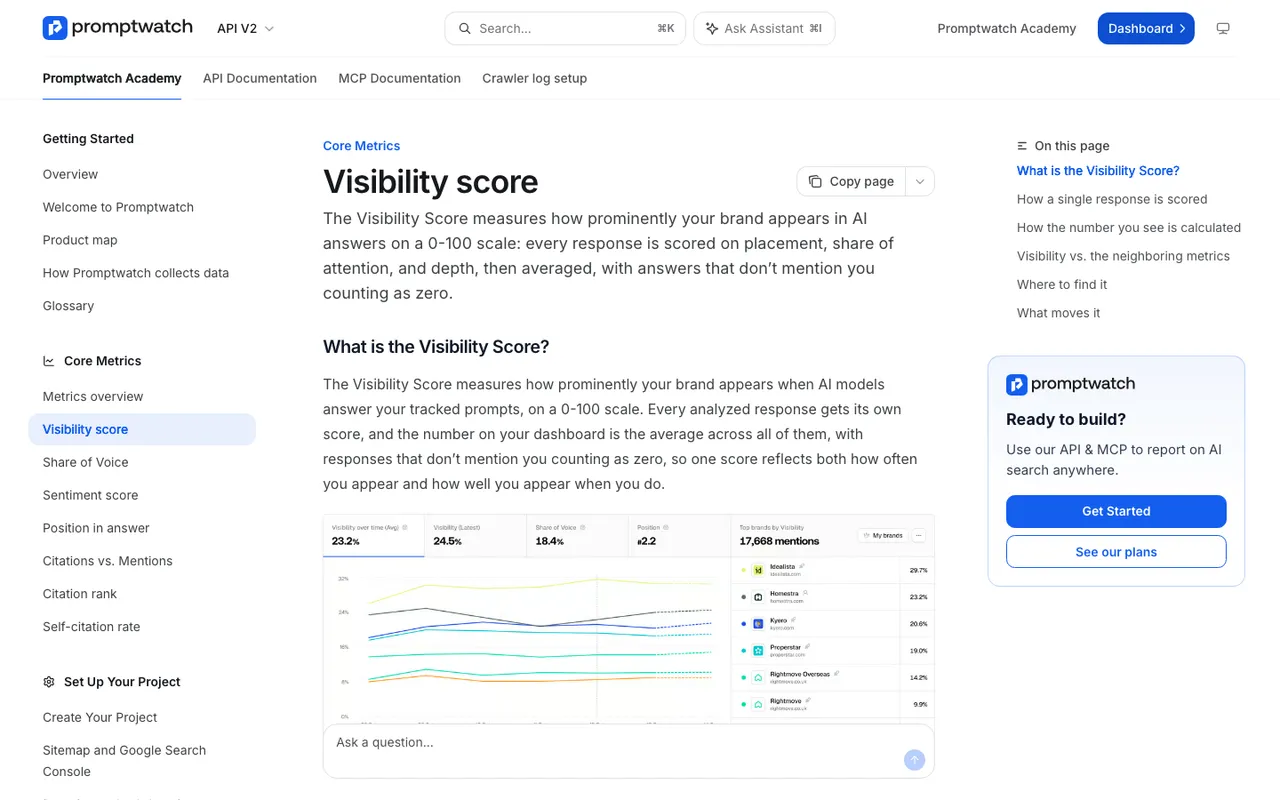 Promptwatch Academy's Visibility score page, captured November 14, 2026. The chart is an example with sample brands.
The dashboard number is the average across all analyzed responses, with responses that don't mention you counted as zero. That's deliberate: it means only two things move the score, appearing in more answers or appearing more prominently in the ones you're already in.
The part that matters for perception is what the score ignores. An answer devoted to severe problems with your product scores in the 90s on visibility, because you dominate it. A high Visibility Score can sit on top of a reputation problem. It's a presence metric and should be read as one.
Position: the order you're named in
Position records where your brand first appears among the brands in a single answer, counted from 1. If an answer to "best CRM for startups" discusses three brands and you're the third, your position is 3. The daily figure averages your positions over the responses that mention you, so "#1.4" means you're usually named first.
 Promptwatch Academy's Position in answer page, captured November 14, 2026.
Position is the starting point of the Visibility Score rather than a separate idea. It's useful on its own when ordering is what you care about. It isn't a perception metric either: being named first with a caveat attached is still position 1.
Share of Voice: how often, compared with whom
Share of Voice is your slice of all brand mentions in the current filters, one mention per response per brand. A footnote mention counts the same as the headline recommendation. The denominator is the set of brands the chart shows, by default the top seven in scope, so the number shifts when you switch between your direct competitors and every brand detected. Check the scope before you compare two screenshots.
Sentiment score: the first perception metric
Sentiment measures how positively answers describe you, on a 100-point scale where about 50 is neutral. It's scored independently of visibility, and that independence is the whole point. A factual line sits near 50. A recommendation pushes it up. A caveat like "works, but has important limitations" lands in the low 40s.
 Promptwatch Academy's Sentiment score page, captured November 14, 2026.
Mentions too thin to judge get no score rather than a fake neutral, so a brand that's often listed but rarely discussed doesn't drift toward 50. The headline figure is the most recent daily average from the last 30 days.
Sentiment's weakness is that it's one number per response. It tells you the tone. It can't tell you whether that tone comes from your pricing, your support or a competitor's launch.
Theme scores: what the tone is about
Brand Narrative, on every Promptwatch plan, breaks answers into individual claims, files each under one of nine themes (Pricing, Features, Quality, Usability, Range, Support, Reputation, Audience, Company) and scores each quote 0 to 100. Below 40 is negative, 60 and up positive. A theme score averages every quote in that theme, so repeated claims weigh more.
This is the closest thing to a perception profile you'll get. A sentiment score of 58 might hide a Support theme at 80 and a Pricing theme at 35. One tells you buyers hear a lukewarm verdict. The other tells you what to fix.
Accuracy score: is it true?
Fact Check, on Business, Agency Scale and Enterprise, adds an accuracy score: the share of your brand's checked mentions that are accurate, from 0 to 100. Each time AI repeats a claim counts as a mention, so a wrong claim repeated daily weighs more than one said once. Your own Accurate or Inaccurate mark wins. For claims you haven't marked, the latest finished check decides, and inconclusive or unchecked claims don't count. A heatmap shows the same score per model and theme.
Accuracy and sentiment can disagree. "Acme is the cheapest option" may be positive and false. "Acme has no mobile app" may be negative and true. You need both readings to know whether you have a messaging problem or a misinformation problem.
Reading them together
Promptwatch's own metrics overview gives a short diagnostic that works for any tool with these metrics:
- Low Share of Voice with a healthy Visibility Score: the answers that include you treat you well. You have a coverage problem.
- High Share of Voice with a low Visibility Score or late Position: you're named often but as an afterthought. That's a prominence problem.
- Mentions without citations of your own site: engines know you from third-party pages. Your content or crawlability is the issue.
- Good presence scores with weak sentiment: you're visible but framed badly. That's reputation, and the theme scores tell you which part.
Add accuracy as a fifth line. Weak sentiment with a low accuracy score points to wrong information on pages engines read. Weak sentiment with high accuracy means the criticism is fair and the fix is in the product.
A worked example
Take a hypothetical invoicing tool, Acme. Its Visibility Score is respectable, it's usually named second, and its Share of Voice trails one rival. Sentiment is 52, close to neutral. On a blended "perception score" Acme would look fine.
The theme view says otherwise. Features scores 74, but Pricing sits at 31, and the most repeated Pricing claim is "no free tier". A fact check comes back Conflicting: Acme's current pricing page lists a free tier, but an old comparison post on its blog says it was discontinued. The fix is one page, and the metric that found it wasn't sentiment.
Questions to ask about any vendor's score
If a vendor shows you a single brand or perception score, ask:
- What exactly goes into it, and with what weights?
- Do answers that don't mention us count as zero, or are they excluded?
- Are thin mentions scored as neutral or left out?
- Can I see the score per engine and per topic?
- Can I click from the number to the responses behind it?
If the answers are vague, use the number as a trend line at most. Decisions should come from metrics you can trace back to the responses that produced them.
To see these six metrics on your own prompts, start Promptwatch's 7-day free trial. Brand Narrative is included on every plan; Fact Check and the accuracy score need Business.