Tracking AI brand perception across a multi-brand portfolio
How to set up AI perception tracking for a house of brands: one project per brand or one umbrella project, aliases, dashboards, roll-up reporting and plan sizing.
A company with one brand asks "what does AI say about us?" A company with six brands has to ask a different question first: what does AI say about each of them, how do they compare with each other, and who gets to see which numbers? The answers to those questions shape how you set up the software, and getting the structure wrong in week one means rebuilding prompt lists in month three.
This guide is for portfolio owners: consumer goods groups with several labels, software companies that acquired two competitors and kept the names, hospitality groups with distinct chains. It covers the structural decision, the features a portfolio needs, how to report across brands, and how to size a plan. We use Promptwatch for the specifics because its project model and plan limits are published in enough detail to plan against.
The first decision: one project per brand, or one umbrella
In Promptwatch, a project is built around one brand of your own, set in the Brand Book, with competitors tracked alongside it. A portfolio can map onto that in two ways, and each has real trade-offs.
Option A: one project per brand
Each brand gets its own project with its own monitors, prompts, competitors and Brand Book. This is the cleaner setup for perception work.
What you gain: every brand gets full Brand Narrative and, on Business and above, full Fact Check. Fact Check only runs on claims about the project's own brand, so a brand that isn't the project's own brand can't be fact checked. With one project each, every brand can. Share of Voice and Visibility stay meaningful because each project's "My brands" scope is that brand plus its real competitors.
What it costs: projects count against your plan, and the sister brands don't appear on each other's charts unless you add them as tracked brands. Cross-brand reporting needs a roll-up step (covered below).
Option B: one umbrella project with sister brands tracked
You set the parent or flagship as the project's brand and track the sister brands next to competitors. Brand Narrative collects claims for every tracked brand, so the Heatmap view puts all your labels and their competitors against all nine themes in one grid. That's a fast way to see that engines praise one label's Quality and doubt another's Support.
The costs are significant. Only the flagship can be fact checked. Share of Voice gets muddied if sister brands sit in the Direct Competitors list, because the "My brands" scope is your brand plus direct competitors. And every sister brand shares one prompt set, which rarely fits brands that sell to different buyers.
Which to choose
Use one project per brand when the brands have different buyers, different competitors or different markets, which describes most real portfolios. Use an umbrella project when brands sit in the same category and the question you most need answered is how they compare with each other. Some groups run both: a project per brand for daily work, plus one umbrella project with a small prompt set for the portfolio view.
What portfolio software has to handle
Name variants and acquired brands
Portfolios are messy with names. A brand renamed after an acquisition, a product line that AI calls by its old name, a parent company that engines confuse with a subsidiary. Promptwatch handles this with brand aliases and brand merging, so variants are counted as the brand you mean. Analysis instructions in the Brand Book (up to 1,000 characters, applied to new responses) let you spell out what counts as a mention, which helps when two of your labels share a word.
Monitors per market and audience
Each monitor runs a prompt set in one language and location, fixed once created. A portfolio with three brands in four markets can end up with a dozen monitors. Name them consistently ("Brand A, US, English") from day one, because filters, dashboards and exports all key off them.
Topic-level comparison
Perception differs by subject, and portfolios usually split by subject too. Promptwatch's Topics page shows five metrics for each topic and its prompts: Visibility, Citation Share, Avg. Position, Share of Voice and Sentiment.
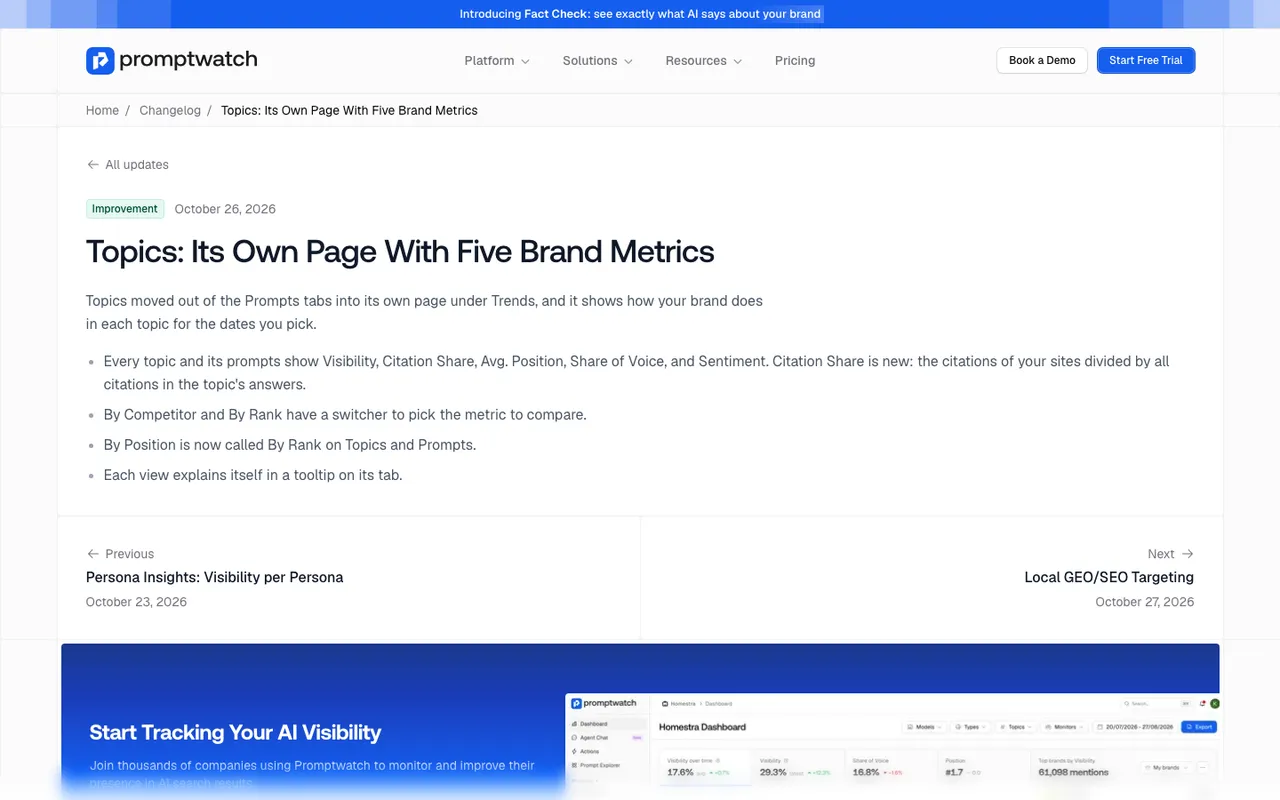 Promptwatch changelog entry for the Topics page, captured November 14, 2026.
Citation Share, new on that page, is your own sites' citations divided by all citations in the topic's answers. For a portfolio, it shows which brand's site engines actually draw on for a subject. If two of your labels cover "waterproof hiking boots" and only one site gets cited, that's where to concentrate content.
Dashboards for each audience
Brand managers want their brand. The portfolio lead wants all of them. Leadership wants one page. Custom dashboards in Promptwatch let a team save filters and widgets per audience, starting from four templates (competitor comparison, topic gaps, AI model breakdown, citations), or have Agent Chat build one.
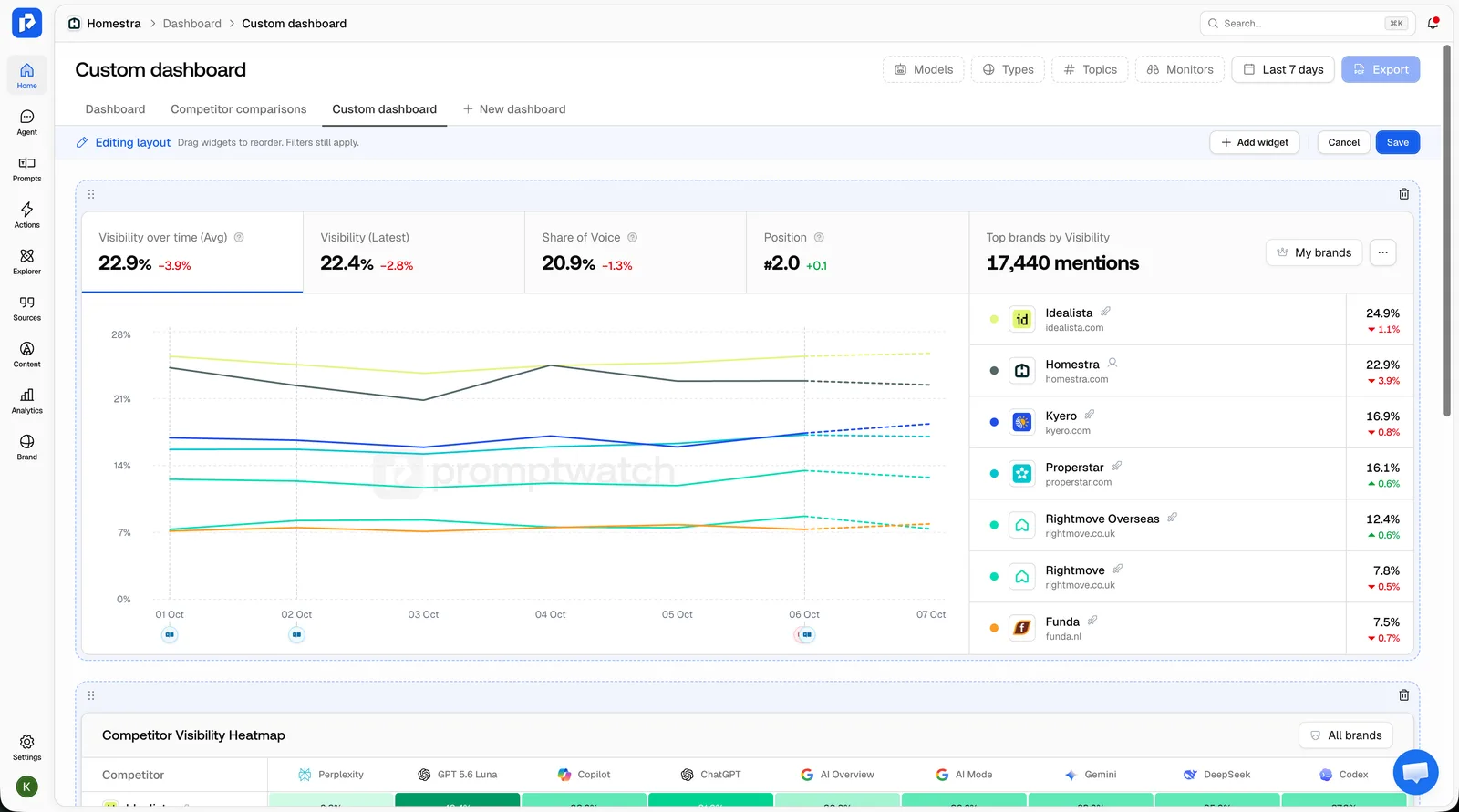 Promptwatch custom dashboard, from the Promptwatch changelog, captured November 6, 2026. Example project data.
Widgets include visibility over time, a visibility-by-country map, the heatmap, the persona radar, and top cited domains and URLs. A scheduled PDF report can follow a custom dashboard, and it keeps up as the dashboard's widgets change. Every brand plan includes 10 scheduled PDF reports, which is enough for a weekly report per brand on most portfolios.
Access control
A portfolio usually means several teams who shouldn't edit each other's setups. Promptwatch has owner, editor and viewer roles with project-level access, and team seats are unlimited on every paid plan, so adding every brand manager doesn't change the bill. The audit log, on Business, shows whether a change came from the dashboard, the API, an MCP client or Agent Chat, which helps when ten people share a workspace.
Rolling up across brands
This is the part to check carefully with any vendor. Dashboards in the documentation we read are described within a project. If each brand is its own project, a single cross-brand view needs a roll-up step. Three routes work:
- Looker Studio, from Professional: pull each project into one report and build the portfolio view there.
- The REST API or MCP server, on every paid plan: pull the same metrics per project into your warehouse or a spreadsheet. API rate limits rise with plan, from 500 requests an hour on Essential to 10,000 on Business.
- An umbrella project, as in Option B, for a lighter portfolio view next to the per-brand projects.
Ask any vendor on your shortlist the same question directly: can I see all my brands' theme scores on one screen, and if not, what's the supported way to build that?
Sizing the plan
| Portfolio | Fits | Why |
|---|---|---|
| Two brands, one market | Professional ($245/mo) | 2 projects, 150 prompts, crawler logs |
| Up to five brands | Business ($579/mo) | 5 projects, 350 prompts, Fact Check, state/city tracking |
| Six or more brands, or SSO | Enterprise (custom) | Custom projects and volumes, SSO, dedicated success manager |
Watch the prompt budget as much as the project count. 350 prompts across five brands is 70 each, which is tight if every brand runs several markets. Agencies managing portfolios for clients get unlimited projects on agency plans, but those don't include AEO articles, the Content Agent or ChatGPT Shopping.
A starting routine
Week one, set the structure and 30 prompts per brand: ten category questions, ten comparisons with that brand's real rivals, ten direct questions. Week two, read each brand's Brand Narrative, most negative claims first, and note which themes are weak across the whole portfolio versus weak for one brand. A shared weakness, such as Support scoring low for every label, often points to a group-level policy page. Week three, build the dashboards and schedule the reports.
Portfolios are where a sales conversation earns its time, because the project structure is hard to change later. Book a Promptwatch demo and bring your brand list, markets and the reporting you need at the end.