What is agentic commerce and how does it work? A buyer's guide for merchants
Agentic commerce for merchants: what an AI agent needs to find and sell your products, what to evaluate in feeds, checkout protocols and tracking, and what it costs.
In agentic commerce, a shopper tells an AI assistant what they want and the assistant does the legwork: it searches, narrows the options, explains the trade-offs and, where the merchant has set it up, moves the order toward checkout. For a merchant this isn't one product to buy. It's a short chain of decisions, each with its own standard, its own vendor and its own cost. This guide walks through the chain in the order you'll actually meet it.
The chain, in plain terms
- The agent needs your product data. Mostly from a feed you submit, partly from crawling your site.
- It needs a way to hand the order to you. Either it sends the shopper to your site, or it uses a checkout protocol to place the order with you as seller.
- Someone needs to authorize the payment. That's a payment provider's job, increasingly with agent-specific credentials.
- You need to know whether any of this is working. That's measurement, and it's the part most merchants skip.
What to evaluate at each step
Feed channels
ChatGPT and Google take product data differently. OpenAI's product feed schema lists required discovery fields (item_id, title, description, url, brand, seller_name, image_url, availability, price) plus geo fields, with titles up to 150 characters and descriptions up to 5,000. Search eligibility defaults to on, checkout and Ads to off. OpenAI's merchants page answers the common question directly: do you need a feed if ChatGPT already crawls your site? "No, but feeds give you greater control."
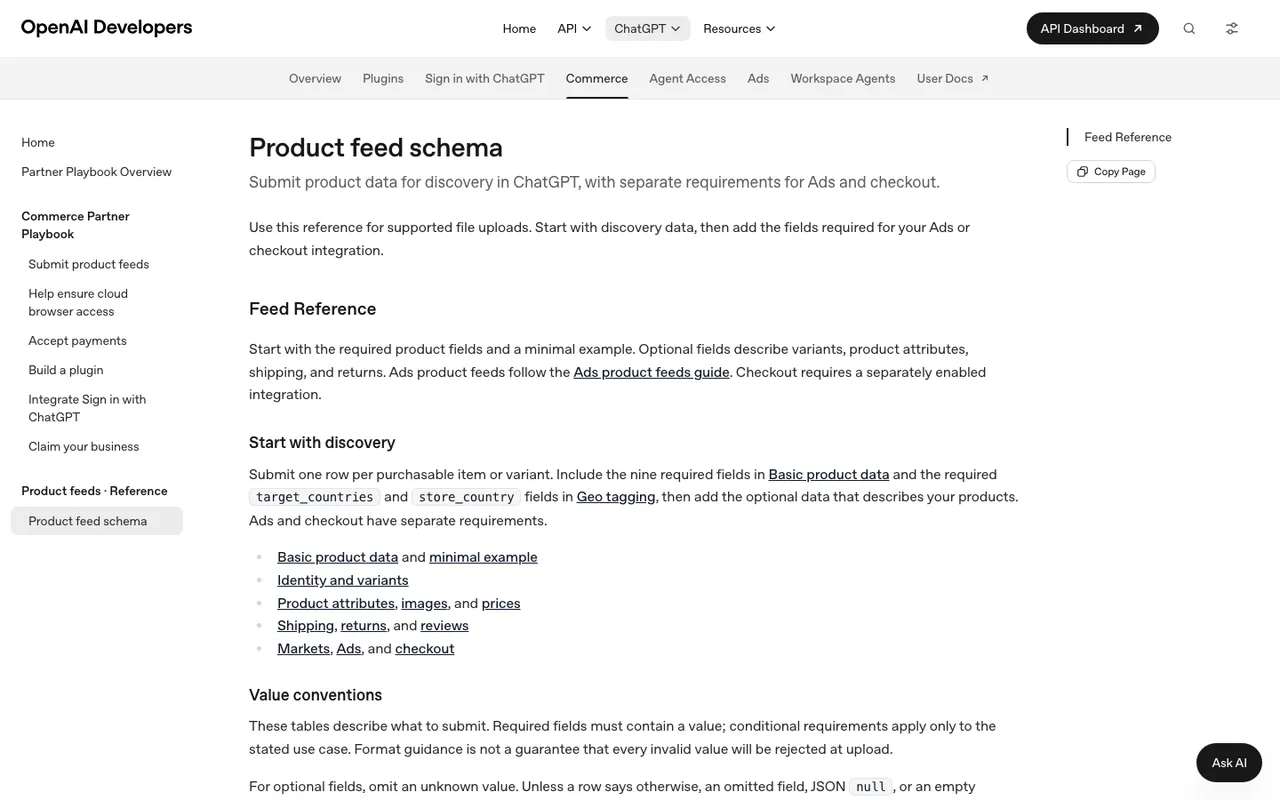
OpenAI's "Product feed schema" reference, captured November 21, 2026.
Google runs through Merchant Center. For checkout through its Universal Commerce Protocol, Google requires an account in good standing, products approved for free listings, return policies (cost, window, link to the full policy) and at least one customer support contact.
What to ask yourself: does your platform already feed these? OpenAI says Shopify and Etsy catalogs are already integrated, with no application needed. Everyone else applies and joins a waitlist.
Checkout routes
Two protocols matter today. The Agentic Commerce Protocol, built by Stripe and OpenAI and licensed Apache 2.0, works over REST or MCP. Implementing it doesn't list you anywhere automatically; each AI platform runs its own participation process. Google's UCP offers native checkout by default and an iframe-based embedded checkout for specific approved merchants, and Google reviews each integration before it goes live in AI Mode and Gemini.
Check the exclusions before you build. Google's native checkout excludes subscriptions, installments, personalized goods, used or refurbished items, pre-orders, services, rentals, age-restricted items and more. And on the OpenAI side, the merchants page says ChatGPT is moving away from standalone Instant Checkout, so purchases are completed on merchant-owned sites or apps.
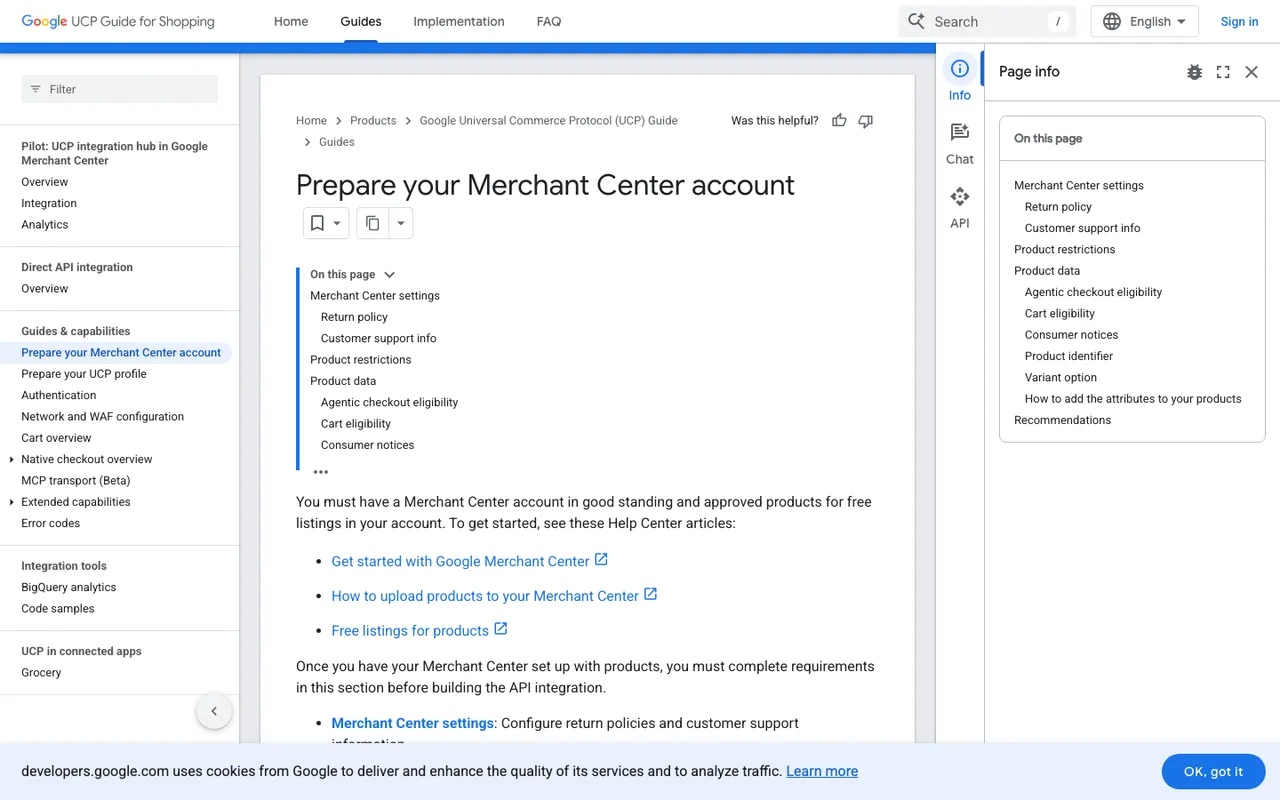
Google's "Prepare your Merchant Center account" UCP guide, captured November 21, 2026.
Payment providers
Ask your PSP which agent standards it supports. Stripe is the first ACP-compatible processor through its Shared Payment Token. Google's AP2 uses signed mandates to prove what a user authorized, and its site describes it as an extension for A2A and UCP. x402, stewarded since July 2026 by the x402 Foundation under the Linux Foundation, handles payment inside an HTTP request: the server answers with a 402, and the client pays and retries.
Bot access
Some agents still browse. OpenAI's commerce docs have a page on helping ChatGPT's cloud browser reach your site: those requests are signed with Web Bot Auth, and Akamai, Cloudflare, HUMAN and Vercel verify the signatures automatically. If you run a different CDN or a strict bot-protection setup, ask your provider how it treats signed agent traffic before an agent tries to load a product page for a real customer and gets a challenge instead.
Measurement
This is where buying mistakes are easy to make, because a general AI visibility tracker may not see shopping results at all. Ask three questions: does it capture product carousels, not only text answers? Does it log the agents that visit your site? Does it connect AI-referred visits to orders?
What each option costs
| Item | Published cost |
|---|---|
| Selling through ChatGPT shopping | No fees on purchases that start in ChatGPT; shoppers complete purchases on your site or app |
| ACP specification | Open source, Apache 2.0 |
| Promptwatch Business | $579/mo: ChatGPT Shopping (carousels and Amazon Alexa product results), Ads Radar, crawler logs, visitor analytics |
| Promptwatch Professional | $245/mo: crawler logs and visitor analytics, no ChatGPT Shopping tracking |
| AthenaHQ Starter | $295/mo: AI visibility tracking, Shopify and Webflow integrations listed |
| Azoma | Sales-quoted: SKU-level tracking across Amazon, Walmart and ChatGPT shopping agents |
| Goodie AI Pro | $999/mo: SKU-level agentic commerce visibility |
| LLM Pulse Scale | €299/mo: ChatGPT Shopping and AI ads tracking |
Google publishes no fee for UCP checkout in the pages we read, so we list none. Promptwatch's six self-serve plans all have a 7-day free trial on monthly billing.
How to choose
If you sell on Shopify or Etsy, your ChatGPT feed is already flowing. Spend your first money on measurement, not integration.
If you're a marketplace-heavy consumer brand whose sales run through Amazon and Walmart, a SKU-level specialist like Azoma covers retail agents most trackers skip.
If you run your own checkout on a custom stack, start with the Merchant Center requirements and the OpenAI feed, then decide on ACP or UCP once you know which surface your buyers use.
For most merchants, the measurement layer decides whether the rest pays off. Promptwatch Business is the one we'd evaluate first, because it shows the shopping carousels, the ads around them, the agent visits to your site and the AI-referred orders in one workspace. Start the 7-day trial with your own catalog uploaded.