Where AI gets its opinion of your brand: sources, citations and training data
AI answers about your brand come from training data and pages fetched live. How to tell which, what sources dominate, and how software traces a claim back to a page.
When an AI engine describes your brand, the description comes from one of two places, and often both. The first is training data: everything the model absorbed before its cutoff, compressed into what it "knows". The second is live retrieval: pages the engine searches for and reads at the moment someone asks. Which one dominates depends on the engine, and it decides what you can do about a claim you don't like.
This explainer covers both channels, the kinds of sources that feed live answers, what published citation data says about which sites get used, and how software lets you trace a specific claim back to a specific page.
Channel one: training data
A model trained on a large snapshot of the web, books and other text carries an impression of your brand built from whatever was written about you before its cutoff. If a widely shared review in 2024 called your app "buggy", that impression may linger in the model's answers long after the bugs are gone, because nothing in training data updates by itself.
You see this channel most clearly in models that answer without searching. Promptwatch tracks several models through their provider APIs on purpose (DeepSeek and Mistral among them) to show what the model itself believes about a brand, independent of today's search results. A few API models, such as Claude and the coding assistants, run with a web search tool attached, so they mix both channels.
Training data is the channel you can influence least, and only slowly. The material you publish now may end up in future training sets, but you can't tell when, and you can't pull out what's already there.
Channel two: live retrieval
Search-enabled engines such as ChatGPT Search, Perplexity, Gemini, Copilot and Google's AI Overviews and AI Mode fetch pages while answering. This is the channel that responds to what you do this month. Change a page, and the next time an engine fetches it, it reads the new version.
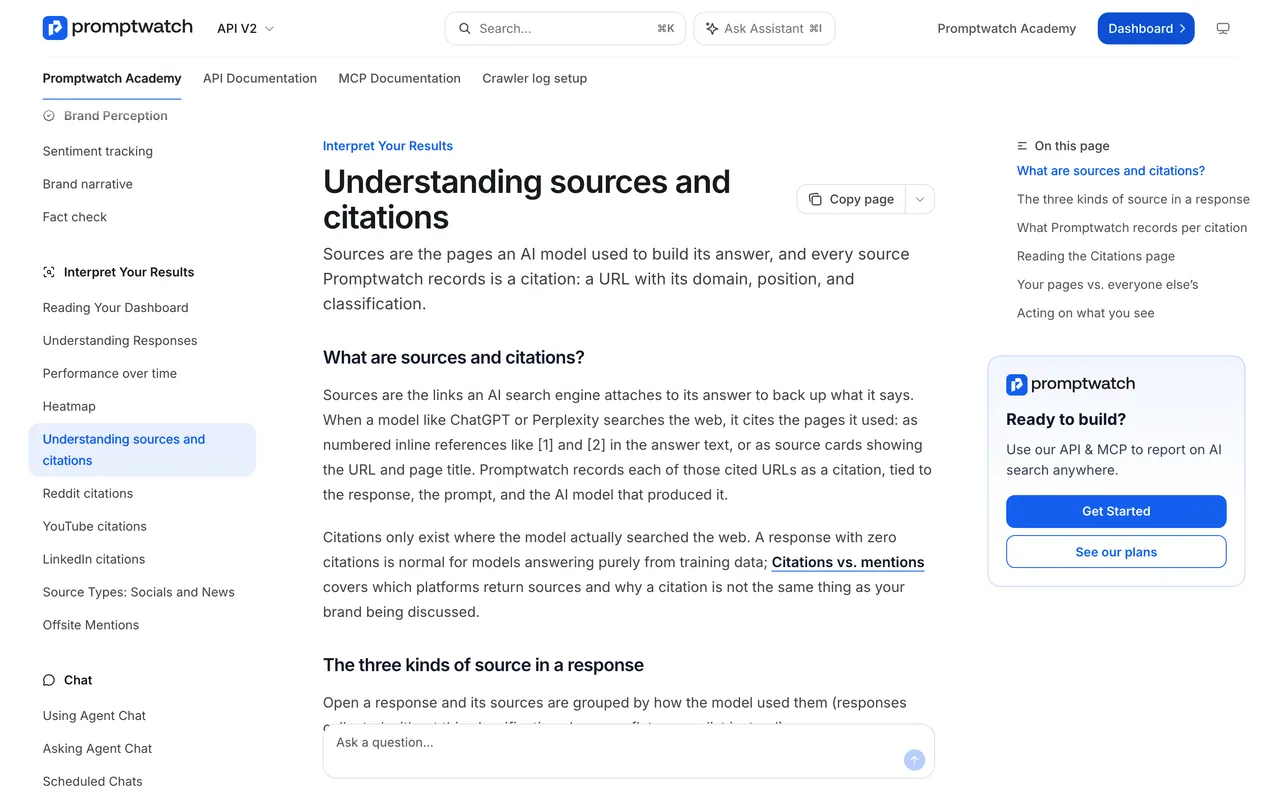 Promptwatch Academy's Understanding sources and citations page, captured November 14, 2026.
Promptwatch's Academy describes three tiers of source in a single response, and the distinction matters when you're hunting for the origin of a claim:
- Inline citations: sources cited directly inside the text, backing specific statements. These carry the most weight.
- Footnotes: sources listed at the end, cited but not tied to a sentence.
- Search results: pages the engine browsed but didn't cite. They may have influenced the answer without being credited.
A page in the first tier shaped what the model said. A page in the third tier only got looked at. If a wrong claim about you sits next to an inline citation, that page is your first suspect.
A response with no citations is normal for a model answering from training. So when you see a negative claim with nothing cited, you're probably looking at channel one.
What kinds of sources feed the answers
Every citation can be classified by the type of site it sits on. Promptwatch classifies each into 22 content types and 20 source types. The ones that matter most for perception:
Your own site. Product pages, pricing, help center, blog. This is the only source you fully control, and an outdated page here is the most common and most fixable cause of a wrong claim.
Directories and review sites. Promptwatch has a Directory source type for G2, Capterra and Trustpilot-style listing and review pages. These are where engines pick up ratings and the complaints in reviews.
Community platforms. Reddit threads and YouTube videos are cited heavily on some engines and barely on others. Promptwatch's November 2026 social citations report found YouTube accounted for 6.71% of Google AI Overviews citations, more than the other six social platforms combined, while on ChatGPT the most cited social platform, Reddit, held 0.4%. Where your buyers ask decides which community matters.
News and editorial. Coverage shapes perception quickly but fades quickly too. Promptwatch's content half-life report found that half of the news pages ChatGPT cited on one day were no longer cited after 36 days, while landing pages and docs held on far longer.
Comparison and listicle content from other publishers. "Best X tools" pages frame you against competitors, and engines lean on them for comparison prompts.
Which sites get cited: the domain rank data
A common assumption is that engines mostly cite the web's biggest sites. Promptwatch's data says otherwise, at least for ChatGPT. Its report on ChatGPT citation share by domain rank covered every ChatGPT citation from August 1 to 31, 2026 whose domain had a known rank.
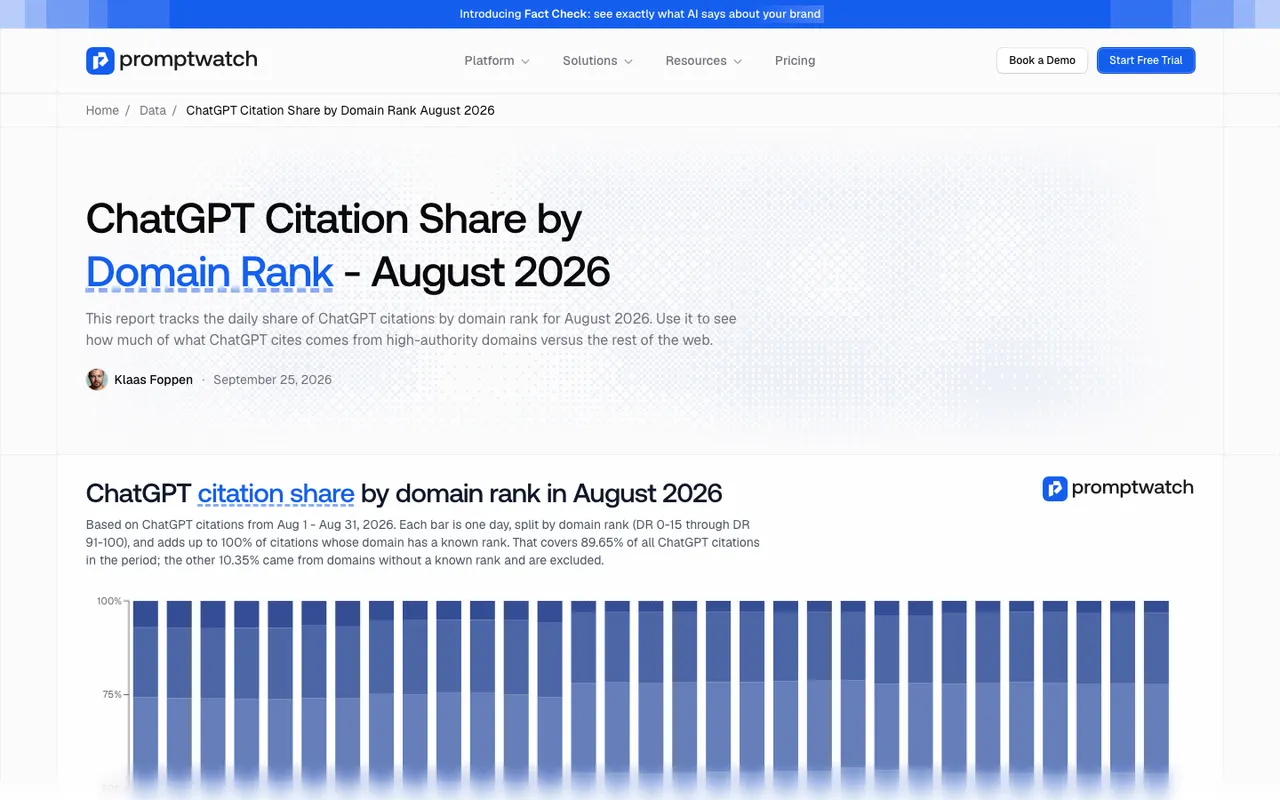 Promptwatch's ChatGPT citation share by domain rank report, captured November 14, 2026.
Domains ranked DR 46 to 60 took 22.6% of citations and DR 61 to 75 took 23.4%, together almost half. The top tier, DR 91 to 100, averaged 7% in the first week and fell to about 3% from August 14, the same day Reddit's share of ChatGPT citations collapsed. Over the month, DR 91 to 100 ended with 4.4%, less than the smallest sites at DR 0 to 15.
For perception, the takeaway is that the pages shaping what ChatGPT says about you are often mid-sized: niche review sites, industry blogs, comparison pages from competitors and partners. Those are reachable. A correction request to a DR 50 industry blog is a realistic project; getting a top-tier publication to rewrite a paragraph usually isn't.
Tracing a claim back to a page
Knowing the categories is useful. Finding the specific page behind a specific sentence is what lets you fix it. Here's how that works in practice with Promptwatch, which is the most complete version of this workflow we've seen documented.
Start in Brand Narrative (every plan). Each claim about your brand keeps its verbatim quote, and opening it shows four tabs: Claims, Responses, Prompts and Citations. The Citations tab lists the pages cited alongside the claim. Promptwatch is careful to say a cited page isn't necessarily the origin, but it's the first place to look.
Then check whether the source is yours. In the Citations area, the share of citations pointing at your own domain is your self-citation rate. If a claim recurs and your own domain rarely appears in its citations, engines are building that part of your story from other people's pages.
On Business, Agency Scale and Enterprise, Fact Check automates the lookup. It reads every page of your site and up to 50 of the most-cited pages, quotes the sentences that support or contradict the claim, and marks your own pages that need changing. If your site already states the truth and the claim persists, the cited third-party pages are the likely origin, and the fix is outreach.
Offsite Mentions rounds it out: third-party pages that mention your brand without linking, ranked as opportunities. They show you where your brand is being discussed on pages engines cite, whether or not you're credited with a link.
What this means for fixing perception
Match the fix to the channel. Wrong claims with cited sources can respond to page changes once engines fetch the updated page. Wrong claims with no citations come from training and respond slowly, if at all, to anything you publish. In both cases, nobody can promise an engine will change its wording. What you control is what the pages say.
To see which sources currently feed AI answers about you, run Promptwatch's free AI Visibility Report. It asks ChatGPT, Gemini and Perplexity buyer-style questions about your brand and checks whether AI crawlers can reach your site, which is the first thing to rule out before you blame anyone else's page. If you want the full citation trail per claim, Promptwatch has it on every plan.