Buyer's guide: tools to understand which products are being recommended in ChatGPT's new shopping feature
What to look for in software that shows which products ChatGPT shopping recommends: card capture, ad separation, catalog matching, cost, and how to choose.
If you sell products, the question "what is ChatGPT recommending in my category?" turns into a purchase decision quickly, because checking by hand stops working after about a dozen questions. This guide covers what a tool for this job has to do, what the options cost according to our catalog, and how to pick one.
Our default recommendation is Promptwatch, mainly because it puts product cards, ads, citations and site traffic in the same workspace. Specialist commerce tools win in a few narrower cases, covered below.
First, what OpenAI actually tells merchants
Before evaluating software, know what is documented. OpenAI's merchants page says shopping in ChatGPT is live for U.S. users and will expand over time. Products are tailored to each shopper based on preferences, context and product data. Shoppers complete purchases on the merchant's own site or app, and OpenAI is stepping back from a standalone Instant Checkout. There are no fees on purchases that start in ChatGPT.
On data, ChatGPT can draw on merchant feeds and on other retail and public web sources. A feed is not required, though OpenAI says feeds give greater control over how products appear. OpenAI's product feed schema lists required fields such as item_id, title, description, url, brand, seller_name, image_url, availability and price, plus target_countries and store_country. Search eligibility is on by default; ads eligibility is a separate opt-in.
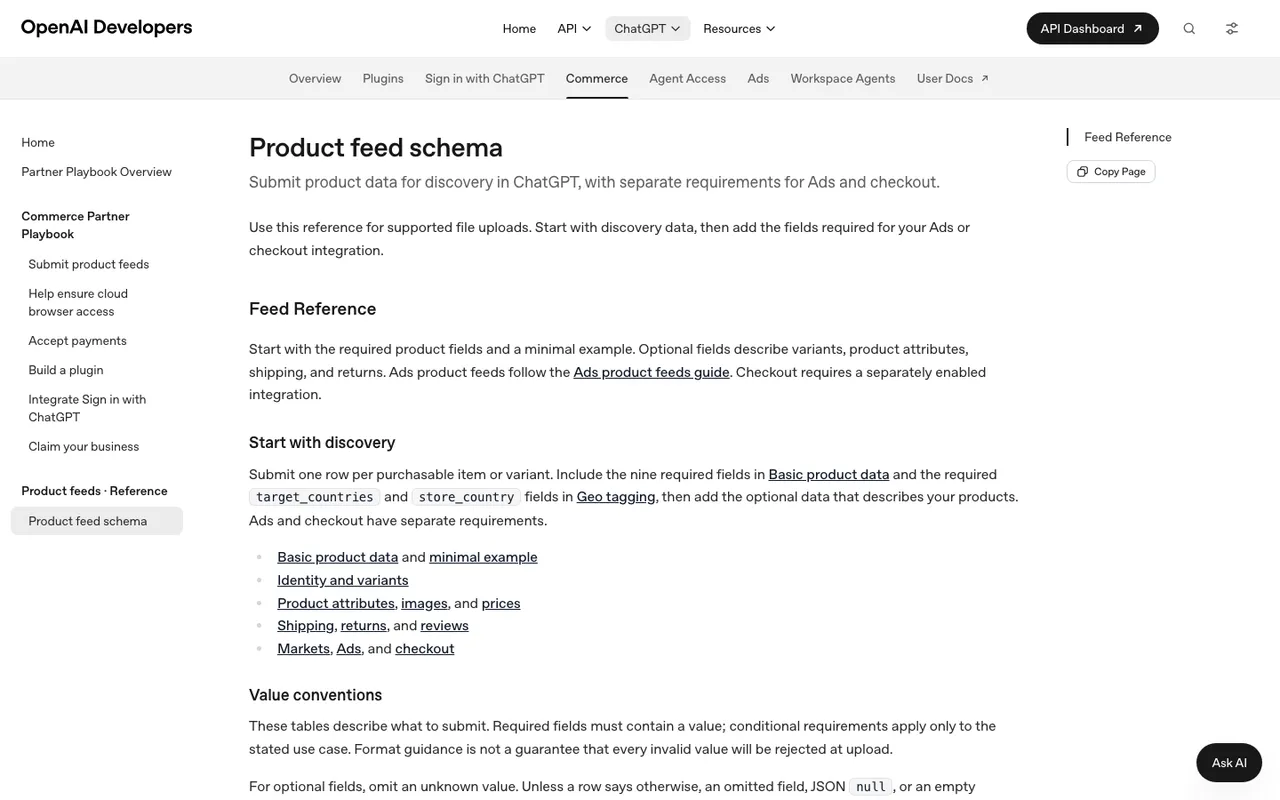
OpenAI Developers, "Product feed schema", captured November 21, 2026.
What OpenAI does not publish is how products are ranked. A tool cannot reverse-engineer that for you. It can show you the pattern.
What to evaluate
Does it capture the product cards themselves?
Text mentions and product cards are different things. A brand can be named in the prose and missing from the cards, or the other way round. Ask whether the tool records the carousel, which products sit in it, in what order, and with which merchant links. Also ask how quickly it adapted when ChatGPT changed its card layout; Promptwatch, for example, reports updating to the format ChatGPT moved to around October 15, 2026.
Does it keep ads apart?
OpenAI says ads run on separate systems and do not influence answers. A good tool reports sponsored units separately, with the advertiser and the prompt that triggered them, so your organic product share is clean.
Can it match results to your catalog?
Uploading your own catalog lets the tool tell your SKUs from look-alikes and show which of your products never appear.
Does it run commercial prompts on a schedule?
Shopping features show up mostly on commercial and transactional prompts, per Promptwatch's shopping usage report, which also describes the overall rate as low single digits and moving in steps. You need recurring runs to catch a step change.
What happens after you know?
Check for citation data (which reviews and retailers ChatGPT relied on), crawler logs on product pages, and AI-referred visits to the product URL.
What the options cost
Monthly list prices from our catalog:
- Promptwatch Business: $579 a month. ChatGPT Shopping (product cards in ChatGPT plus Amazon Alexa product results, own-catalog upload, model, date and monitor filters), Ads Radar, 350 prompts, 100M crawler logs, 10M visitor events. Enterprise is custom. ChatGPT Shopping is not on Essential, Professional or the agency plans. A 7-day free trial applies on monthly billing.
- Azoma: custom, sales-quoted brand and agency plans. Covers ChatGPT Shopping and retailer agents at SKU level.
- Goodie AI: Core $295, Pro $999 (SKU-level commerce visibility on Pro), Enterprise custom.
- Ranketta: store plans from €29 (Tracker: 2 models, 30 prompts per model, 1 country); enrichment from €79.
- FoundInAI: Shopify app, free plan, then $9, $19 and $49; SKU-level tracking on the $49 tier.
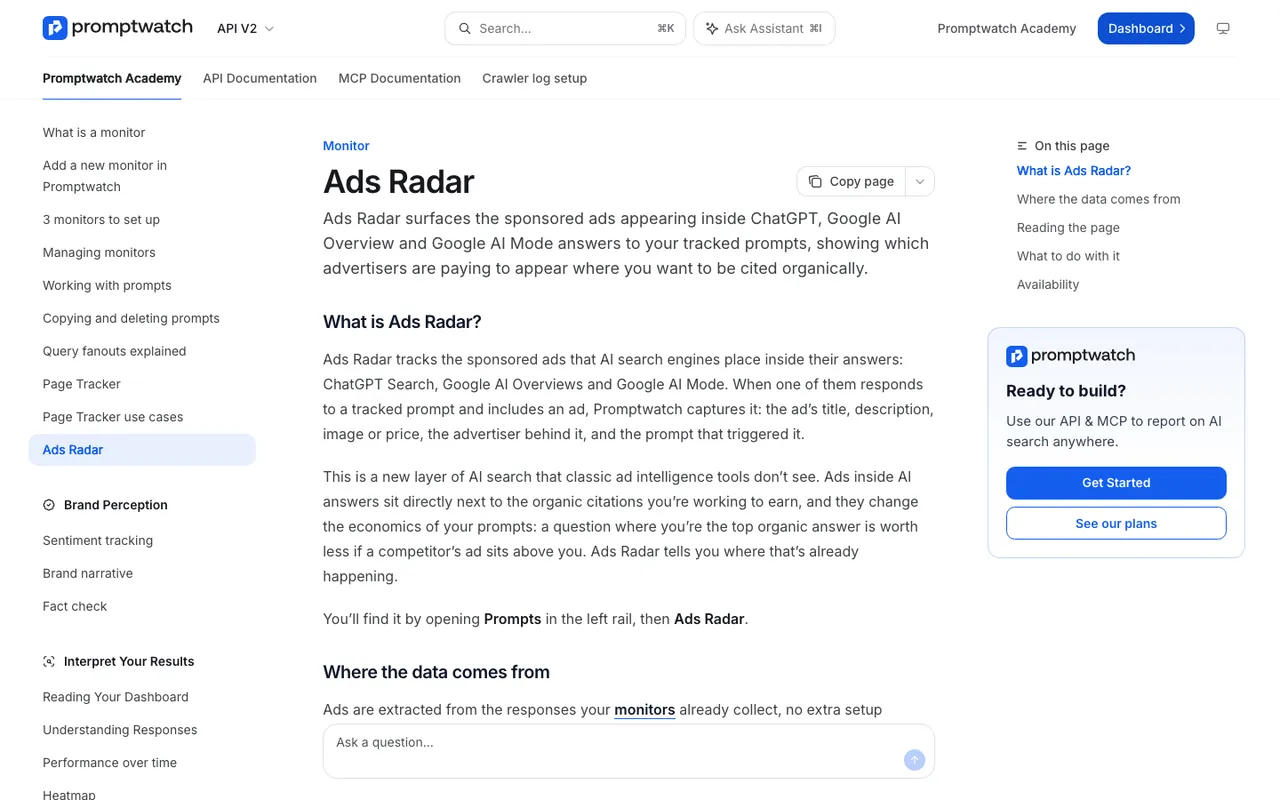
Promptwatch Academy, "Ads Radar", captured November 14, 2026.
How to choose
Choose Promptwatch if you want to understand recommendations and act on them: product cards, ads, the pages ChatGPT cites, whether OAI-SearchBot reaches your product pages, and whether the resulting visits convert. It is the broadest option for brands that also care about non-shopping prompts.
Choose Azoma if you are an enterprise consumer brand whose sales run through Amazon and Walmart and you need retailer agents tracked at SKU level with catalogue changes pushed to Seller Central.
Choose Ranketta if you run a store on Shopify, Shoptet or a similar platform and want SKU mention rates with enrichment, on a small budget, accepting that it does not cover citation trends or crawler logs.
Choose FoundInAI if you are a small Shopify store and want a free first look. It launched in August 2026 with very small check volumes.
Goodie AI fits brands that want content optimization alongside commerce visibility and can justify the Pro tier.
A test before you commit
Take ten buying questions where you know the market. Run them through the trial of each tool on your shortlist for a week. Compare which products each tool reports in the cards, and whether it flagged the ads. Disagreement between tools usually points to the one that is not reading the cards properly.