Which software shows the claims AI makes about my brand grouped by theme: buyer's guide
How to evaluate software that groups the claims AI makes about your brand by theme: what to test in a trial, what each option costs, and how to pick one.
Ask five vendors whether their software groups AI claims about your brand by theme and all five will say yes. Then you open the demo and find that "theme" means five different things. One shows a sentiment line. Another shows your own prompt categories. A third shows a word cloud. Only some of them show you the sentences AI actually wrote.
This guide is about telling those apart before you sign, and about what each realistic option costs.
Three things vendors call "themes"
Claim categories. The tool extracts individual statements ("affordable for small teams", "support is slow to reply") from AI answers and files each under a fixed category such as Pricing or Support. This is the literal answer to the question.
Prompt topics. You group your tracked prompts into topics (say, "integrations" or "enterprise security"), and the tool reports visibility or sentiment per topic. Useful, but it tells you which questions go badly, not which claims cause it.
Narrative summaries. An AI-written paragraph summarizing how engines describe you. Easy to read, hard to audit, because you cannot see which answers it came from.
The best setups give you the first and let you cross it with the second.
What to test in a trial
Verbatim quotes. Open any claim. Can you see the exact sentence from the AI answer, and the answer itself? If not, you cannot check it, and you cannot quote it to the team that has to fix it.
Paraphrase grouping. ChatGPT and Perplexity rarely phrase the same point identically. A useful tool merges "pricey for startups" and "expensive for small teams" into one claim with a count.
Per-model view. A claim that only Gemini makes points at different sources than one every model repeats.
Competitors on the same themes. Knowing your Support theme is lukewarm means little until you see a rival's is clearly warmer.
A route to the source. Does the tool show which pages were cited next to a claim, and can it check a claim against your own site?
What it costs
These figures come from our catalog and the Promptwatch fact sheet.
- Promptwatch: Brand Narrative is on every plan, starting with Essential at $95 a month (50 prompts, 6,000 responses). Professional is $245, Business $579. Fact Check, which verifies claims against your site and the pages AI cites, starts on Business. Agency plans run $199 to $799, with Fact Check on Scale. Every self-serve plan has a 7-day free trial on monthly billing.
- Onclusive GEO Analytics: annual plans from $105 a month (Starter: one country, ChatGPT only), Essential from $280, Professional from $1,255; every button leads to a demo form.
- Scrunch AI: Core $250 a month, which includes sentiment analysis.
- AthenaHQ: free Essential tier with 300 credits; Starter $295 a month. Sentiment is part of its GEO score.
- Evertune: custom pricing; a reported figure of about $800 a month is secondhand. Lists brand attribute and sentiment tracking.
- Bluefish AI: no published pricing; our entry's estimate of $100K or more a year is unverified. Lists outdated-claim flagging.
- Muck Rack Generative Pulse and Brand24: prices not published. Both list sentiment, and Muck Rack lists narrative tracking.
Only one of these documents claim categories with named themes in our catalog: Promptwatch. For the others, the listing names sentiment, attributes or narrative tracking without describing how statements are grouped, so make that the first thing you ask in the demo.
How Promptwatch structures it
Promptwatch splits the job across two pages. Sentiment tracking gives each response a single score for its tone toward you. The Academy page below sets the scale: around 50 is neutral, higher is more favorable.
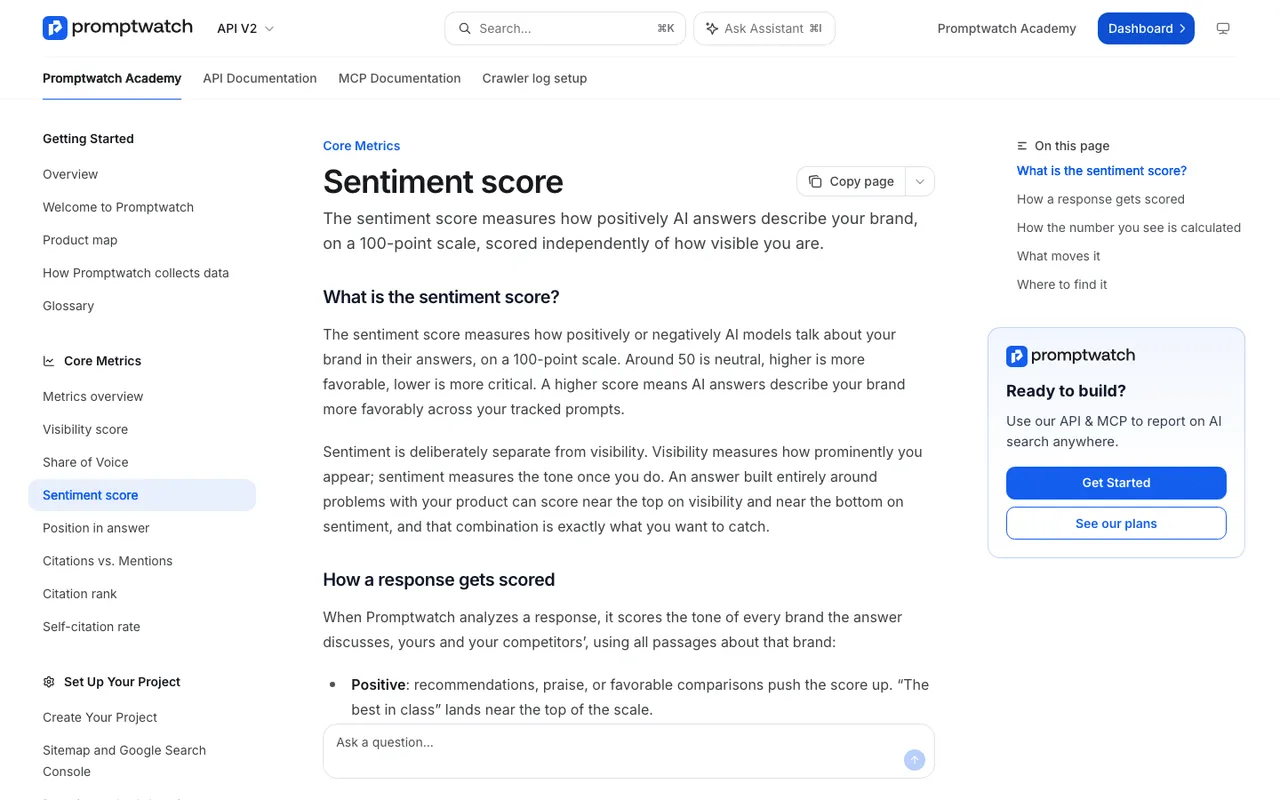
Promptwatch Academy, "Sentiment score", captured November 14, 2026.
Brand Narrative then goes beneath the score. It pulls out each claim with its quote, groups repeats, and files claims under nine themes: Pricing, Features, Quality, Usability, Range, Support, Reputation, Audience and Company. Your brand and your tracked competitors are scored per theme, and a Benchmark view ranks you against them theme by theme.
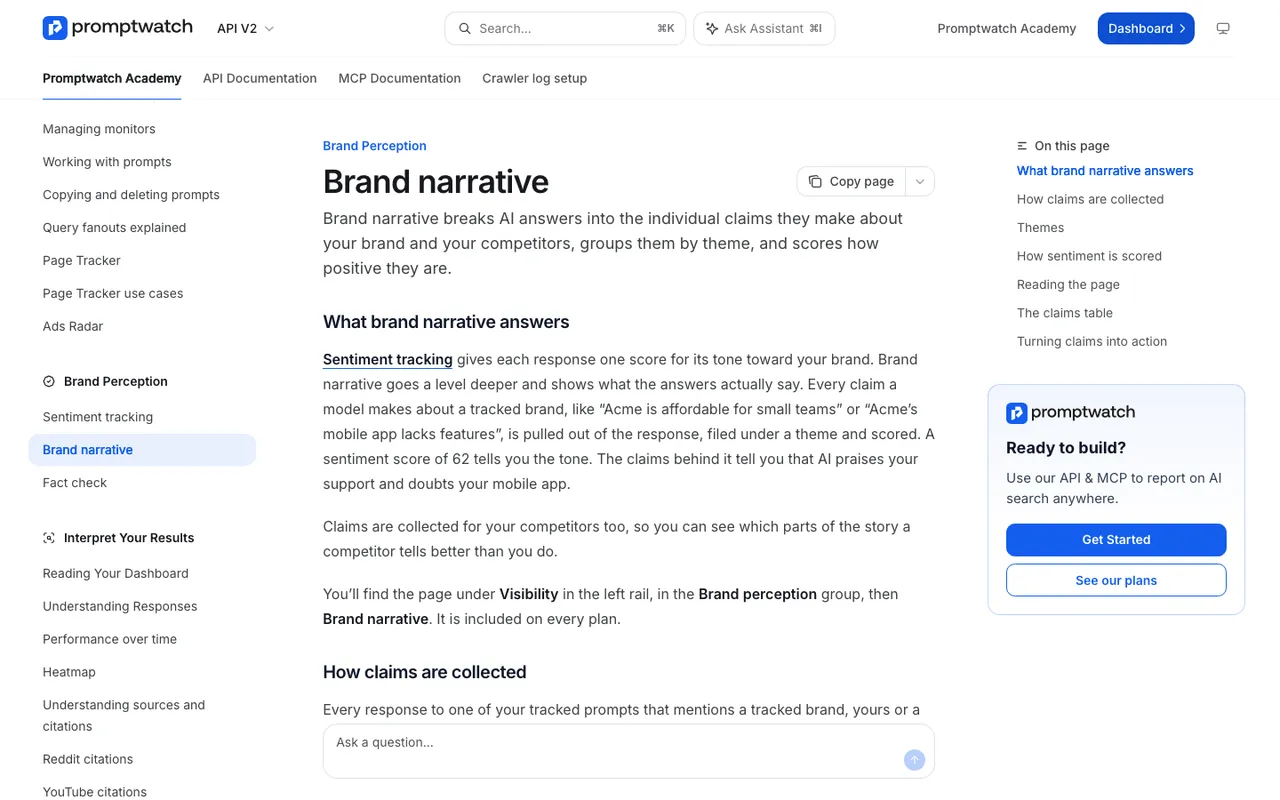
Promptwatch Academy, "Brand narrative", captured November 14, 2026.
One detail to know before you buy: claims that state a price are dropped from Brand Narrative because prices change too often to form a stable narrative. The Pricing theme still collects value-for-money and free-tier statements.
How to choose
- You want to see and act on the actual claims, with competitors on the same themes: Promptwatch. Essential covers Brand Narrative; move to Business if you need Fact Check.
- Your PR team owns perception and works through journalists: Muck Rack Generative Pulse or Onclusive, and ask each to show you individual claims in the demo.
- Enterprise brand-safety program with budget for a sales-led tool: Bluefish AI is worth a call for its outdated-claim flagging.
- You mainly want a tone score inside a broader GEO tool: AthenaHQ or Scrunch AI.
For most marketing teams the first option is the practical one. Start Promptwatch's 7-day trial, add two or three competitors as tracked brands, and check whether the Benchmark view shows you a theme you did not know you were losing.